


Updated 5 months ago
How to choose the right Blood Collection Needle size and gauge?

Admin
How to choose the right Blood Collection Needle size and gauge?
The choice of blood collection needle size and gauge is an important issue in the field of phlebotomy and clinical practice. The correct decision does not only guarantee patient comfort, but also good sample quality, lessening complications, and workflow efficiency. As a healthcare professional, lab technician or medical buyer, it is vital to know the sizes and gauges of needles to collect blood in the best way possible.
This guide will demystify all the information you should know about selecting the correct blood collection needle, such as the gauge size, patient considerations, and tips that can be used to achieve better results.
Knowledge of Needle Gauge and Size.
Before selecting a needle, it’s important to understand what “gauge” means.
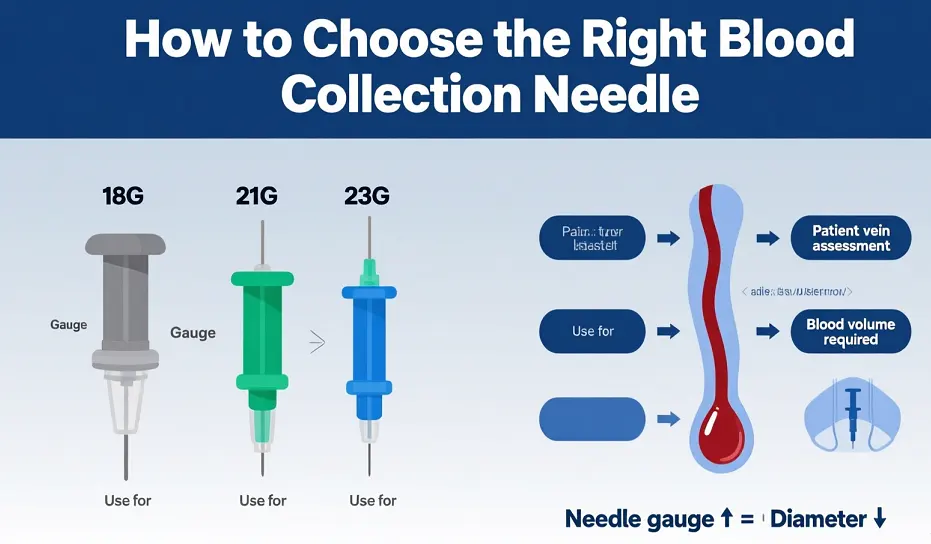
· The thickness of the needle is called Gauge (G).
· The more the gauge number, the finer the needle.
· The higher the gauge number, the finer the needle.
Frequently used Blood Collection Needle Gauges.
· 21G -Normal size of routine venipuncture.
· 22G – A little smaller, applied to smaller veins.
· 23G (Butterfly needle) – Best to use in delicate or hard-to-find veins.
The needle length is also an important consideration, but generally, it is standardized to blood collection processes. Majority of needles used in venipuncture measure between 1-1.5 inches.
The Importance of Selecting the Right Needle.
The choice of the appropriate needle size and gauge directly influences:
1. Patient Comfort
The needle that was used should be big enough to prevent needless pain, but not too small as it might increase the time of the procedure.
2. Sample Quality
The improper choice of gauge may result in:
· Hemolysis (destruction of red blood cells)
· Slow blood flow
· Clotting issues
3. Procedure Efficiency
The right needle assures easy flow of blood and saves the chances of trying several times.
4. Safety
The correct choice of needles reduces the damage to the veins, bruising, and complications.
Considerations to make when selecting the size of the needles.
1. Patient Age
Various age categories can be approached in different ways:
· Adults: Generally well tolerate 21G needles.
· Children: Smaller veins may need 22G or 23G.
· Older: Soft veins can require 22G or butterfly needles.
2. Vein Condition
Evaluate the vein prior to the choice of a needle:
· Big, strong veins: 21G is best.
· Small or weak veins: 22G or 23G.
· Rolling veins: Butterfly needles are more controlable.
3. Type of Test
Some tests have flow rate requirements:
· Regular blood tests: 21G or 22G.
· Blood cultures: Prefer larger gauge (20G21G)
· Coagulation tests: Small gauges should be avoided to avoid hemolysis.
4. Patient Condition
Consider medical conditions such as:
· Dehydration (veins can be more difficult to reach)
· Chronic illness
· Chemotherapy patients (veins are sensitive)
5. Collection Method
The procedure also influences the selection of the needles:
· Vacutainer system: Usually 21G or 22G
· Syringe draw: Can revise with smaller gauge.
· Butterfly system: Perfect in challenging cases.
Straight vs Butterfly Needles.
Straight Needles
Best for:
· Routine blood draws
· Patients that have visible, stable veins.
Advantages:
· Faster blood flow
· Reduced chance of hemolysis.
· Cost-effective
Butterfly Needles (Winged Infusion Sets)
Best for:
· Pediatric patients
· Elderly patients
· Difficult or shallow veins.
Advantages:
· Greater control and precision
· Less risk of vein collapse.
· More convenient with hand veins.
Common sizes: 21G–23G
Practical Advice on the choice of needles.
The following are some broad suggestions:
Type of patient Suggested Gauge.
· Healthy adults 21G
· Small veins 22G
· Pediatric patients 23G
· Elderly patients 22G–23G
· Blood donation 16G–18G
Frequent Fallacies.
1. With Too Small A Needle.
Though smaller needles are less painful, they may:
· Slow blood flow
· Increase hemolysis risk
· Complicate sample collection
2. Too Large a Needle.
Large needles may:
· Cause discomfort
· Damage veins
· Lead to bruising
3. Ignoring Patient Differences
Never make generalizations about patients, but treat them on an individual basis.
4. Poor Technique
The right needle will not do good when:
· The angle is incorrect
· Vein is not stabilized.
· The insertion is either too deep or shallow.
Suggestions on How to make Blood Collection a Success.
· Always examine and feel the vein and then select a needle.
· Stabilize the vein so that it does not roll.
· Take the minimal effective gauge to sufficient blood flow.
· Have correct insertion angle (1530 degrees)
· Do not probe too far in case the vein is missed.
Safety and Compliance.
Contemporary blood collection focuses on safety:
· Single-use, sterile needles should be used.
· Adhere to infection control measures.
· Use sharps containers to dispose needles.
· Discuss safety-engineered needles to avoid needlestick injuries.
Healthcare standards guarantee patient and practitioner safety.
Selection of the appropriate Supplier.
When buying blood collection needles, take into account:
· Quality certifications (ISO, CE, FDA)
· Sterility and packaging
· Sharpness and coating of needle.
· Conformance with collection systems
· Dependability and consistency of suppliers.
Good-quality needles minimize complications and enhance efficiency.
Conclusion
Selecting the appropriate blood collection needle size, gauge, is not just a technicality, but a crucial element of patient care and diagnosis. Knowledge about the size of gauges, assessment of patient requirements, and best practice techniques can help healthcare practitioners to achieve safe, efficient, and comfortable blood collection.
In summary:
· Routine adult draws should be done using 21G.
· Opt for 22G–23G for smaller or fragile veins
· Always put into consideration patient-specific factors.
· Comfort, flow rate, and sample integrity.
Informed choices on needle selection will eventually yield positive results to patients and healthcare providers.