



automated liquid handling systems
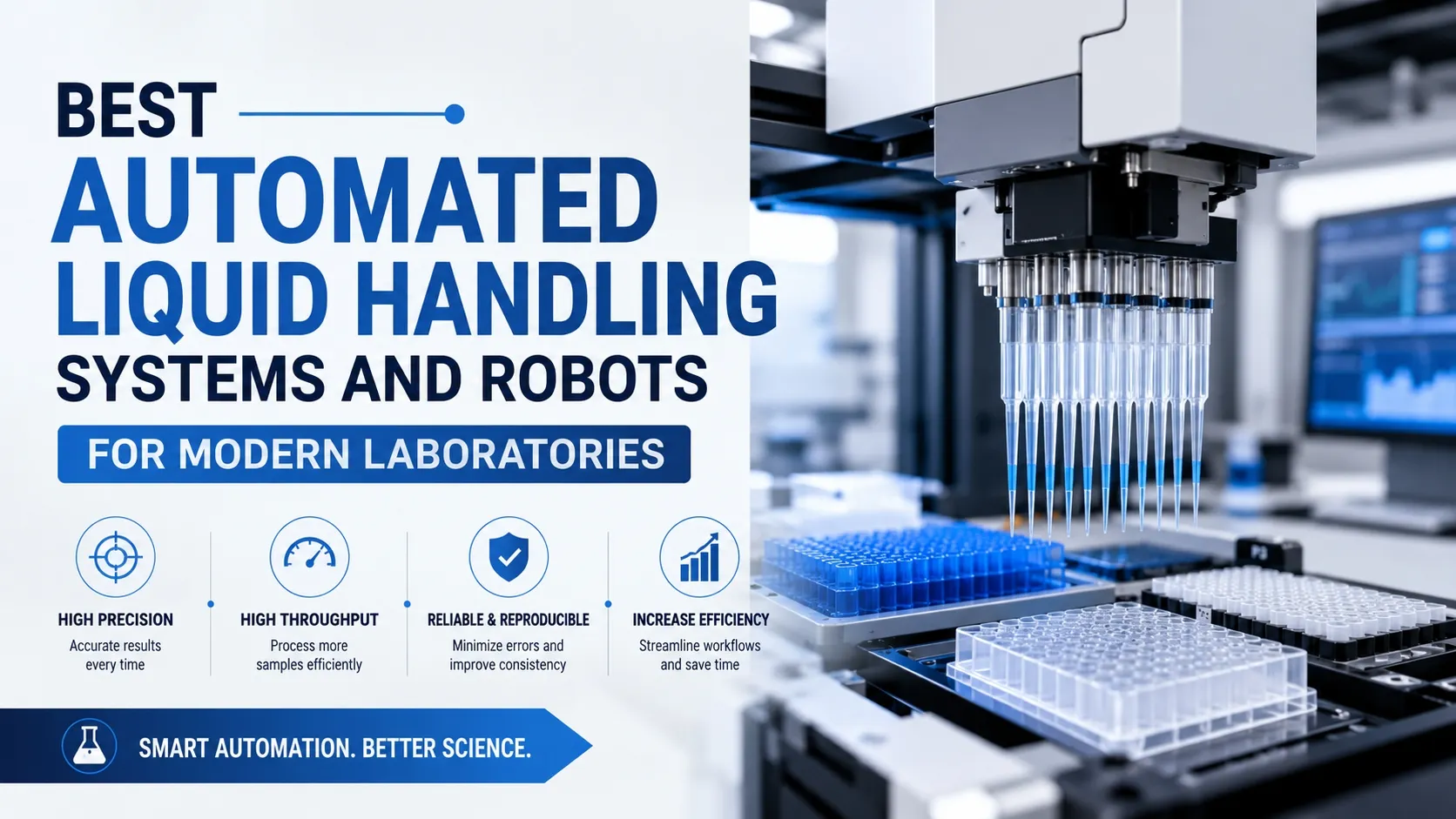
Automated liquid handling systems are increasingly being implemented in laboratories throughout the pharmaceutical, biotechnology, clinical diagnostics, and academic research industries for enhanced precision, reproducibility, and throughput. Manual pipetting is not efficient enough for many experiments and workflows, especially as they become more complex and larger in size. Automated liquid handling robots can minimize human error, simplify repetitive tasks and boost productivity in the lab.
Modern liquid handling technologies are revolutionizing laboratory operations from pipetting robots to complete robotic workstations. There are a number of factors that you need to consider when selecting the appropriate automated system, such as throughput, complexity of the assays, cost, and level of automation that you want.
It covers the various types of automated liquid handling systems and robots, their use, benefits, and selection of the most appropriate system or robot for your lab.
What Is an Automated Liquid Handling System?
Automated liquid handling system is a robot that can precisely aspirate, dispense, mix, transfer or distribute liquids. These systems can be used to replace or aid manual pipetting and are commonly applied in:
- Genomics and proteomics
- Drug discovery
- PCR setup
- ELISA assays
- Cell culture
- Clinical diagnostics
- High-throughput screening
- Sample preparation workflows
Today, robotic arms are frequently used in conjunction with electronic pipettes, computer-controlled controls, microplate handlers and integrated accessories to automate entire laboratory workflows in modern systems.
Why Laboratories Are Moving Toward Automation
Manual liquid handling introduces factors of inconsistencies that may arise from fatigue, repetitive motion or pipetting errors. Automated systems have the distinct advantage of increasing the degree of reproducibility and decreasing contamination and technician workload.
Key benefits include:
- Improved accuracy and precision
- Reduced sample handling errors
- Increased throughput
- Better reproducibility
- Enhanced laboratory safety
- Reduced reagent waste
- Improved workflow standardization
- Digital documentation and traceability
In any laboratory that performs hundreds or thousands of tests per day, automated systems are particularly useful.
1. Automated Pipetting Robots
One of the most frequently encountered types of liquid handling systems in the modern laboratory is automated pipetting robots. These robots perform aspirating and dispensing functions over tubes, plates and reservoirs.
They are available in:
- Single-channel systems
- Multi-channel systems
- 8-channel and 12-channel configurations
- 96-head pipetting platforms
Automated pipetting robots are ideal for repetitive tasks such as:
- PCR preparation
- Serial dilutions
- Plate replication
- Assay setup
- Sample normalization
Robotic pipetting offers greater consistency and decreases operator fatigue, when compared to manual pipetting. Several systems are also available for ultra-low volume dispensing in genomics and molecular biology.
2. Microplate Washers and Dispensers
Laboratories that conduct ELISA, Immunoassays and Cell-based assays require microplate washers and dispensers.
These systems automate:
- Plate washing
- Reagent dispensing
- Buffer addition
- Aspiration steps
Multi-mode washer dispensers provide the washing and dispensing features in one unit, simplifying the workflow and increasing efficiency.
Microplate washers are particularly convenient for:
- Bead-based nucleic acid purification
- Cell washing procedures
- ELISA assays
- High-throughput screening
Laboratories can achieve greater assay reproducibility and less assay variability by automating repetitive wash cycles.
3. Robotic Plate Handlers
Robotic plate handlers are used in automated workflows for the transport of microplates between instruments.
These systems support laboratories to:
- Reduce hands-on intervention
- Improve throughput
- Coordinate multi-step workflows
- Support continuous operation
Plate handlers can transfer plates between:
- Liquid handlers
- Plate readers
- Incubators
- Washers
- PCR instruments
For high throughput applications, robotic plate handling can greatly boost productivity by enabling instruments to run without manual loading.
4. Automated Workstations
Automated liquid handling workstations combine several technologies into one. These systems typically include:
- Pipetting modules
- Robotic arms
- Heating and cooling units
- Shakers
- Magnetic bead stations
- Plate stackers
- Software automation
Workstations are highly customizable and designed for complex laboratory workflows.
Common applications include:
- NGS library preparation
- DNA and RNA extraction
- Protein purification
- Drug screening
- Clinical sample processing
Advanced workstations can automate entire experimental protocols with minimal human intervention.
5. Microplate Stackers
Microplate stackers offer automatic feeding and storing of plates on liquid-handling systems.
These devices improve:
- Walk-away time
- Continuous processing
- Workflow scalability
- Sample throughput
Stackers are particularly useful in laboratories where many plates are being stacked in a batch or overnight workflows are being performed.
Labs can enable near-continuous lab automation by combining stackers with robotic and liquid handlers.
6. Nano Dispensers and Acoustic Liquid Handlers
Nano dispensers and acoustic liquid handlers are excellent options for applications that demand very small volumes of liquids.
They are common in:
- Drug discovery
- High-density screening
- Genomics
- Synthetic biology
Nano dispensers use a small amount of reagent and reduce assay costs, and retain high accuracy.
There has been increasing interest in ultra-low volume systems that can reliably dispense volumes less than 1 µL, especially for 384-well plate workflows, in recent days in the lab.
Key Features to Consider When Choosing a Liquid Handling Robot
The choice of the optimal automated liquid handling system will depend on your laboratory's needs.
Throughput Requirements
Compact benchtop systems may be sufficient for low throughput labs, whereas fully integrated robotic workstations may be desired for high throughput labs.
Volume Range
Think about the smallest and largest volumes you will need for your applications.
Precision and Accuracy
For highly sensitive workflows like genomics and PCR, it is crucial to have the highest pipetting accuracy.
Software Usability
It's essential to have software that is easy to use to reduce training time and increase flexibility in workflow.
For laboratory professionals, software usability and integration problems are often top considerations when making a software purchase decision.
Scalability
Select systems with the flexibility to grow and expand laboratory workflow.
Integration Capabilities
Modern laboratories often benefit from systems that integrate with:
- Plate readers
- Incubators
- LIMS software
- Automated storage systems
Footprint and Laboratory Space
Compact benchtop systems are ideal for smaller laboratories with limited space.
Manual vs Semi-Automated vs Fully Automated Systems
Liquid handling solutions generally fall into three categories:
| System Type | Best For | Advantages |
|---|---|---|
| Manual Pipetting | Small sample volumes | Low cost, flexibility |
| Semi-Automated Systems | Medium throughput | Improved consistency |
| Fully Automated Systems | High-throughput workflows | Maximum efficiency and reproducibility |
For laboratories processing hundreds or thousands of samples, full automation often delivers the greatest return on investment.
Challenges of Laboratory Automation
While automation offers major benefits, laboratories may encounter several challenges:
- High initial investment
- Workflow customization complexity
- Software integration issues
- Maintenance requirements
- Training demands
Others point out that the more a workflow is repetitive and standardized, and the more often it is repeated, the more likely it is to benefit from automation. Efficiency gains might not be as high in smaller laboratories with irregular (and oft-changing) protocols.
Recent developments in robotics software design, modular automation and miniaturisation of systems are helping to make robotic liquid handling more accessible to labs of all sizes.
Future Trends in Automated Liquid Handling
The future of liquid handling automation is moving toward:
- AI-assisted workflow optimization
- Cloud-connected laboratory systems
- Compact modular robotics
- Improved ultra-low volume dispensing
- Increased integration with laboratory information systems
- Greater accessibility for smaller laboratories
Laboratories will increasingly come to rely on automated liquid handling technologies for scientific innovation, as they increasingly adopt high throughput research and precision medicine.
Final Thoughts
In today's fast-paced, accuracy-focused, and human error-averse laboratory environments, automated liquid handling systems have become indispensable. Regardless of manual or automated pipetting robots, automation can significantly enhance lab productivity and reproducibility.
The ideal liquid handling system will be based on the complexity of your workflow, throughput requirements, space considerations, and budget. Laboratories can make informed choices that will drive long-term efficiency and research success by understanding the various options for automated liquid handling robots available.