Lab spaces are intended for innovation, discovery and advancement of science. They also carry chemical, biological, electrical and physical risks, however, which can be hazardous without taking certain precautions. Lab safety rules are important to follow and understand for protecting people and experiments, whether you are in a research institute, medical laboratory, pharmaceutical company or an educational facility.
To prevent injuries, damage to equipment, contamination, loss of money and legal liability, modern laboratories are working under more stringent safety regulations. Research and industry reports persist that many laboratory accidents are caused by preventable errors like misuse of chemicals, lack of personal protective equipment (PPE), inadequate housekeeping and failure to adhere to laboratory protocols.
This guide outlines the top laboratory safety rules that every student, technician and researcher should be familiar with to make their working environment safer and more productive.
Why Lab Safety Matters
Lab safety is more than just compliance with regulations. It prevents researchers from coming in contact with dangerous chemicals, limits contamination, and guarantees accurate results when conducting experiments. Another benefit of a solid laboratory safety culture is operational efficiency and minimising downtime due to accidents.
Lab safety is stressed by research organizations and universities around the world, as a small accident can rapidly become a big problem. Safety experts say that many lab accidents are caused by the workers losing track of time or getting complacent with their usual work.
A safe lab is a key factor in helping:
- Prevent injuries and illnesses
- Protect sensitive equipment
- Ensure compliance with regulations
- Preserve research integrity
- Reduce operational disruptions
- Improve team accountability
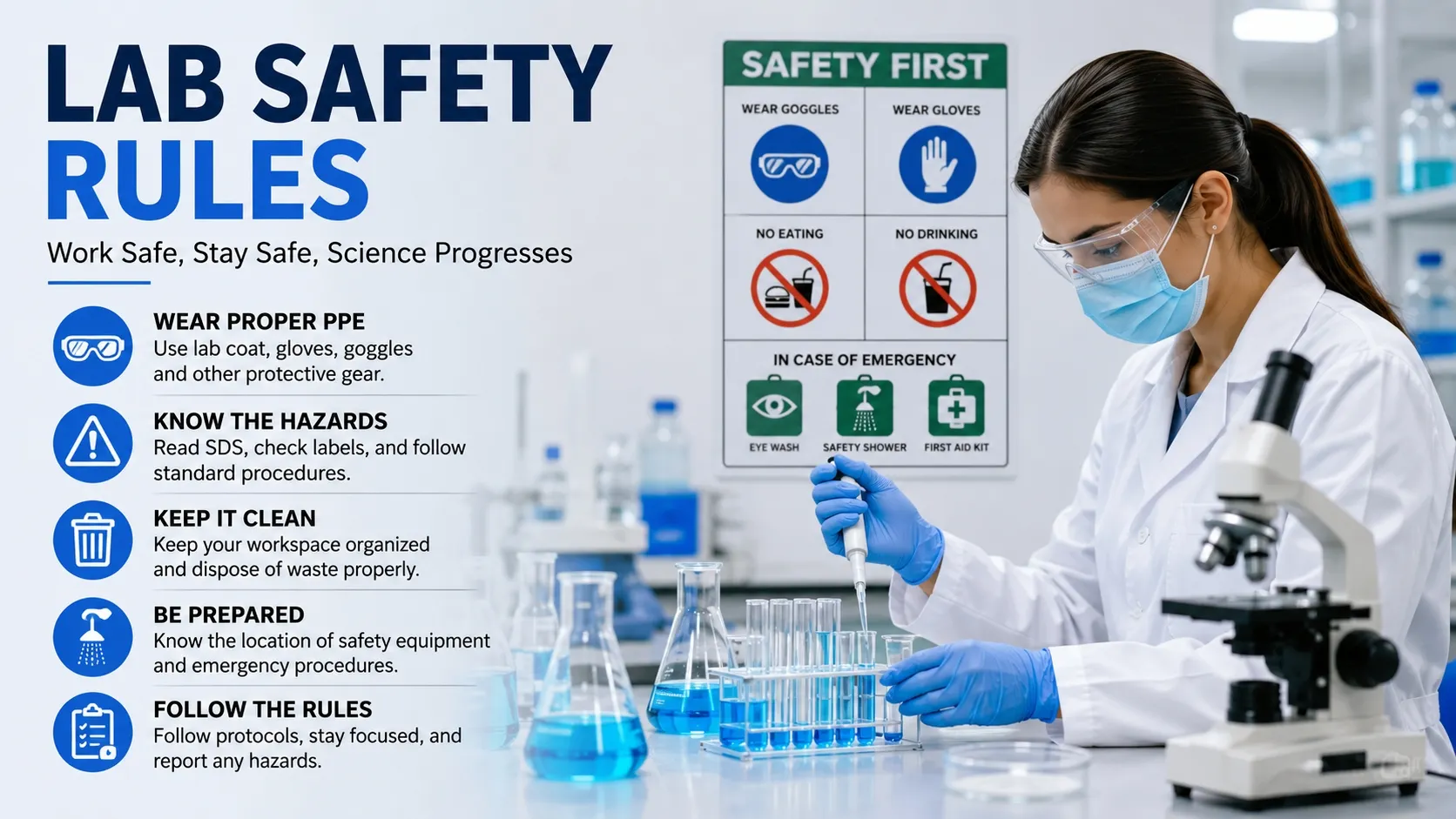
1. Always Wear Proper Personal Protective Equipment (PPE)
Wearing the proper safety equipment is one of the most crucial rules of lab safety. The researchers' first line of defense against dangerous materials is protective equipment.
Depending on the laboratory environment, PPE may include:
- Lab coats
- Safety goggles
- Face shields
- Gloves
- Respirators or masks
- Closed-toe shoes
- Hearing protection
There are various types of PPE for various tasks. Special protective clothing and masks may be needed for chemical laboratories and biological laboratories.
Loose clothing, sandals, jewelry and long hair that is not tied back should be avoided as it may contribute to accidents that could be serious near flames, machinery or chemicals. A frequent cause of injuries in laboratories is the lack of proper use of PPE.
2. Understand Laboratory Hazards Before Starting Work
Each laboratory has its own specific hazards. Researchers must become thoroughly familiar with the safety hazards of any chemicals, biological agents, radioactive materials, or equipment that will be used before conducting any experiments.
Preparation is very important, and the following steps are to be taken:
- Reading Safety Data Sheets (SDS)
- Reviewing standard operating procedures (SOPs)
- Understanding hazard symbols
- Learning emergency response procedures
- Identifying exposure risks
Do not presume that a material is safe because it is used frequently. Most laboratory chemicals can burn, cause respiratory problems, lead to poisoning, or lead to chronic health problems if mishandled.
3. Keep the Laboratory Clean and Organized
An orderly work area decreases risk of accidents. Overcrowded benches, walkways blocked from access and chemicals stored incorrectly create unnecessary hazards.
The good housekeeping practices are:
- Cleaning spills immediately
- Labeling all containers clearly
- Storing chemicals correctly
- Keeping emergency exits accessible
- Disposing of waste properly
- Returning tools after use
Foods and beverages should not be brought into laboratory areas since they may be contaminated. Well-organized equipment also helps to enhance workflow efficiency and enable researchers to find emergency equipment readily in case of emergency.
4. Know Emergency Procedures and Equipment Locations
All laboratory personnel should have an emergency plan. Rapid responses can help to avoid injuries and reduce damages.
The researcher needs to know the location and how to operate:
- Fire extinguishers
- Emergency showers
- Eyewash stations
- Spill kits
- First aid kits
- Emergency exits
- Alarm systems
It is important that there are regular safety drills and emergency response training sessions that should be held in the laboratory so that staff are aware of what to do in the event of an emergency. The experts suggest the review of the evacuation plans regularly and reporting any failure in safety equipment promptly.
5. Handle Chemicals and Hazardous Materials Correctly
The handling of chemicals is one of the main sources of accidents in the laboratory. Transportation, mixing, storage and disposal of hazardous materials should always be done according to established procedures.
Some important chemical safety precautions are:
- Never mixing unknown substances
- Using fume hoods when required
- Labeling chemicals clearly
- Storing incompatible chemicals separately
- Using proper waste containers
- Avoiding direct skin contact
Compressed gas cylinders should always be secured properly to prevent tipping. It is also important that researchers, who are handling volatile or toxic substances, do not work alone as much as possible.
6. Avoid Distractions While Working
It is imperative that one is totally immersed in a laboratory setting. Any distraction, no matter how small, can cause a spill, contamination, fire or exposure incident.
Researchers should avoid:
- Using mobile phones unnecessarily
- Eating or drinking in the lab
- Running or horseplay
- Rushing experiments
- Skipping safety procedures
Attentiveness and accountability are frequently discussed as key aspects of safety culture in online discussions between scientists and laboratory workers. Well experienced researchers have stated that accidents are often a result of complacency or ignoring of routine precautions.
7. Follow Standard Operating Procedures Carefully
All laboratories should have detailed SOPs for operation of equipment, handling of hazardous materials, waste disposal and emergency response.
Researchers should never:
- Modify equipment without authorization
- Use unfamiliar instruments without training
- Perform unauthorized experiments
- Ignore warning labels
- Bypass safety systems
When in doubt about a procedure, it should be taken up to the supervisor or safety officer and discussed before proceeding. Correct training continues to be one of the most powerful means of minimizing laboratory incidents.
8. Report Accidents and Near Misses Immediately
Often, accidents in the lab are not reported, particularly if there is no immediate harm, such as a near miss. But these scenarios are reportable to assist an organisation in realising what safety shortcomings they have before it becomes a serious accident.
Incident reporting improves:
- Risk assessment procedures
- Safety training programs
- Equipment maintenance
- Hazard awareness
- Workplace accountability
Good safety cultures foster the ability to communicate openly, without faultfinding. The use of near miss reporting systems in modern laboratories is becoming more commonplace in order to continuously enhance workplace safety standards.
Building a Strong Laboratory Safety Culture
Lab safety is best achieved when it becomes a culture and not a checklist. Schools with high safety cultures usually offer:
- Continuous safety training
- Routine inspections
- Clear communication channels
- Updated safety documentation
- Leadership accountability
- Employee involvement
The importance of teamwork and shared responsibility in ensuring safe laboratories is highlighted in every research community. The more experienced scientists will also provide mentoring for the newer scientists to ensure safe practices and proper laboratory procedures are maintained.
Final Thoughts
Safety is always a top priority for researchers, students and laboratory managers in the laboratory. Appropriate safety practices protect people from injury, and maintain research quality and efficiency.
Whether it's the right types of PPE or knowing the right procedures to take in the event of an emergency, every measure helps to create a safer scientific setting. Preventing accidents is usually about little things you do each day.
Laboratory technologies are constantly changing; so are the need for safety training and awareness. These organizations are also enhancing the safety of their lab environments, and consequently, the safety of their entire research activities, which increases productivity, reliability, and professionalism for all.