



lab equipment glassware
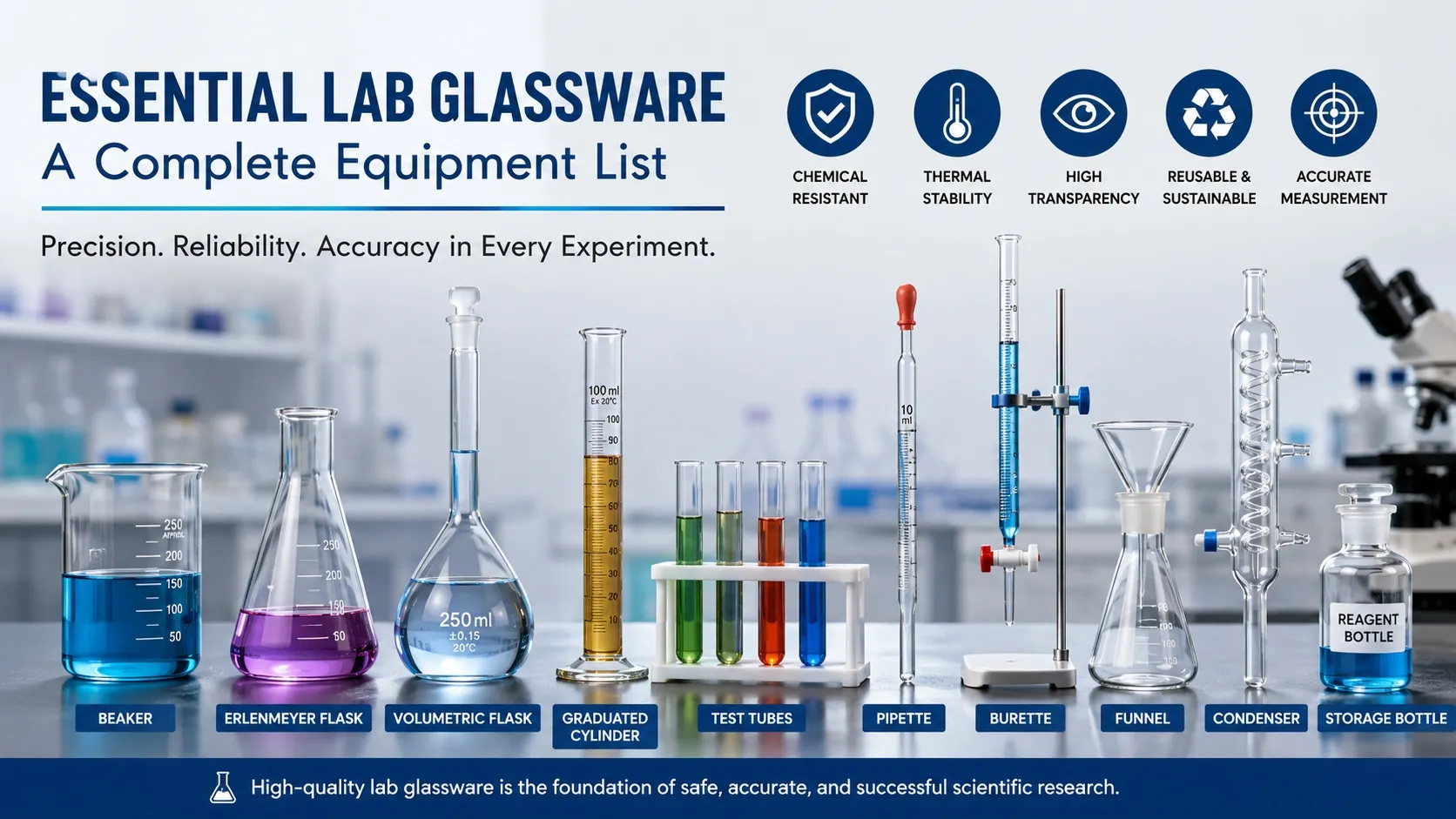
Laboratory Glassware is an integral part of the scientific research, educational and industrial testing processes. Whether it's in a chemistry lab, a biology lab, a pharmaceutical or environmental analysis lab, precision glass equipment guarantees the accuracy, safety and repeatability of experiments. The most sophisticated lab setup can be a failure without the proper glassware.
This guide explains in detail each of the most common items of lab glassware, their uses and why they are a must have in a working laboratory.
Why Lab Glassware Is Essential in Scientific Work
Lab glassware is used in labs because of its chemical resistance, thermal stability, transparency and durability. The borosilicate glass is widely used to manufacture most laboratory glassware, which accounts for its high-temperature resistance and chemical inertness.
Key advantages include:
- High resistance to heat and sudden temperature changes
- Non-reactive surface suitable for most chemicals
- Transparent structure for easy observation of reactions
- Reusable and easy to sterilize
- Suitable for precise scientific measurements (depending on type)
Such properties make lab glassware a basic instrument in scientific research all over the world.
1. Beakers: The Most Versatile Lab Container
One of the most familiar pieces of laboratory glassware is a beaker. They are cylindrical, have a flat bottom and a small spout for easy pouring.
Common Uses:
- Mixing chemical solutions
- Heating liquids
- Holding and transporting substances
- Performing rough volume estimations
Beakers frequently have measurement markings but cannot be used to measure volume accurately. Rather, these are used for general laboratory handling and mixing operations.
They vary in size from small, 50 mL, to large multi-liter beakers and are flexible enough to be used in a variety of experiments.
2. Erlenmeyer Flasks: Ideal for Mixing and Titration
In a conical flask there is a wide base and a narrow neck, it is also called an Erlenmeyer flask. This is an easy shape to swirl without spilling which is best for reactions that need to be mixed.
Common Uses:
- Titration experiments
- Chemical reactions involving mixing
- Heating solutions
- Preventing evaporation during reactions
It is designed to reduce splashing and is one of the most popular flasks in use in chemistry labs.
3. Volumetric Flasks: Precision in Solution Preparation
Volumetric flasks are highly accurate glassware. They have a bulbous base and a long narrow neck with only one calibration line.
Common Uses:
- Preparing standard solutions
- Analytical chemistry applications
- Dilution of liquids to precise volumes
Volumetric flasks are used in cases where accuracy is of the utmost importance and are typically employed in quantitative chemical analysis.
4. Graduated Cylinders: Accurate Liquid Measurement Tools
Graduated cylinders are tall, narrow vessels that have measurement scales on them. These are intended to measure volume of fluid more accurately than beakers.
Common Uses:
- Measuring liquid volume
- Preparing chemical solutions
- Transferring liquids with precision
They are thin and so give a more precise indication of the liquid level, which is important for regular laboratory work.
5. Test Tubes: Small-Scale Experimentation
Test tubes are cylindrical glass tubes with a rounded bottom. They are employed for transporting low quantities of materials.
Common Uses:
- Conducting small chemical reactions
- Heating or mixing small samples
- Observing reactions
- Storing liquid samples temporarily
Test tubes are essential in educational and research laboratories where experiments are to be conducted on a small scale.
6. Pipettes: Precision Liquid Transfer Instruments
A pipette is an indispensable device that can be used to move a very small and accurate amount of liquid. They are available in various types such as volumetric and micropipettes.
Common Uses:
- Transferring exact liquid volumes
- Biological and medical experiments
- Chemical analysis requiring precision
Pipettes are particularly vital in molecular biology, biochemistry and pharmaceutical research where even microliter-level accuracy is critical.
7. Burettes: Essential for Titration Experiments
Burettes are long, graduated glass tubes with a stopcock at the bottom. They can be used for dispensing liquids one drop at a time.
Common Uses:
- Acid-base titrations
- Precise liquid dispensing
- Quantitative chemical analysis
Their accuracy makes them essential for experiments where exact volume control is necessary.
8. Funnels: Safe Transfer of Liquids and Powders
Funnels are basic and vital glassware apparatus that is used for transferring substances from one container to another that has a small opening.
Common Uses:
- Pouring liquids without spillage
- Filtering solutions (with filter paper)
- Transferring powders safely
Funnels help maintain cleanliness and reduce waste in laboratory procedures.
9. Condensers: Key Components in Distillation
Condensers are specialized glass apparatus used to cool vapor back into liquid form during distillation processes.
Common Types:
- Liebig condenser
- Graham condenser
Common Uses:
- Distillation
- Reflux reactions
- Separation of liquid mixtures
Condensers are vital in organic chemistry and chemical engineering processes.
10. Storage Bottles and Reagent Jars
Laboratories require safe storage solutions for chemicals and reagents. Glass bottles and jars are commonly used for this purpose.
Common Uses:
- Storing chemical reagents
- Preserving biological samples
- Holding prepared solutions
These containers are often designed with airtight seals to prevent contamination and evaporation.
How to Choose the Right Lab Glassware
Selecting the appropriate glassware depends on your laboratory requirements. Key factors include:
- Required accuracy level (precision vs. general use)
- Type of chemical reactions
- Temperature resistance needs
- Chemical compatibility
- Volume capacity
- Durability and safety standards
Understanding these factors ensures better experimental outcomes and improves laboratory efficiency.
Final Thoughts
The heart of any scientific laboratory is essential lab glassware. From simple beakers to highly precise volumetric flasks, each tool plays a specific role in ensuring accuracy, safety, and efficiency in scientific work.
From starting a school chemistry lab to building a research lab or an industrial testing station, it is necessary to rely on high-quality lab glassware for accurate results and to ensure the integrity of the experiment.