



Updated 2 days ago
SST Blood Collection Tube Supplier for Serum Separation
trustlabofficial
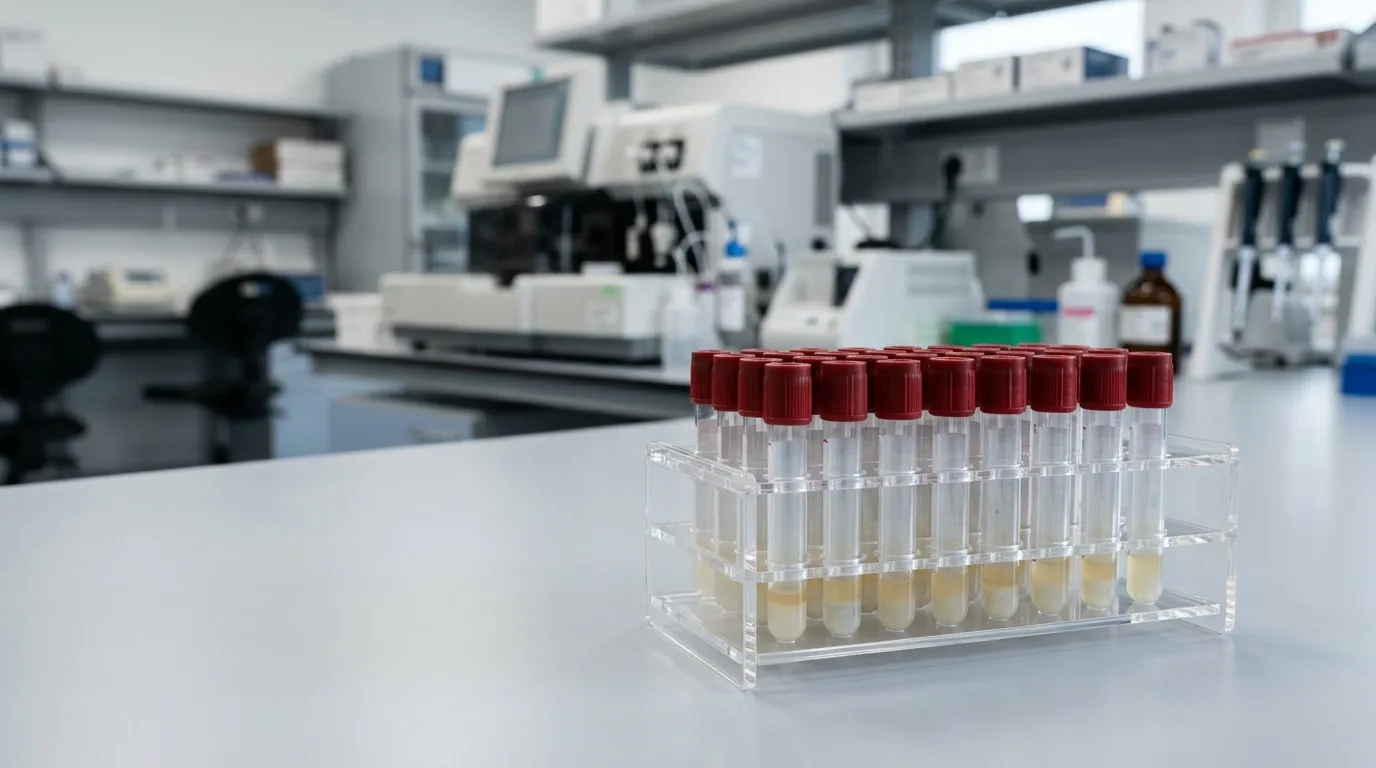
SST blood collection tubes in a rack on a laboratory benchtop
When you are sourcing serum separator tubes (SSTs) for a hospital laboratory, reference lab, or distribution network, the supplier you choose affects sample quality, workflow reliability, and regulatory peace of mind. An SST blood collection tube combines a silica clot activator with a polymer separator gel: after clotting and centrifugation, the gel forms a stable barrier between the serum and the cellular clot. This page explains what to check before you buy, how to compare SST blood collection tube suppliers, and how to begin a specification review with Trustlab, a B2B supplier of blood collection systems and laboratory products.
If you need a refresher on how vacuum tube collection works, start with Trustlab's guide to vacuum blood collection tubes. For a broader view of SSTs versus other tube types, see the overview of different types of vacuum blood collection tubes.
What Is an SST Blood Collection Tube?

An SST, or serum separator tube, is an evacuated blood collection tube designed to produce clean serum for clinical chemistry, serology, and immunoassay testing. The tube contains two functional elements:
- A silica clot activator, usually coated on the inner wall, that accelerates the natural clotting process.
- A polymer gel that sits below the clot activator and moves during centrifugation to form a physical barrier between serum and blood cells.
During collection, blood enters the tube and mixes with the clot activator. The tube is then left to clot, typically for about 30 minutes at room temperature, followed by centrifugation. The gel migrates upward during spinning and locks into place between the serum and the clot, allowing the serum to be poured off or analyzed directly without re-centrifugation or transfer to another tube.
Manufacturer descriptions of SST-type tubes, such as BD Vacutainer SST tubes listed by Fisher Scientific, consistently describe the same principle: a polymer gel and silica clot activator that support serum separation for laboratory testing. Tube color coding varies by manufacturer and market, but SSTs are often identified by a gold or red/grey closure.
Why Serum Separation Quality Matters in Laboratory Testing
The preanalytical phase is one of the most common sources of laboratory error. When serum is not separated cleanly or quickly enough, cells continue to metabolize, and analytes such as glucose, potassium, and lactate dehydrogenase can change before testing. Incomplete separation, hemolysis, or fibrin strands can lead to rejected samples, repeated draws, and delayed results.
A well-designed SST reduces these risks by:
- Standardizing the clotting and separation process.
- Preventing contact between serum and cells after centrifugation.
- Reducing the need to manually transfer serum, which lowers the risk of mix-ups.
Studies of gel-based serum separator tubes have found measurable improvements in sample quality. Work by Li and colleagues, published in the Journal of Clinical Laboratory Analysis, reported that SST-type tubes improved serum separation compared with plain tubes and reduced problems such as incomplete separation and hemolysis in special chemistry testing.
For a procurement manager, this matters because tube quality is not just a product specification — it is a laboratory quality variable. The supplier's ability to provide consistent tubes, with documented specifications and reliable production controls, directly affects your lab's day-to-day operations.
How to Evaluate an SST Blood Collection Tube Supplier
No matter how competitive the price, an SST supplier should be evaluated against quality, documentation, and commercial criteria. The following framework is designed to help you compare suppliers systematically.
1. Published product specifications
A credible supplier should provide clear specifications for each tube type: nominal draw volume, tube dimensions, additive type and concentration, gel separator description, tube material, closure type, sterility status, packaging configuration, and shelf life. If the supplier cannot produce these in a datasheet or IFU, that is a red flag.
2. Quality management system certification
Look for recognized quality management system certification, such as ISO 9001 or ISO 13485. Understand what these certificates mean: they apply to the company's management system, not automatically to every product. Ask to see the certificate and its scope.
3. Product-level regulatory documentation
Regulatory requirements differ by country and product type. For medical-use blood collection tubes, request product-level documentation such as the Instructions for Use (IFU), CE documentation where applicable, registration certificates for your market, and any relevant test reports. A company QMS certificate is not the same as product-level regulatory conformity.
4. Manufacturing process transparency
Ask about production controls: whether tubes are sterile and by what method, what cleanroom conditions are used, how lot numbers and expiration dates are managed, and what in-process or final quality checks are performed.
5. Sample support and evaluation
A serious SST supplier should be willing to provide samples for evaluation under your own conditions. Plan to test clotting time, centrifugation performance, gel barrier stability, and compatibility with your analyzers before committing to a volume order.
6. Commercial flexibility
Depending on your needs, evaluate minimum order quantities (MOQ), OEM or private-label options, custom labeling and packaging, and the supplier's ability to handle international shipping and customs documentation.
7. Documentation and communication reliability
In B2B medical procurement, the supplier's responsiveness matters as much as its catalog. Test whether the supplier answers technical questions clearly and sends the promised documents without repeated follow-up.
For a more detailed method, see Trustlab's own guidance on how to evaluate blood collection system supplier quality.
SST Blood Collection Tube Supplier Checklist

| Evaluation point | Questions to ask | Evidence to request |
|---|---|---|
| Product specifications | What are the nominal draw volume, dimensions, additive, gel type, material, and closure? | Datasheet or specification table for the exact SKU |
| QMS certification | Does the company hold ISO 9001 or ISO 13485? What is the scope? | Certificate copy with scope and issue date |
| Product conformity | Is the tube CE-marked, registered, or otherwise documented for my market? | IFU, declaration of conformity, registration certificate |
| Sterility and packaging | Is the tube sterile? What sterilization method and packaging are used? | Sterility claim in product documentation or test report |
| Sample evaluation | Can samples be provided before bulk ordering? What volume and labeling? | Sample shipment and accompanying product documentation |
| MOQ and custom options | What is the MOQ? Are OEM, private label, or custom packaging available? | Written quotation with commercial terms |
| Logistics and export | Can the supplier handle international shipping and export paperwork? | Export documentation and Incoterms proposal |
What to Look for in SST Tube Product Specifications
When comparing SST tubes from different suppliers, keep the following specification areas separate and verify each one independently.
Nominal draw volume vs. tube capacity Nominal draw volume is the blood volume the tube is designed to collect, not the maximum capacity of the tube. A 4 mL SST is not a 4 mL container; it is a tube that draws approximately 4 mL of blood when filled correctly. Confirm the nominal volume for the assay menu you intend to run.
Additive and gel separator The clot activator type and concentration affect clotting time. The gel separator formulation affects barrier stability and analyte compatibility. Both are product-specific details that must come from the supplier's documentation.
Tube dimensions and material Length and diameter must match your collection workflow, centrifuges, racks, and any automation. Tube material also matters: many modern SSTs use PET (polyethylene terephthalate), which is lighter and less likely to break than glass, but the choice must be validated for your application.
Closure type Safety closures, such as shielded or recessed stopper designs, reduce the risk of blood contact during removal. The closure must also be compatible with your sampling system or analyzer if tubes are opened and closed on automated instruments.
Sterility and expiration For clinical use, blood collection tubes are generally supplied sterile. Sterility status, sterilization method, packaging, and shelf life are separate specifications. "Clean" or "safe" wording is not a substitute for a documented sterility claim.
Centrifugation requirement SST processing requires centrifugation after clotting. Instructions are usually given as RCF (relative centrifugal force, expressed as ×g) and time, e.g., 1300×g for 10–15 minutes. RCF is not the same as RPM. If a supplier provides instructions in RPM only, ask for the rotor radius used to calculate those instructions, because the same RPM on a different rotor will produce a different RCF.
Trustlab: Your SST Blood Collection Tube Supplier
Trustlab — Ningbo Trustlab Instruments Co., Ltd. — is a China-based B2B supplier of medical and laboratory products. The company's website covers blood collection products, rapid tests, general laboratory consumables, life science plastics, glassware, and lab equipment. Within the blood collection product line, Trustlab supplies vacuum blood collection tubes, including SST-type serum separator tubes, as part of a broader range of collection devices.
The Trustlab website lists ISO 9001 and ISO 13485 quality management certificates. These certificates are a useful starting point because they show that the company operates under formal quality management systems. They do not, by themselves, prove that every Trustlab product is CE-marked or approved for sale in a specific country. Always request product-level documentation for the exact tube you plan to purchase.
The website also provides educational resources on vacuum tube technology and tube selection. Reviewing these resources can help you understand the product landscape before you contact the company with specific questions. Because website category pages offer general product information rather than SKU-level technical documents, the correct next step is to request the current specification sheet and IFU for the exact SST tube you need, along with export documentation valid for your market.
Regulatory and Certification Documents to Request
When evaluating Trustlab, or any other SST supplier, ask for the following before you place an order:
- Company QMS certificates — ISO 9001 and ISO 13485 certificates, including their scope.
- Product IFU — the Instructions for Use for the exact tube model, which should state intended use, draw volume, additive, handling, centrifugation, storage, and expiration.
- Regulatory conformity documentation — CE documentation or other market-specific registration, where applicable. Confirm that the documentation covers the product you are importing, not just the company.
- Sterilization and test documentation — where available, documentation of the sterilization method and any performance or biocompatibility testing.
Do not infer product-level approval from a company-level certificate. A supplier that is transparent about the difference is usually a stronger partner.
Sterility, Packaging, and Shelf Life Considerations
Blood collection tubes intended for clinical use are often supplied sterile, with sterilization typically performed by ethylene oxide or another validated method. When reviewing a supplier:
- Confirm whether the tube is labeled sterile.
- Ask which sterilization method is used.
- Check the packaging configuration — for example, tubes per box and boxes per case.
- Verify the stated shelf life from the date of manufacture.
- Confirm recommended storage conditions, including temperature range and protection from light or humidity.
These factors affect inventory rotation, storage planning, and compliance with your lab's quality requirements. They should be confirmed in writing before the first purchase order.
OEM, Private Label, and Custom Specifications
Many B2B buyers source SST tubes for private-label distribution or custom laboratory programs. OEM agreements can include customized tube labeling, packaging design, barcode placement, and documentation sets. Customization may also extend to tube dimensions, closure selection, gel formulation, or additive concentration, though any change to the tube's functional components requires validation by the manufacturer.
If you are evaluating Trustlab for an OEM or private-label project, state this clearly at the first inquiry. Ask whether the specific tube can be supplied with your label, what the MOQ would be for a customized batch, and what documentation would accompany the finished product. A supplier that is experienced with OEM work should respond with concrete specification and qualification steps rather than vague assurances.
How to Request Samples and Get a Quotation from Trustlab
A product inquiry is most useful when it is specific. When you contact Trustlab, include the following information so the sales team can match the correct SST tube to your application:
- Tube type and volume — for example, SST with a nominal draw volume of 3.5 mL, 4 mL, 5 mL, or 8.5 mL.
- Intended application — clinical chemistry, serology, immunoassay, or specific analyzer compatibility.
- Target market and regulatory needs — country of import, and whether you need CE documentation, registration support, or an IFU in a specific language.
- Estimated annual volume — whether you expect a standard catalog order or a customized OEM program.
- Requested documentation — datasheet, IFU, sterilization information, and certificate copies.
Start your inquiry through the Trustlab website. The company's sales and technical team can confirm current specifications, packaging, MOQ, lead time, and shipping terms for the SST tube that fits your application.
Frequently Asked Questions
How long should blood clot in an SST tube?
Manufacturer instructions for SST tubes typically direct the user to allow the blood to clot for approximately 30 minutes at room temperature before centrifugation. The exact time can vary by tube manufacturer and by the additives used. Follow the IFU supplied with the specific tube and verify clotting time during sample evaluation.
Do SST tubes need to be centrifuged?
Yes. Centrifugation is required to separate the serum from the cellular clot and to move the gel into its barrier position. The recommended RCF and centrifugation time are stated in the tube's IFU. RCF is expressed in ×g, not RPM, because RPM alone does not define centrifugal force without rotor radius.
What tests can be performed using serum from SST tubes?
Serum from SST tubes is commonly used for clinical chemistry, serology, and immunoassay testing. However, not every assay is validated for gel-containing tubes. Check the test manufacturer's instructions to confirm that serum collected in an SST is acceptable for the specific assay.
What is the difference between an SST and a PST tube?
An SST produces serum and uses a clot activator plus separator gel. A PST, or plasma separator tube, contains an anticoagulant such as lithium heparin and a separator gel, and produces plasma. Serum and plasma differ in composition, so the choice depends on the assay and the laboratory's protocol. For a full comparison of tube types, see different types of vacuum blood collection tubes.
Can SST tubes be used for veterinary testing?
Serum separator tubes are used in veterinary laboratories, but compatibility must be confirmed with the tube manufacturer and the reference laboratory. Tube volume, additive formulation, and centrifugation requirements may differ between human and veterinary applications. Confirm the intended use before ordering.
Why is RCF used instead of RPM in SST tube instructions?
RCF describes the actual centrifugal force applied to the sample, which is what matters for serum separation. The same RPM on two different centrifuges can create very different RCF values because rotor radius affects the force. Always follow the RCF and time in the tube instructions, or ask the supplier for RCF values if only RPM is stated.
—
Choosing an SST blood collection tube supplier is a specification decision as much as a commercial decision. Verify the product data, request the right documentation, test samples under real laboratory conditions, and confirm that the supplier can support your market's regulatory expectations. Trustlab is a reasonable supplier to shortlist, and the company's team can clarify current SST tube specifications, documentation, and commercial terms on request.