


Updated 5 months ago
Lab Pipettes and Consumables for Precision Liquid Handling
sidrahafeez754

Lab Pipettes and Consumables
What is the Lab Pipettes and Consumables Ecosystem?
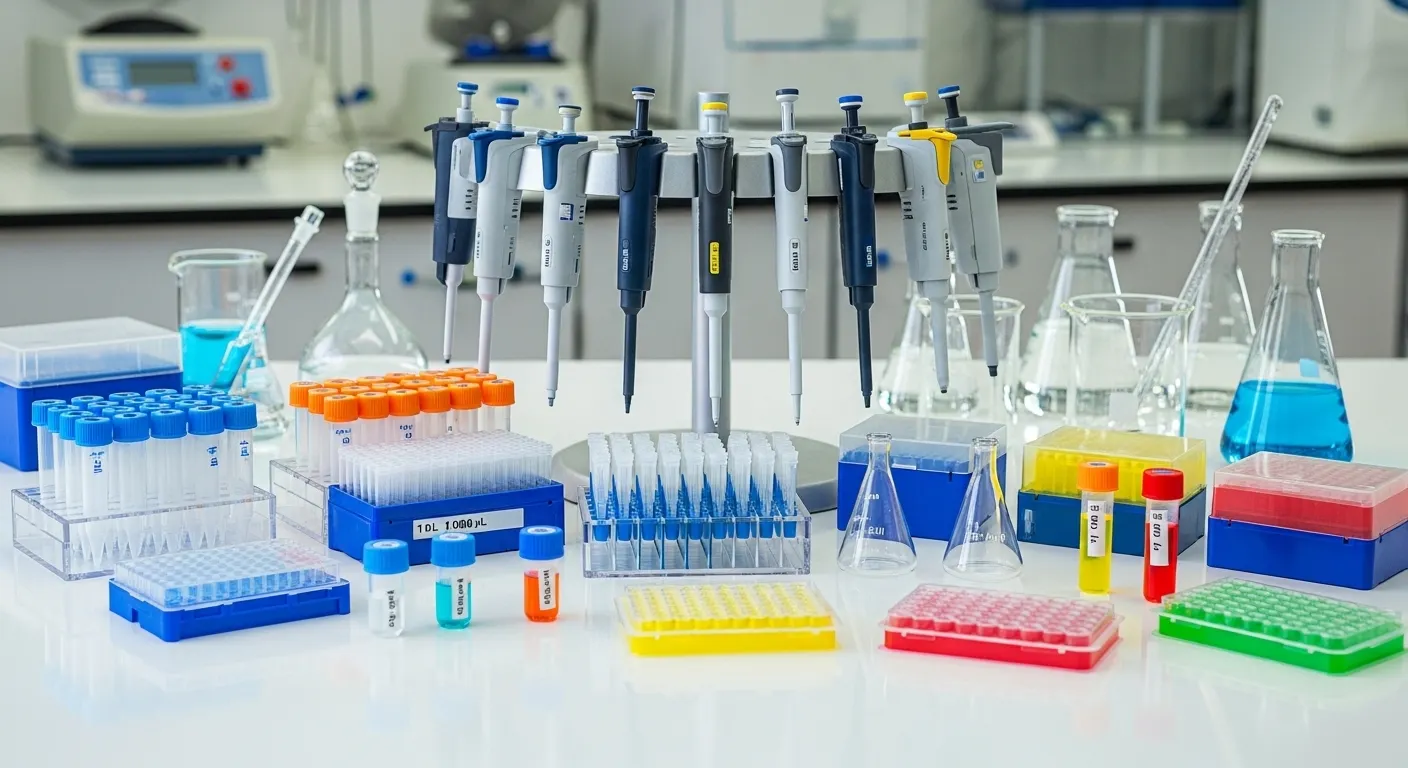
Pipetting is among the most significant functions of a laboratory as it is a complete system. Laboratory pipettes and consumables have tools and instruments that work together to transfer liquids in a precise manner.
This ecosystem includes:
- Multichannel pipettes and micropipettes.
- Fixed volume and adjustable volume pipettes.
- Air displacement and positive displacement pipettes.
- Lab supplies and pipette tips.
- Disposable laboratory consumables
- Sample processing materials, such as micro centrifuge tubes.
These factors ensure that there is smooth operation in the laboratory sample transfer equipment and the analytical laboratory equipment.
It is required in biotechnology and diagnostics in the preparation of samples in molecular biology, ELISA sample processing, and PCR amplification preparation.
Lab Pipettes and Consumables: Precise Liquid Manipulation in the Modern Laboratory
Precision is not only a value in modern science, but everything. It may be a clinical diagnostic, biotechnology research, or even the quality control of pharmaceuticals, yet even a single error in the measurement of liquids can change the outcomes completely. This is where Lab Pipettes and Consumables play a major role in the laboratory performance.
- They are not just tools. They are part of a complete laboratory liquid handling system that is designed to be utilized in micro-volume liquid handling, accurate sample transfer, and contamination-free workflows. The provision of reliable data involves precision pipetting instruments, a sterile tip of the pipette, and all the other components.
- State-of-the-art laboratories are based on advanced laboratory dispensing systems and volumetric measurement tools that promote consistency. The quality pipettes and lab consumables are essential to even the most advanced research.
Types of Pipettes in Modern Laboratory Work
Different laboratory operations require different pipetting tools. The right type will increase accuracy and reduce human error.
- Multichannel Pipettes and Micropipettes
Micro-volume liquids are usually dealt with using micropipettes. Multichannel pipettes can be applied in high-throughput testing, like ELISA and PCR.
- Variable and Non-Variable Volume Pipettes
Pipettes may be set to choose the volume. When repetitive tasks are being conducted, fixed-volume pipettes are more precise.
- Air Displacement Pipettes
They are the most common in the laboratories and are used in general applications, in biotechnology research applications, and in clinical testing.
- Positive Displacement Pipettes
They work best with viscous or volatile liquids and are accurate even with problematic sample conditions.
- Laboratory Electronic Pipettes
The old-fashioned pipettes were tiring and uncomfortable in repetitive work, whereas electronic pipettes are more comfortable and less tiring.
- Pipette Calibration Systems
Calibration is also important in ensuring that the volumetric measurement tools are precise and that they comply with the ISO laboratory requirements.
Laboratory Pipette Consumables Significance
Consumables are not auxiliary; they are crucial in the control of contamination and accuracy.
The key laboratory pipette consumables are:
• Sterile pipette tips
• Filtered pipette tips
• Low-retention pipette tips
• Disposable laboratory consumables
• PCR-compatible consumables
• Autoclavable lab consumables
These consumables assist in preparing laboratory tests and sample transportation under sensitive test conditions. Even the best pipettes cannot maintain the accuracy of the clinical diagnostic test process or pharmaceutical quality control test process without appropriate consumables.
Technical Performance and Accuracy of Pipetting System
Accuracy in pipetting is defined by a set of technical problems:
• Precision in the manipulation of micro-volume liquids.
• Stability of air displacement calibration.
• Temperature and viscosity resistance.
• Less strain ergonomic pipetting equipment.
• Repeatability of laboratory dispensing system.
In order to obtain reproducibility in experiments, contemporary laboratories use high-performance precision pipetting tools.
Any minor failure in the manipulation of liquids will affect the results of sensitive processes like:
• PCR testing
• ELISA assays
• Microbiology laboratory procedures
• Pharmaceutical formulation testing
This is why laboratories invest in good lab consumables to be utilized in testing and calibrated pipetting systems.
Scientific and Clinical Workflow Applications
Lab Pipettes and Consumables find their application in different fields of science.
- Genetic Research and Molecular Biology
It can be used in DNA extraction, in PCR set-up, and in enzyme reactions.
- Clinical Diagnostics
Critical to the sample preparation of patients and diagnostic accuracy.
- Microbiology Laboratories
Used in culture preparation, dilution, and microbial analysis.
- Pharmaceutical Industry
Helps in the formulation of drugs and testing the quality of pharmaceuticals.
- ELISA and Immunology Work
Important for ELISA sample processing and antibody testing.
- Biotechnology Research
Used in advanced experiments requiring micro-volume accuracy.
All of them are founded on contamination-free and precise laboratory sample processing equipment.
Sterile and Filed Pipette Tips to Be as Precise as Possible
Sterility is one of the most important requirements of contemporary labs. A single contamination is enough to ruin an experiment. This is why sterile pipette consumables and filtered pipette tips are trendy. Trustlab provides quality filter pipette tips, which are contamination-free and of high quality.
The tips target:
- PCR and molecular biology applications.
- Workflows of clinical diagnostic testing.
- Sensitive biochemical assays
- High-precision research experiments
Benefits include:
• Aerosol barrier protection
• Reduced cross-contamination
• High transparency of samples.
• Most micropipettes are compatible.
To offer reliability in liquid handling systems in laboratories and improve the reproducibility of experiments, sterile consumables are employed.
Choosing the Most Appropriate Lab Pipettes and Consumables
The selection of the right tools is a key factor in lab efficiency.
The key factors that should be taken into account.
• Accuracy and calibration.
• Pipette models compatibility.
• Resistance to contamination and sterility.
• Quality of consumables.
• Long-term ergonomic design.
Standards of Certification and Compliance
• When handling protein or DNA, always use low-retention pipette tips.
• Filter when using sensitive PCR.
• Set the volume range of the match pipette to your experiment's needs.
• Autoclavable consumables should be used in reusable workflows.
Training on the use of lab pipettes and consumables improves accuracy and cost-efficiency in the long-term.
Quality Standards of Laboratory Consumables
To be reliable, laboratory equipment must be of high quality and capable of meeting international standards. The major quality standards are:
• ISO-certified manufacturing
• DNase/RNase-free consumables
• Pyrogen-free materials
• High-precision calibration systems
• International compatibility with lab equipment.
These standards are required to guarantee the precision of analytical laboratory instruments and to assure consistency of research findings.
Conclusion:
The difference is in the little things that make the difference in any laboratory. Lab Pipettes and Consumables are not just a tool; they are the foundation of scientific accuracy, reliability, and confidence in the results.
All processes involved in the preparation of PCR amplification for clinical diagnostic testing need accuracy in liquid manipulation and contamination-free consumables. The choice of the right instruments will ensure improved reproducibility, improved efficiency, and improved scientific outcomes. When your laboratory values accuracy and reliability, it is high time to enhance your workflow with professional-grade solutions provided by Trustlab.