



microscope slide cover glass
Microscope slides and coverslips are one of the most significant laboratory instruments in scientific research, medical diagnostics and education. While they might seem straightforward, these precision-made glass parts play a crucial role in shaping image clarity, sample preservation, and microscopy accuracy. The material of the slide and coverslip can make a difference in the laboratory, ranging from biological imaging to fluorescence microscopy and some other uses of UV.
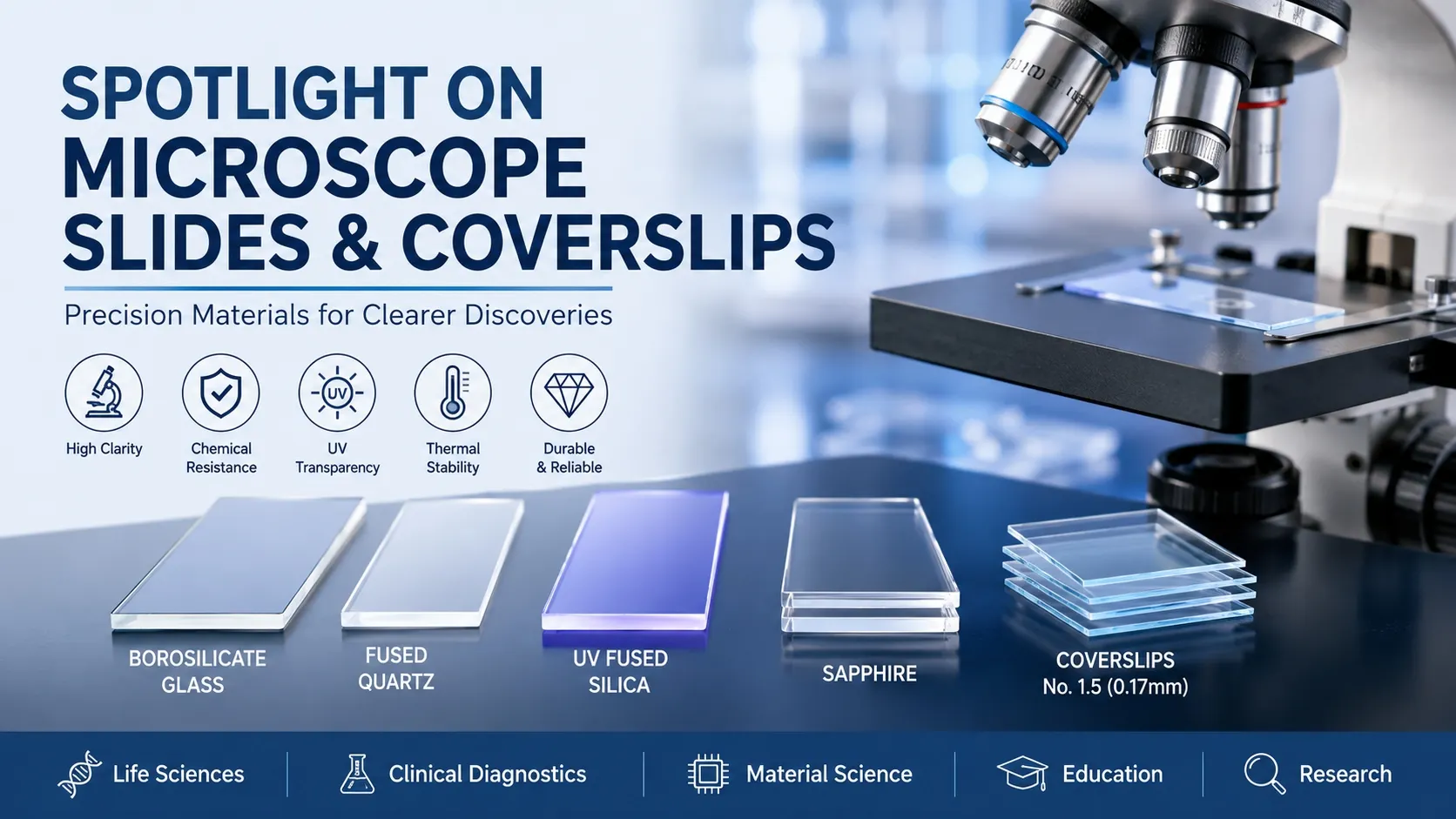
Today's labs have a greater need for more than just a glass slide. Special materials like fused quartz, UV fused silica, sapphire and borosilicate glass are being used more and more to enhance high performance optical systems and cutting edge microscopy techniques.
What Are Microscope Slides and Coverslips?
Microscope Slide: A flat piece of optical material used to place specimens for viewing using a microscope. Coverslips or cover glasses are very thin transparent glass slides that are used to protect a specimen and enhance optical performance when the microscope is being used.
All combine to provide a controlled viewing environment where microscopes can provide accurate magnification, sharp contrast and higher resolution. In many applications, slides and coverslips can be used:
- Biological laboratories
- Clinical diagnostics
- Pathology and cytology
- Pharmaceutical research
- Material science
- Fluorescence microscopy
- UV and IR spectroscopy
- Educational laboratories
The light transmission, refractive consistency and imaging precision depend on the quality of the slide and coverslip. Low quality materials will add distortion, out of focus, or other unwanted fluorescence.
Why Microscope Slide Material Matters
Not all microscope slides are made of the same material. There are different microscopy applications which require different optical and thermal properties.
Borosilicate Glass
Among the most popular materials used in laboratory slides and cover glasses is borosilicate glass. It is very resistant to chemicals, has a high optical transparency, and has a satisfactory life for normal laboratory work. Precision thin glass slides and cover glasses are typically made of high-grade borosilicate materials, like D263M.
Benefits include:
- Strong chemical resistance
- Excellent visible light transmission
- Smooth surface quality
- Affordable cost
- Suitable for routine microscopy
Borosilicate slides are ideal for educational labs, biological imaging, and general-purpose microscopy.
Fused Quartz
Slides and coverslips for fused quartz are optimised for challenging optical applications. Fused quartz is more UV transparent, has a lower thermal expansion and is more chemically resistant than standard glass.
Advantages include:
- High UV and visible transmission
- Excellent thermal resistance
- Reduced optical absorption
- Better imaging performance
- Suitable for UV confocal microscopy
Fused quartz has a high temperature resistance (up to 1200°C), and is suitable for high temperature microscope stages and industry research applications.
UV Fused Silica for Advanced Microscopy
Advanced microscopy systems may opt for UV fused silica as a higher quality option. This material exhibits extremely high UV and VUV transmission and is also free from fluorescence, essential for fluorescence imaging and UV spectroscopy.
UV fused silica coverslips are widely used in:
- Fluorescence microscopy
- UV spectroscopy
- Biomedical research
- Confocal microscopy
- Cell imaging applications
These coverslips can be used to transmit wavelengths from about 160nm to > 2 microns and provide excellent optical clarity.
Advanced biomedical imaging researchers tend to require UV fused silica as it will not cause unwanted fluorescence, which can affect the imaging results from lower quality glass.
Sapphire Microscope Slides
Sapphire microscope slides are also high performance slides used in special science applications. Sapphire has outstanding hardness, scratch resistance and excellent transmission for both UV and visible and infrared light.
Key advantages include:
- Exceptional durability
- High scratch resistance
- Excellent thermal conductivity
- Chemical resistance
- UV, VIS, and IR compatibility
Sapphire slides are employed in many industrial inspection systems, semiconductor research and high pressure laboratory applications.
Understanding Coverslip Thickness
The thickness of the coverslip can be a key factor in microscopy. Numerous microscope objectives have been specially designed for use with a coverslip thickness of about 0.17mm (No. 1.5 coverslips).
Common cover slip thickness specifications are:
- No. 0: 0.10mm
- No. 1: 0.15mm
- No. 1.5: 0.17mm
- No. 2: 0.20mm
Accurate focal planes are achieved with precision thickness, and this will enhance image sharpness at high magnification levels.
Many microscopy enthusiasts and professionals will agree that better quality coverslips offer greater tolerance for thickness, which can enhance contrast and resolution at higher magnifications.
Custom Microscope Slides and Coverslips
Many labs have special requirements for slide size, thickness or coating. Today's optical manufacturers are able to provide the OEM instrument manufacturer and the researcher with custom slides and coverslips for their projects.
Custom Options can include:
- Anti-reflective coatings
- ITO conductive coatings
- Precision-polished surfaces
- Custom dimensions
- Specialized thickness tolerances
- UV-enhanced optical materials
ITO coated coverslips are particularly useful in electrochemical studies, semiconductor studies, and any applications that require conductivity while maintaining optical transparency.
Best Practices for Handling Microscope Slides
Cleaning and handling slides properly can improve the slide quality and prevent contamination to the image field.
Cleaning Tips
Researchers commonly recommend:
- Using lint-free wipes
- Cleaning with isopropyl alcohol
- Avoiding fingerprints on optical surfaces
- Using distilled water for final rinsing
- Handling coverslips gently to prevent breakage
Users of microscopes who post on web forums often remark on the significance of having clean coverslips, particularly when using darkfield or fluorescent microscopy, where dirt can make a huge difference.
Storage Recommendations
Slides and coverslips should be stored in:
- Dust-free containers
- Dry laboratory environments
- Protective slide boxes
- Anti-static packaging where appropriate
Improper storage can introduce particles, residue, or scratches that negatively affect microscopy results.
Emerging Trends in Microscopy Slide Technology
The technology of making microscope slides is continually progressing, which is achieved by improving optical and nanotechnology. Multifunctional slides are being developed that have temperature sensing, computational microscopy support and enhanced imaging capabilities.
Innovations now include:
- Thermally responsive microscope slides
- High-index optical substrates
- Photonic crystal materials
- Computational imaging systems
- Enhanced fluorescence-free substrates
With the development of increasingly sophisticated microscopy techniques, the need for precision optical materials will extend to biomedical, industrial and academic research.
Choosing the Right Microscope Slides and Coverslips
Selecting the best microscope slide depends on your application requirements. Laboratories should evaluate:
- Optical transmission needs
- UV compatibility
- Temperature resistance
- Surface quality
- Thickness tolerance
- Chemical resistance
- Fluorescence performance
Borosilicate glass may be a good choice for standard laboratory applications where moderate performance and cost are not prohibitive. In the case of advanced fluorescence or UV microscopy, fused quartz or UV fused silica might provide better imaging accuracy. For special industrial uses, Sapphire slides are unmatched in durability.
Conclusion
Nowadays, microscope slides and coverslips continue to play a central role in scientific research. Even though they may be the less obvious, these precision optical components play a significant role in achieving microscopy performance, image clarity and experimental reliability.
The range of materials now available for the laboratory, from standard borosilicate glass to highly specialized UV fused silica and sapphire substrates, enables researchers to obtain the materials needed for specific imaging applications. The choice of high-quality slides and coverslips with the right optical and mechanical characteristics can enhance accuracy, minimize artifacts in imaging procedures and facilitate the advancement of scientific research.