


Updated 1 week ago
OEM PCR Consumables China: Sourcing Tubes, Plates, and Packaging
trustlabofficial
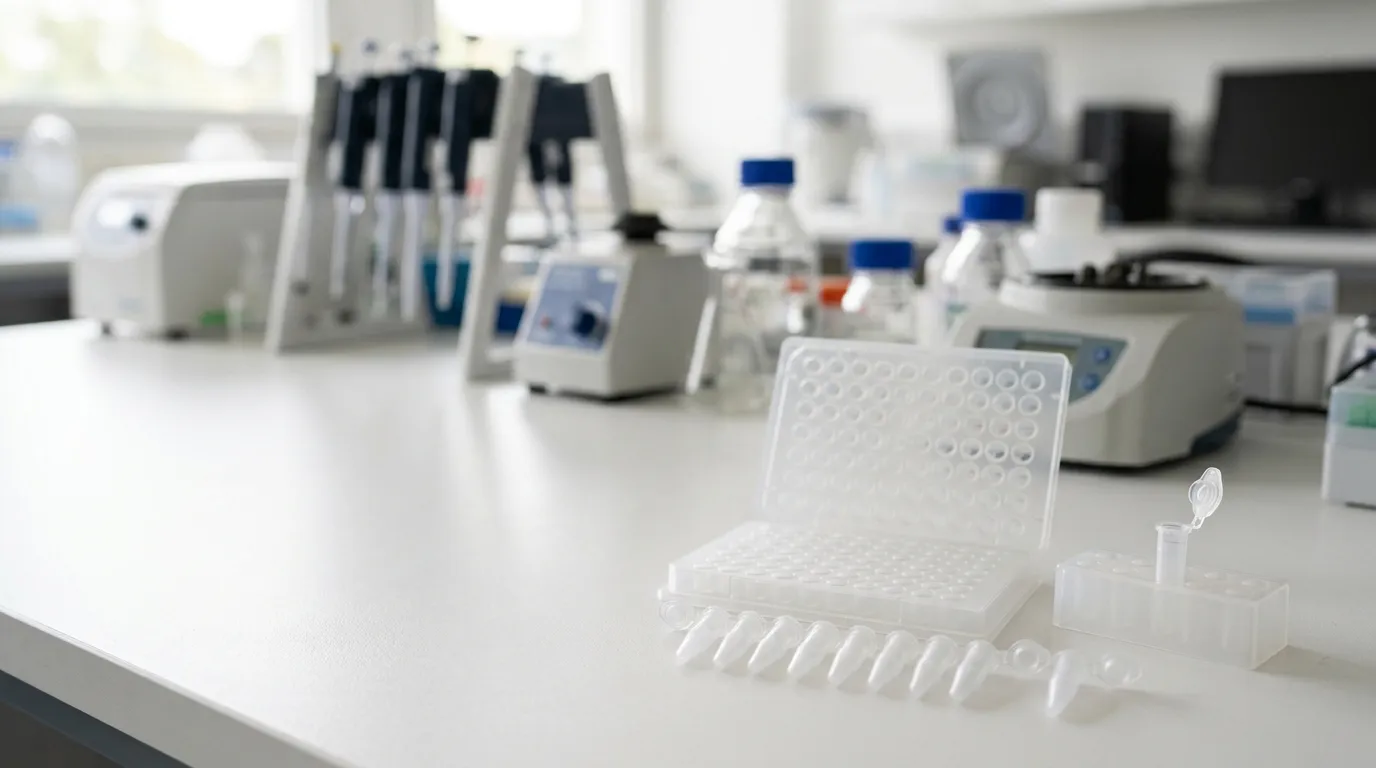
Unlabeled PCR tubes, strips, and a PCR plate arranged on a clean laboratory bench
OEM PCR consumables sourcing from China means contracting a manufacturer to produce PCR tubes, strips, plates, sealing films, or their packaging under your brand and specification. For buyers evaluating Chinese suppliers, the task comes down to three things: knowing which consumable formats match your workflow, verifying the quality claims attached to those products, and establishing a sourcing process that protects batch-to-batch consistency. This guide covers all three, with emphasis on what to check before you place an order.
Trustlab, a B2B laboratory equipment and consumables supplier based in Ningbo, China, lists PCR tubes and related consumables within its broader life-science product scope. The guidance below applies to any supplier you evaluate, including Trustlab.
PCR Consumables You Can Source from Chinese Manufacturers
Most Chinese OEM manufacturers group PCR consumables into four product families: individual tubes, 8-strip tubes, PCR plates, and sealing films. Each family has its own specification variables, and buyers who understand those variables can communicate requirements more precisely during the quotation stage.
Tubes and 8-Strip Tubes

Individual PCR tubes are typically available in 0.2 mL and 0.1 mL formats. The 0.2 mL format is the conventional choice for standard thermal cyclers; the 0.1 mL format suits fast-cycling instruments that use thinner reaction volumes and faster ramping. Most tubes are molded from virgin polypropylene, chosen for its low protein-binding characteristics and its ability to withstand the repeated heating and cooling cycles of PCR. Thin-wall construction is a design attribute worth checking, because it allows faster thermal equilibration between the block and the reaction mixture.
8-strip tubes combine eight individual tubes in a single strip, usually with attached flat or dome caps. They reduce handling steps when preparing multiple reactions and are commonly used in qPCR workflows. Cap design can influence evaporation, so it is worth confirming that the caps create a consistent seal across all eight positions.
PCR Plates (96-Well and 384-Well)
PCR plates follow the same well-format conventions used by thermal cycler manufacturers. The 96-well format is the standard choice for most laboratories; the 384-well format serves high-throughput applications with smaller reaction volumes. Three specification variables matter most when selecting plates:
- Skirt type. Non-skirted plates are flexible and suited to standard blocks; semi-skirted and fully skirted plates provide greater rigidity, which matters when plates are handled by automated liquid-handling systems.
- Well volume. Plates are typically designed for 0.2 mL or 0.1 mL reactions. Check that the plate's well volume matches your thermal cycler's block format, because the two are not interchangeable.
- Well color. Clear plates are used for standard PCR. White plates are used for qPCR because they reflect emitted fluorescence toward the optical detector, improving signal-to-noise ratios in many instruments.
Sealing Films and Plate Seals
Sealing films prevent evaporation and cross-contamination during thermal cycling. The three main options are:
- Pressure-sensitive adhesive films — applied manually or with a roller; convenient for short PCR runs and repeated access.
- Heat-seal films — bonded to the plate using a heat sealer; provide a stronger seal suitable for long-term storage, shipping, and automated workflows.
- Foil seals — used when maximum moisture barrier is needed, such as long-term sample storage. Foil seals must be pierced for sample access.
For qPCR, optical sealing films allow fluorescence detection without removing the seal. Confirm that the film you choose is compatible with the optical detection system in your real-time instrument.
What "RNase-Free" and "DNase-Free" Really Mean — and How to Verify It
"RNase-free" and "DNase-free" are among the most common claims on PCR consumable packaging, yet they are also the easiest claims to misread. These terms mean that the product has been tested and found free of detectable ribonuclease or deoxyribonuclease activity. They do not mean the product is sterile, and they do not automatically make it suitable for clinical or diagnostic use.
The practical implication for buyers is straightforward: a claim is only as reliable as the documentation behind it. When a supplier states that PCR tubes or plates are RNase-free, request a certificate of analysis (COA) or batch test report that states the test method used, the lot number tested, and the acceptance criteria. A supplier that tests every lot will provide this documentation without hesitation. A supplier that only tested a single prototype, or that relies on a raw-material certificate, should be asked for additional evidence.
The Difference Between "Sterile," "RNase/DNase-Free," and "Non-Pyrogenic"
These three terms describe different product attributes and require different test methods.
| Claim | What it means | How it is verified |
|---|---|---|
| Sterile | Free of viable microorganisms | Validated sterilization process; batch sterility testing |
| RNase/DNase-free | Free of detectable nuclease enzyme activity | Enzyme activity assay with defined detection limit |
| Non-pyrogenic (pyrogen-free) | Free of endotoxin or pyrogenic substances | Endotoxin assay (for example, LAL test) with defined limit |
Sterilization does not destroy nucleases, so a sterile product may still contain RNase activity. Conversely, a product that tests nuclease-free has not necessarily been sterilized. A cleanroom-manufactured product is not automatically sterile either. If your workflow requires sterile PCR consumables, request the sterilization validation certificate and lot release documentation. If you need nuclease-free consumables for research use, request the enzyme assay report for the specific lot you are ordering. Do not accept "clean" or "contamination-free" language as a substitute for either claim.
Cleanroom Class and Its Impact on Claims
Manufacturers often describe their PCR consumables as produced in a "cleanroom." Cleanroom classification follows ISO standards and refers to the maximum allowable concentration of airborne particles in the manufacturing environment. An ISO Class 7 or Class 8 cleanroom is common for general consumables production. An ISO Class 5 environment provides a higher level of particulate control.
Understanding cleanroom class helps you evaluate a supplier's production environment, but it should not be confused with product-level claims. A cleanroom reduces the risk of particulate contamination during manufacturing; it does not by itself make a product sterile, nuclease-free, or pyrogen-free. Those attributes require their own validated processes and lot-level testing.
When a supplier mentions a cleanroom, ask which ISO class applies and request supporting evidence such as a cleanroom classification report. Ask whether the PCR consumables are molded, packed, and sealed within that controlled environment, since final packaging steps determine whether the product reaches you in the claimed condition.
Sourcing OEM PCR Consumables: A 5-Step Process
OEM sourcing of PCR consumables follows a repeatable five-step process.
Step 1 — Define the reference product and its specifications. Identify the exact PCR consumable format you need: individual tubes, strips, a 96-well or 384-well plate, a sealing film, or a combination. Specify well volume, skirt type, well color, packaging configuration, and the product's intended workflow. A useful technique is to provide a reference SKU from a brand whose product you currently use, along with dimensions and photographs. This gives the manufacturer a precise target for matching.
Step 2 — Request a quotation with packaging and branding details. Your quotation request should include not only the consumable format but also the packaging type, label content, barcode requirements, language requirements, and any private-label branding. The more complete your specification, the fewer surprises you will encounter at the sample stage.
Step 3 — Evaluate samples. Samples should be evaluated against your own PCR or qPCR conditions. Test for fit on your thermal cycler, seal integrity during a full run, and optical compatibility if you are using qPCR. If you have the capacity, run a no-template control and a dilution series to check for inhibition or contamination. Visual inspection of surface quality, packaging, and lot labeling also matters.
Step 4 — Review documentation. Ask for the documents that verify the quality claims: certificates of analysis, test reports, sterilization records, and, where applicable, regulatory registrations or declarations. Review the scope of any ISO certificate — an ISO 13485 or ISO 9001 certificate covers a quality management system and is not the same as a product-level CE mark or regulatory registration.
Step 5 — Plan pilot and repeat supply. Once samples pass evaluation, move to a pilot order under real production conditions. Confirm lead times, packaging consistency, and lot-to-lot reproducibility before committing to a long-term supply arrangement.
MOQ, Samples, and Export Basics in OEM PCR Consumables Sourcing
Minimum order quantities vary by manufacturer and product type. A supplier that molds PCR tubes in high volumes may set a higher MOQ for custom colors or custom packaging, while standard configurations may be available in smaller quantities. There is no universal number; the practical step is to ask for the MOQ for the exact product configuration you need and compare it across suppliers.
Sample policies also differ. Most OEM manufacturers will provide samples before a bulk order, but it is reasonable to expect a sample fee plus shipping for custom configurations. Treat samples as a technical evaluation step, not as a free-goods request.
Export logistics add another layer to the sourcing decision. Understanding Incoterms, documentation requirements, and how they affect your landed cost is essential for comparing Chinese suppliers. The moq and export guide explains these topics in detail.
Packaging and Private-Label Requirements for OEM PCR Consumables
Packaging decisions in OEM PCR consumables sourcing are often treated as an afterthought, yet they determine whether your product arrives intact, remains traceable, and meets your customers' expectations.
For tubes and strips, specify whether you want them loose in bags, in racks, or in bulk sleeves. Racked formats cost more but protect tube integrity and simplify laboratory handling. If tubes are individually sealed or packaged in strips, confirm how the packaging interacts with automated handling equipment.
For plates, the main packaging decision is individual wrapping versus bulk packing. Individually wrapped plates are common in clinical and IVD workflows where contamination control is critical; bulk packing reduces cost per unit for research use. Confirm that the packaging material and sealing method are appropriate for the product's storage claim.
Labeling goes beyond brand identity. A compliant label includes the product name, catalog number, lot number, and, where applicable, storage conditions and expiration date. Barcode labeling supports inventory tracking and is a requirement for many distributors and IVD manufacturers. If your product is intended for research use only, the label should say so. If you intend to register the product for clinical or diagnostic use in specific markets, labeling requirements follow the applicable regulatory framework, which is a separate qualification process.
Sealing films are typically packaged as precut sheets or in rolls. Confirm that the packaging keeps the adhesive surface clean and that the film lies flat when applied. For sterile film configurations, request the sterilization validation documentation as discussed earlier.
When requesting packaging from any supplier, provide a written packaging specification that includes materials, dimensions, label text, barcode symbology, and tolerances. This document becomes the baseline for both sample evaluation and repeat order consistency.
Choosing a Supplier: Verification Checklist and Common Pitfalls

Selecting an OEM supplier for PCR consumables requires more than comparing prices. Use this checklist when evaluating manufacturers:
- Certificate scope. Does the supplier hold ISO 9001 or ISO 13485 certification, and what does the certificate actually cover? A QMS certificate confirms that the company operates a documented quality management system. It is not proof that every product is CE marked, FDA cleared, or registered with a national regulatory authority. Ask for certificate copies and read the scope clause.
- Quality-claim documentation. If the product is described as RNase-free, DNase-free, or pyrogen-free, request the test method and acceptance criteria used for that claim, plus a COA for the lot you are evaluating.
- Cleanroom evidence. Ask which cleanroom class applies to which production step, and request a classification report if the claim matters to your application.
- Change control. Ask how the manufacturer manages changes to raw materials, molds, process parameters, and packaging. Supply consistency depends on controlled change, not on undocumented substitution.
- Reference SKU matching. Confirm that the manufacturer can match the physical dimensions and thermal performance of the reference product you provided.
- Batch traceability. Confirm that each finished lot can be traced to raw material lots and production records. This traceability is essential when a quality issue appears downstream.
- OEM experience. Ask which consumable categories the manufacturer has produced under OEM arrangements, and request references or case examples where appropriate.
Several warning signs justify extra scrutiny. Vague language on certificates — such as a company claiming its entire product range is "CE approved" without product-specific documentation — is a common red flag. Inconsistent specification tables, duplicate product codes with conflicting values, and mismatch between marketing copy and technical documentation all suggest data-quality problems that could affect your orders.
The same scrutiny applies to Trustlab as it would to any supplier. Trustlab positions itself as a B2B laboratory equipment and consumables supplier offering OEM support for global research, healthcare, and distribution customers. Its published product scope includes PCR tubes within its laboratory consumables categories, and it offers customization across laboratory and medical consumables. Buyers should treat these positions as company-level statements and should still request SKU-specific documentation — certificates, COAs, and technical datasheets — before adopting any product.
PCR Consumables and Troubleshooting: Preventing Plastics Problems in Your Workflow
The quality of PCR consumables becomes visible only when reactions fail. The most common plastic-related problems include evaporation, inconsistent sealing, and inhibition, and each one has a preventable cause.
Evaporation is usually a sealing problem. If a plate seal or cap does not create a uniform barrier across all wells, reaction volumes decrease during thermal cycling, which can alter results and create well-to-well variation. Heat-sealed films provide a stronger barrier than pressure-sensitive films and are often recommended for longer reaction protocols. Ensuring that the plate and film are compatible with your heat sealer or applicator tool is part of good workflow design.
Tube and plate quality affects thermal transfer. Thin-wall polypropylene allows the reaction to equilibrate quickly with the block; thicker walls or inconsistent wall thickness can cause uneven heating and run-to-run variability. This is why reference-SKU matching matters during OEM evaluation — dimensional precision and material consistency produce uniform thermal performance.
PCR inhibition can originate from plastic additives, mold-release agents, or residual manufacturing contaminants. This is the reason nuclease-free claims alone are not sufficient. Ask suppliers whether their PCR consumables are tested for PCR inhibition using an amplification assay. A PCR-performance test provides more practical confidence than a certificate that only lists material specifications.
For a detailed overview of plastics-related PCR issues, the PCR/qPCR plates and tubes troubleshooting guidance from Thermo Fisher Scientific is a useful technical reference].
Good consumable hygiene also depends on workflow. Opening plates and films only immediately before use, storing products according to the manufacturer's conditions, and handling plates by the edges reduces the risk of contamination that has nothing to do with the product itself.
Working With a Partner: Why Documentation and Transparency Matter
When you are sourcing OEM PCR consumables from a Chinese manufacturer, documentation is your primary tool for managing risk. A transparent supplier will answer specification questions clearly, share relevant test documentation, and acknowledge when a product claim requires more evidence.
Trustlab's stated position as a supplier of laboratory instruments, consumables, and supply support for global research and healthcare is consistent with its current site structure. The company's life-science category includes PCR plates and tubes, and its OEM capabilities apply across laboratory consumable lines, including medical consumables and laboratory sample collection products.
What this means for you as a buyer is practical: Trustlab can be evaluated using the same reference-SKU matching and sample-request process described in this guide. There is no reason to accept company-level marketing wording as a substitute for product-specific documentation, and Trustlab's own website invites this kind of inquiry by presenting its products as configurable OEM items.
How to Request Samples, Certificates, and Technical Documents from Trustlab
If Trustlab's PCR consumable scope aligns with your project, the most direct next step is to contact the company with a specific request. Include the following in your first communication:
- The exact PCR consumable format you need (product type, well format, volume, skirt type, color, packaging configuration)
- A reference SKU from a brand you currently use, if available
- The quality documentation you want to review (COA, batch test reports, sterilization records where applicable, certificate files)
- Your intended application or workflow (research use, IVD integration, distribution) so the supplier can flag relevant regulatory considerations
This approach shortens the evaluation cycle because the supplier knows from the first message that you understand the verification requirements. You can also request a catalog of current PCR consumable formats to compare against your specification.
Trustlab's medical consumable supplies page describes its general OEM capabilities and can give you a sense of its approach to customization. The company's laboratory sample collection consumables page similarly confirms its broader OEM scope. For the most current product and documentation evidence, a direct inquiry with your reference SKU and packaging specification is the most reliable route.
Frequently Asked Questions
How does OEM PCR consumables sourcing from China work?
You define the product specification and branding, the manufacturer produces the consumables to that specification, and you sell them under your own label. The process normally involves reference-SKU matching, sample evaluation, documentation review, and a pilot order before routine bulk supply.
How do I verify RNase/DNase-free claims from a PCR consumables supplier?
Request a certificate of analysis or batch test report that states the test method used, the lot number tested, and the acceptance criteria. Ask whether every production lot is tested or only representative samples. Treat the claim as unverified until you have that documentation in hand.
What documents should I request from a PCR consumables OEM supplier?
At minimum, request a COA for the specific lot being evaluated, the material specification for the polypropylene resin used, the cleanroom classification report if a cleanroom claim is made, and any sterilization validation records if the product is sold as sterile. If the product is intended for regulated markets, request the product-specific regulatory documentation for the relevant jurisdiction.
What minimum order quantities should I expect from Chinese manufacturers?
MOQs vary by manufacturer, product type, and packaging configuration. A custom color or packaging format will generally carry a higher MOQ than a standard configuration. Ask for the MOQ for the exact product specification you need rather than relying on industry averages.
Are Trustlab PCR consumables CE or FDA approved?
Regulatory status is product-specific and market-specific. Trustlab operates as a B2B laboratory equipment and consumables supplier, and its website describes company-level and category-level capabilities. To confirm the regulatory status of any specific PCR consumable, request the applicable certificates, IFUs, or registration documentation for the exact SKU you intend to order. A company QMS certificate is not the same as a product-level regulatory approval, so it should not be treated as one.
Why source PCR consumables from China rather than an established global brand?
Chinese OEM manufacturers can offer competitive pricing, flexible customization, and supply-chain efficiency for buyers who need private-label consumables at scale. The trade-off is that you must invest more time in supplier qualification, documentation review, and sample testing to confirm that product quality and batch consistency meet your requirements. The verification framework described in this guide is designed to close that gap.