



Updated 2 weeks ago
Rapid Test Kits for Distributors: Sourcing and Launch Checklist
trustlabofficial

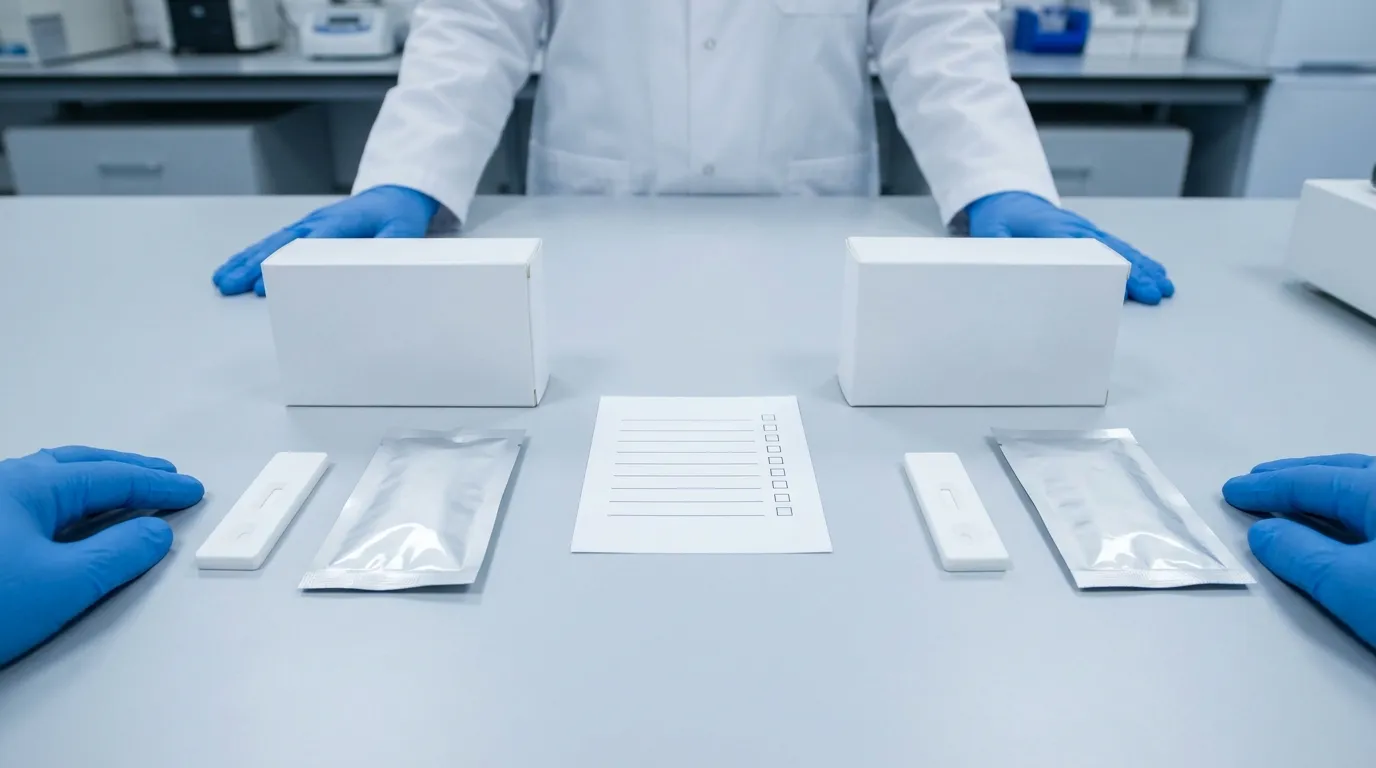
Rapid test kit distribution review with packaged cassettes and sourcing checklist on a clean desk
Entering rapid test distribution can expand your product portfolio and open new customer segments — from clinics and laboratories to pharmacies and workplace health programs. But the difference between a smooth launch and a costly mistake usually comes down to how thoroughly you qualify your manufacturer before you commit.
This guide walks through a five-step sourcing and launch checklist for rapid test kit distributors: qualifying the manufacturer, verifying documentation, choosing product categories, evaluating samples, and managing stock after launch. Each section gives you concrete questions to ask and documents to request — from any manufacturer, including Trustlab.
Before You Source: What Rapid Test Distribution Really Requires
Rapid tests are point-of-care diagnostic tools. As a distributor, you are not just moving inventory — you are handling products with regulatory, storage, and quality-management obligations. Before you approach any supplier, understand what the role carries:
- Documentation management. You need certificates, package inserts (IFUs), and batch records that support what you sell.
- Regulatory responsibility. Your target market may require product registration, import permits, or notification before you can distribute.
- Storage diligence. Many rapid tests have defined temperature and humidity limits that affect shelf life.
- Accurate communication. The performance data you pass to clinics or pharmacies must match what the manufacturer's documentation actually states.
None of this is difficult, but it requires a structured approach. The steps below give you that structure.
Step 1 — Qualify the Manufacturer Before You Negotiate
The most important step happens before you discuss pricing. A manufacturer's marketing page can say almost anything; the documents behind those claims are what matter.
Start by confirming the manufacturer holds ISO 13485, the quality management system standard for medical devices. This tells you the company operates under a recognized quality framework. But keep the scope clear: ISO 13485 certifies the manufacturer's quality system. It is not, by itself, proof that every product the company sells has been reviewed or registered for every market.
Ask these questions in your initial qualification conversation:
- What is your exact company name and manufacturing location?
- Which legal entities hold your ISO 13485 and other certifications?
- Which product lines fall within your certified scope, and are any excluded?
- Can you provide the certificate, issuing body, and validity dates?
- Which of your products carry CE marking, FDA authorization, or other market-specific registrations?
- How do you handle batch traceability and recalls?
- What export markets do you currently serve?
Watch for red flags during this stage:
- Claims like "FDA/CE/ISO approved" without supporting documents. These three terms mean different things, apply at different levels, and belong to different regulatory systems.
- A company that cannot state which products hold which registrations.
- Performance claims such as "high accuracy" or "extremely reliable" without reference to an IFU or validation data.
- Reluctance to share certificates because they are "confidential."
How to Verify an ISO 13485 Certificate
When you receive the certificate, do not just file it. Check it:
- Confirm the issuing body. Recognized registrars are accredited by national accreditation bodies.
- Check the certificate number and validity dates. Is it current?
- Read the scope statement. The scope describes what the quality system covers. It may list specific product categories or exclude certain sites or processes.
- Verify the legal entity. The certificate holder should match the company you are contracting with.
- Ask whether the scope covers the products you intend to buy.
A legitimate manufacturer will not hesitate to provide this information. Vague answers at this stage predict vague answers later.
Step 2 — Verify the Documentation That Actually Matters

Once the manufacturer passes your initial qualification, request the product-level documentation. This is where most sourcing mistakes happen: distributors accept a company-level certificate as proof that a specific product is approved. Those are different claims.
The table below lists the documents to request and how to evaluate them.
| Document | What It Proves | How to Verify It | Red Flag |
|---|---|---|---|
| ISO 13485 certificate | Manufacturer's quality management system meets the medical-device QMS standard | Check scope, validity, issuing body, legal entity | Scope does not mention your product category; certificate expired |
| CE Declaration of Conformity or CE certificate | Product meets applicable EU directive/regulation requirements for its intended market | Confirm the document names the exact product; check notified body involvement where required | Document lists a different product or a different legal manufacturer |
| FDA registration, clearance, or authorization (for US market) | Product is registered, cleared, or authorized with FDA as applicable | Confirm which FDA pathway applies (510(k), EUA, registration); match the product name | "FDA approved" wording without a product-specific identifier |
| Package insert / IFU | Intended use, specimen type, procedure, interpretation, storage requirements, and limitations for the exact product | Read it — verify the product name matches; check storage temperature claims | IFU cannot be provided before purchase |
| Certificate of Analysis (per batch) | The specific batch meets release specifications | Compare batch number on the CoA with batch number on cartons | CoA is generic and not batch-specific |
| Lot traceability records | Manufacturer can track each batch through production and distribution | Ask how far back records go and how quickly they can retrieve them | No recall history or traceability process described |
A useful benchmark for documentation expectations comes from public-sector procurement. The World Health Organization's guidance on procuring malaria rapid diagnostic tests, for example, requires manufacturers to supply product-specific performance data, IFU, and batch documentation as part of tender submissions. Private distributors should hold their suppliers to a similar standard.
Step 3 — Choose Categories That Match Your Market
Rapid tests are not one product category — they are a family of tests serving different clinical needs, specimen types, and market segments. Your product mix should reflect the customers you serve and the regulatory path in your target market.
Categories that distributors commonly carry include:
- Infectious disease markers for tropical and travel health: malaria, dengue, and typhoid rapid tests are frequently requested in endemic regions and by travel clinics.
- Hepatitis screening: HBsAg (hepatitis B surface antigen) and HCV (hepatitis C antibody) tests support screening programs, blood banks, and primary care.
- Sexual health: combined HIV/syphilis rapid tests serve antenatal clinics, STI programs, and community screening.
- Women's health: HCG pregnancy tests are the most widely recognized rapid test format, with demand across pharmacies, clinics, and hospitals.
- Gastrointestinal screening: fecal occult blood (FOB) tests are used in colorectal cancer screening programs.
Trustlab's own rapid test catalog covers all of these categories, and its product pages explicitly list "laboratories, and distributors worldwide" as intended audiences. That makes Trustlab a straightforward example of a manufacturer that already works with distributor partners.
When choosing categories, weigh three factors:
- Your market's disease burden and screening programs. Which tests will your customers actually need?
- Regulatory complexity. Some product categories face more rigorous registration requirements than others in certain countries.
- Storage and expiry handling. Different formats have different shelf-life and storage demands. Start with products whose requirements align with your existing logistics capabilities.
Step 4 — Run a Sample Evaluation Before Committing
A manufacturer can look excellent on paper and still send a product that underperforms in practice. That is why sample evaluation is non-negotiable. You are not looking for a single good result — you are looking for evidence that the product performs consistently across batches.
Request samples that include:
- Multiple lot numbers, not just one batch.
- Package inserts for each product.
- Certificates of Analysis for each batch.
- Packaging and labeling samples in your target market's language if applicable.
Then run a structured evaluation:
- Check physical packaging. Are cartons and pouches intact? Is the labeling clear and complete?
- Check expiry dates. Are you receiving product with adequate remaining shelf life for your sales cycle?
- Confirm lot numbers. Do the lot numbers on the outer cartons match the CoA documents?
- Run the tests. If you have practical access, test with known positive and negative controls or reference samples. Document every result.
- Compare across lots. Do all batches perform similarly? Batch-to-batch consistency is a stronger signal than one perfect sample.
- Review the IFU critically. Is the intended use clearly stated? Are specimen types, procedure steps, interpretation criteria, and limitations described well enough for your downstream customers to use the test correctly?
Use the same evaluation protocol for every manufacturer you are considering. That gives you comparable data instead of impressions.
Step 5 — Place the First Order, Stock, and Launch
Once your sample evaluation is complete and the manufacturer has passed your documentation checks, you can move to commercial terms.
Negotiating your first order means covering minimum order quantity, lead times, payment terms, packaging, labeling, and shipping responsibilities. For a detailed walkthrough of MOQ and export terms, see the moq and export guide.
A few points specific to rapid tests:
- Order enough to test the market, not enough to fill a warehouse. First orders should balance MOQ requirements with realistic early sales forecasts.
- Confirm expiry dating on arrival. Ask the manufacturer how much shelf life you should expect on shipments.
- Plan for market registration. Depending on your country, rapid tests may require registration or notification before you can legally distribute them.
Receiving and Storage Checklist
When the shipment arrives, work through this checklist:
- Inspect packaging for damage, moisture, or crushed cartons.
- Verify lot numbers against the Certificate of Analysis for each batch.
- Record expiry dates. Log them in your inventory system immediately.
- Confirm storage conditions. Check the IFU for temperature and humidity requirements, then verify your storage area meets them.
- Rotate stock by expiry date. Sell soonest-expiring stock first.
- Maintain lot traceability records. Your records should link each sale to the specific batch you sold — this becomes critical in the event of a recall.
Monitoring Quality, Handling Recalls, and Managing Risk
Your responsibilities continue after the first shipment. Distributors who treat quality monitoring as someone else's problem are the ones caught off guard when a batch fails.
Understand the performance metrics. Two terms matter most: sensitivity and specificity. Sensitivity measures how well a test identifies positive cases; specificity measures how well it identifies negative cases. These are product-specific values that should appear in the manufacturer's validation documentation — they are not marketing claims. When you communicate a test's performance to your customers, use the documented figures, not adjectives.
Expect occasional false results. No rapid test is perfect. False positives and false negatives occur at rates described by the product's validation data. Your customers need to understand this, and your product training should reflect what the IFU actually says.
Handle batch issues quickly. If a customer reports a problem with a specific batch:
- Quarantine the remaining stock from that lot.
- Notify the manufacturer promptly.
- Keep your traceability records accessible so you can identify which customers received that batch.
- Cooperate with the manufacturer's investigation — batch-specific issues require batch-specific responses.
Track documentation renewals. Certificates expire. IFUs get revised. Ask your manufacturer for updated documents on a regular schedule rather than waiting for a problem to surface.
Questions to Ask Any Rapid Test Manufacturer (Including Trustlab)
Use this list in your conversations with any supplier — including Trustlab. The answers will tell you more than any brochure.
Documentation
- Which ISO certificates does your company hold, and what is the exact scope?
- Which of your rapid tests hold CE marking or other market-specific registrations?
- Can you provide a package insert for each product I plan to order?
- Do you provide batch-specific Certificates of Analysis?
Product performance
- What sensitivity and specificity data do you have for each test?
- What is the shelf life from the date of manufacture?
- What storage conditions do the IFUs require?
- What specimen types does each test support?
Commercial terms
- What is the minimum order quantity per product?
- What is the typical lead time from order to shipment?
- How much remaining shelf life can I expect on delivery?
- Do you offer private-label or custom packaging options?
Quality and support
- How do you handle batch traceability and recall notifications?
- Can you provide references from other distributors in comparable markets?
- How do you handle technical questions after the sale?
Trustlab manufactures rapid tests across infectious disease, hepatitis, sexual health, women's health, and gastrointestinal screening categories, and its product documents explicitly welcome distributor partnerships. If you are evaluating Trustlab alongside other manufacturers, apply the same checklist above and request Trustlab's current certificates, package inserts, and batch documentation before you commit.
Sources and Further Reading
The following sources provide additional context for evaluating rapid test suppliers and understanding procurement expectations:
- World Health Organization (WHO) — Good practices for selecting and procuring rapid diagnostic tests for malaria: describes what buyers should expect from RDT manufacturers in terms of product information, batch documentation, and quality assurance. Available via WHO's publications portal.
- USDA Agricultural Marketing Service — Criteria & Specifications documents: explain how conformance claims and Certificates of Performance are evaluated for test kits. Available at ams.usda.gov.
- Trustlab Rapid Diagnostic Test Kits — Trustlab's rapid test category page lists the product families the company supplies to laboratories and distributors worldwide: https://www.trustlab-china.com/rapid-test/
- Trustlab Global Health Rapid Testing — Trustlab's diagnostic testing resource page provides additional context on rapid testing applications: https://www.trustlab-china.com/global-health-rapid-testing/
For practical help with distributor pricing, MOQ, and export logistics, the moq and export guide covers those details in depth.
The checklist above applies to any supplier relationship. Use it to compare manufacturers fairly, verify the documents behind the claims, and launch with a distribution line you can stand behind.