


Updated 2 weeks ago
IVD Rapid Test Manufacturer | Trustlab for Diagnosticslogy Applications
trustlabofficial

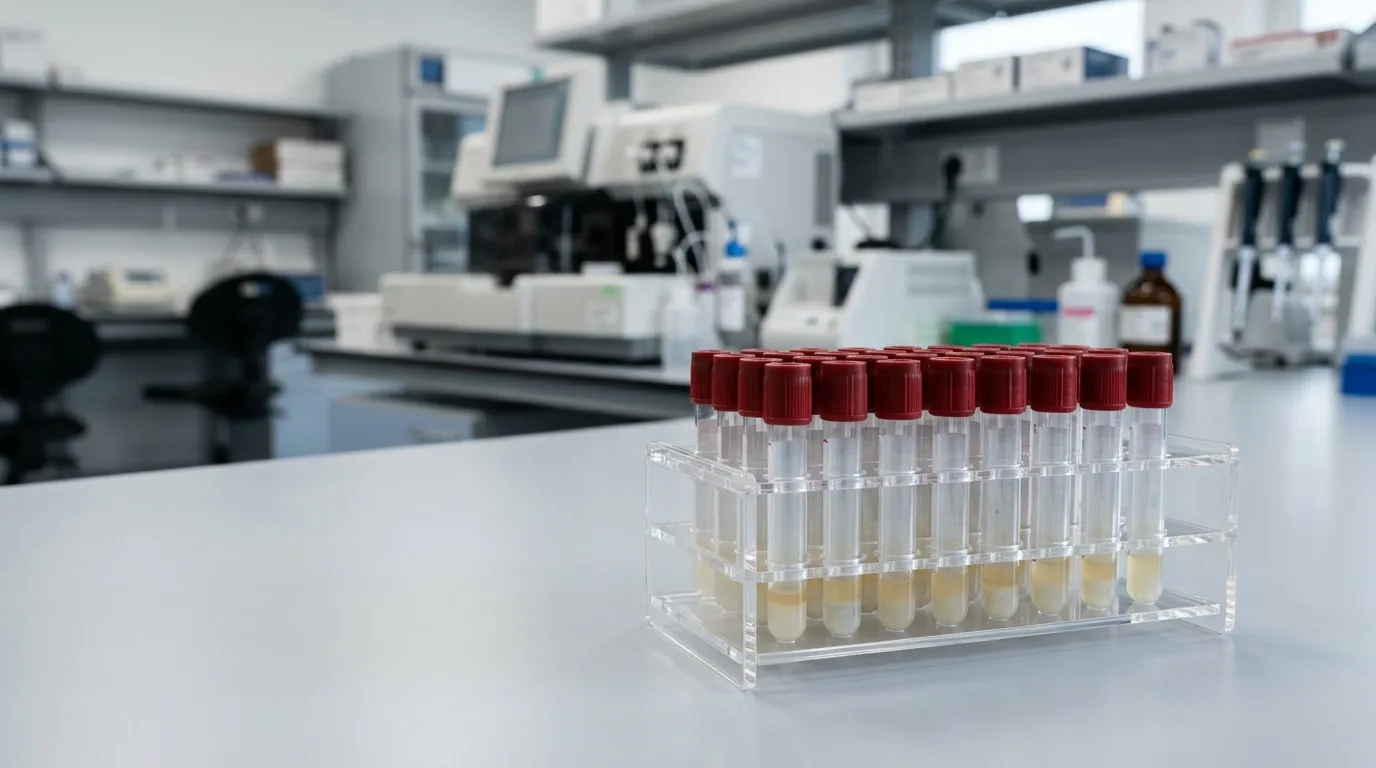
Unused rapid test cassettes on a clean laboratory work surface.
K2 EDTA tubes are among the most common blood collection tubes in hematology labs. They hold whole blood for tests such as complete blood count (CBC) and blood film examination by using dipotassium EDTA as the anticoagulant. If you are sourcing these tubes for clinical use, the product itself and the manufacturer behind it both need scrutiny.
Trustlab—Ningbo Trustlab Instruments Co., Ltd.—supplies K2 EDTA blood collection tubes as part of its blood collection product line. This page explains what K2 EDTA tubes are, how they compare with K3 EDTA tubes, which specifications matter, and how procurement teams can evaluate a K2 EDTA tube manufacturer before placing an order.
What Is a K2 EDTA Tube?
A K2 EDTA tube is a blood collection tube that contains dipotassium EDTA as an anticoagulant. During manufacturing, K2EDTA is applied to the inner wall of the tube, usually as a spray-dried coating. When blood enters the tube, the coating dissolves and the EDTA binds ionized calcium.
Calcium is required for the coagulation cascade. By removing available calcium, K2EDTA stops the blood from clotting. The sample stays in a liquid, whole-blood state that can be used for hematology testing.
EDTA is not a single chemical. It refers to a family of salts. K2 EDTA is the dipotassium salt; K3 EDTA is the tripotassium salt. Therefore, "K2 EDTA tube" does not mean the same thing as a generic "EDTA tube." The salt form, concentration, and tube design all affect how the sample behaves.
EDTA tubes are identified by a lavender or purple cap in most blood collection tube systems. That cap color is shared by K2 EDTA and other EDTA tubes, so color alone does not tell you which salt is inside. Always check the label. For a broad overview of additive categories and colour coding, see different types of vacuum blood collection tubes.
K2 EDTA Tube Applications in Hematology
K2 EDTA tubes are used mainly when the laboratory needs to preserve blood cells in a near-native state.
Common applications include:
- Complete blood count and differential counts
- Peripheral blood smear preparation
- Blood typing and crossmatching in some blood bank workflows
- Molecular testing methods that accept EDTA whole blood as the starting material
The advantage of K2EDTA is that it keeps cells stable without significantly distorting their size or shape. That matters when an analyzer is counting cells or a technologist is looking at a blood film.
K2 EDTA tubes are not appropriate for every test. They should not be used for coagulation assays such as PT/INR or aPTT because EDTA removes the calcium those tests require. Sodium citrate tubes are the standard choice for coagulation. K2 EDTA tubes are also not used when the laboratory needs serum; tubes without anticoagulant or with a clot activator and serum separator gel are designed for that purpose.
If you are evaluating K2 EDTA tubes for an automated hematology analyzer, confirm that the tube format and fill volume match your analyzer's sample requirements. Some analyzers are validated for specific tube types, and changing tube suppliers may require a re-evaluation.
K2 vs. K3 EDTA Tubes: Key Differences
Both K2 and K3 EDTA are anticoagulants that work by the same calcium-chelating mechanism. The practical difference lies in their chemical form and how they affect blood cells over time.
| Feature | K2 EDTA (dipotassium EDTA) | K3 EDTA (tripotassium EDTA) |
|---|---|---|
| Chemical form | Two potassium ions per EDTA molecule | Three potassium ions per EDTA molecule |
| Typical presentation | Spray-dried coating on the tube wall | Liquid or dried coating |
| Mode of action | Chelates calcium ions | Chelates calcium ions |
| Common use | Hematology, especially CBC and blood films | Some EDTA-based applications; less common in routine hematology |
| Cell-morphology consideration | Often preferred when cell morphology matters | Can have a stronger osmotic effect if concentration is not carefully controlled |
K2 EDTA is frequently the default choice for routine hematology because the dried coating dissolves gradually and exposes cells to less osmotic stress than a liquid additive. K3 EDTA can still produce acceptable results when the tube is filled and mixed correctly, but the tube design and concentration need to be validated for the intended test.
K2 EDTA is also compared with other anticoagulants:
- Sodium citrate is used for coagulation testing.
- Heparin is used for some plasma chemistry tests.
- No additive or clot activator tubes are used when serum is required.
The best tube depends on the test method, not on which anticoagulant is "stronger." A reliable manufacturer should state clearly which salt is in the tube and provide instructions for its intended use.
K2 EDTA Tube Specifications and Selection Factors
When you compare K2 EDTA tube manufacturers, keep the specification table consistent. You need to know the tube material, additive, fill volume, dimensions, cap colour, and mixing instructions for each product you are considering.
| Parameter | What to verify | Why it matters |
|---|---|---|
| Additive | K2 EDTA, not K3 or mixed EDTA | The anticoagulant salt is the defining product specification |
| Additive amount | Concentration and fill-volume tolerance | Too much or too little additive changes sample quality |
| Nominal fill volume | Label volume and actual draw volume | Incorrect fill ratio affects CBC parameters |
| Tube size | Outer diameter and length | Must fit racks, carriers, and analyzer sample probes |
| Tube material | PET or glass | PET is shatter-resistant and common in modern tubes |
| Cap colour | Lavender/purple for EDTA | Helps staff identify the tube during collection |
| Closure type | Screw cap, push cap, or stopper | Affects safety and sample handling |
| Mixing requirement | Number of inversions | Ensures the EDTA is evenly distributed |
| Sterility | Stated sterile or non-sterile | Sterility must be verified from product labelling, not assumed |
| Shelf life and storage | Expiry date and storage conditions | Expired or improperly stored tubes affect result reliability |
Most K2 EDTA tubes are filled by vacuum, which automatically draws a pre-set blood volume. Some product lines use a non-vacuum format in which blood is added manually. Trustlab's blood collection range includes a non-vacuum EDTA tube with a lavender/purple cap labelled as containing K2EDTA. For more on evacuated formats, see vacuum blood collection tubes.
After collection, EDTA tubes must be mixed by gentle inversion. The usual recommendation is 6 to 8 inversions immediately after the tube is removed from the needle. Inversion ensures that the blood contacts the dried EDTA and prevents small clots from forming.
Centrifugation is not normally required for a CBC because the test is performed on whole blood. Some laboratory protocols centrifuge EDTA tubes to obtain plasma for additional tests, but the tube itself does not need centrifugation for routine haematology use.
How to Evaluate K2 EDTA Tube Manufacturer Quality
A polished specification sheet is not enough. The best way to evaluate a manufacturer is to check the evidence behind the product and test the tubes in your own workflow.
Trustlab has published a separate guide on how to evaluate blood collection system supplier quality. Use that framework alongside the K2-EDTA-specific points below.
Ask for the right documentation
A responsible K2 EDTA tube manufacturer should provide:
- Instructions for use or IFU
- A technical data sheet with full specifications
- Batch or lot release documentation
- Labelling information for the tube
- Sterility documentation if the product is labelled sterile
- Certificates relevant to the product's target market
Do not confuse a company-level quality management certificate with a product-level approval. ISO 9001 and ISO 13485 certificates show that a manufacturer operates a quality management system. They do not automatically prove that a specific tube has CE marking, FDA clearance, or regulatory registration in your country. Ask for product-specific documentation when you need it.
Check the fill volume
K2 EDTA is applied to the tube in an amount intended for a specific blood volume. When the fill volume is outside the stated range, the ratio of blood to EDTA changes.
If the tube is underfilled, the EDTA concentration in the collected blood becomes too high. The excess EDTA can change osmotic balance and affect cell morphology or some CBC parameters. A 2010 study of under-filled K2EDTA tubes found that automated CBC results were still acceptable for the under-filled tubes tested, but the authors also emphasised the importance of correct sample collection practices. You can read the study here: Xu et al., 2010.
If the tube is severely overfilled, there may not be enough EDTA to fully prevent clotting. The practical message is simple: choose a tube with a fill range that fits your collection needs, train staff to fill correctly, and inspect tubes before use.
Inspect tube quality
Look for visible problems before you test:
- The tube wall should be clean and free of cracks or debris.
- The closure should fit tightly.
- The dried EDTA coating should be evenly distributed if visible.
- The label should match the actual additive and cap colour.
For vacuum tubes, you can assess suction by collecting a control sample and measuring the volume. Any tube that does not reach its stated draw volume should be rejected.
Evaluate with your own samples
The most convincing quality test is a small evaluation study in your own laboratory. Collect samples from a few healthy donors into candidate tubes, then run CBCs immediately and at several time points. Prepare a blood film and check cell morphology.
CBC stability over time is particularly important if the tubes will be shipped to a central laboratory or stored before analysis. The manufacturer's claimed test menu is less useful than your own analyzer's results with a real sample.
Follow manufacturer mixing instructions
EDTA tubes rely on immediate mixing. If mixing is incomplete, the blood near the clot activator side or near the tube wall may begin to clot.
For standard K2 EDTA tubes, invert 6 to 8 times. Do not shake the tube. Shaking can damage cells and cause haemolysis.
Understand the limits of marketing language
Words like "safe," "accurate," and "high quality" are not specifications. A manufacturer should be able to show you the technical data, not just describe the product with adjectives. If a tube is described as sterile, ask for the sterilization method and validation data. "Clean" or "hygienic" is not the same as sterile. If a product has regulatory approval, ask for the product registration number and the jurisdiction in which it applies.
Why Choose Trustlab as Your K2 EDTA Tube Manufacturer
Trustlab is a B2B manufacturer and supplier of medical and laboratory products. Its blood collection product range includes the K2EDTA tube with a lavender/purple cap in a non-vacuum format, as well as blood collection kits that allow laboratories to consolidate several collection basics from one supplier.
Choosing a manufacturer is not only about the product. In a procurement evaluation, Trustlab should be judged on the same criteria as any other supplier:
- Does the product documentation match the actual tube?
- Can the manufacturer provide samples for evaluation?
- Are the specifications consistent with your laboratory's instruments and collection workflow?
- Is the supplier responsive and transparent about product limits?
Trustlab's wider blood collection range also includes related products for laboratory blood collection. If you need to compare formats, review the Trustlab collection of vacuum blood collection tubes and the guide to different types of vacuum blood collection tubes.
For a final purchasing decision, request current specifications from Trustlab and evaluate them against the checklist above. Ask about available sizes, packaging, labelling, documentation, and sample support. A reliable manufacturer should not hesitate to show the details behind the tube.