



Updated 5 months ago
How to choose the best Blood Collection System for hospitals?

Admin
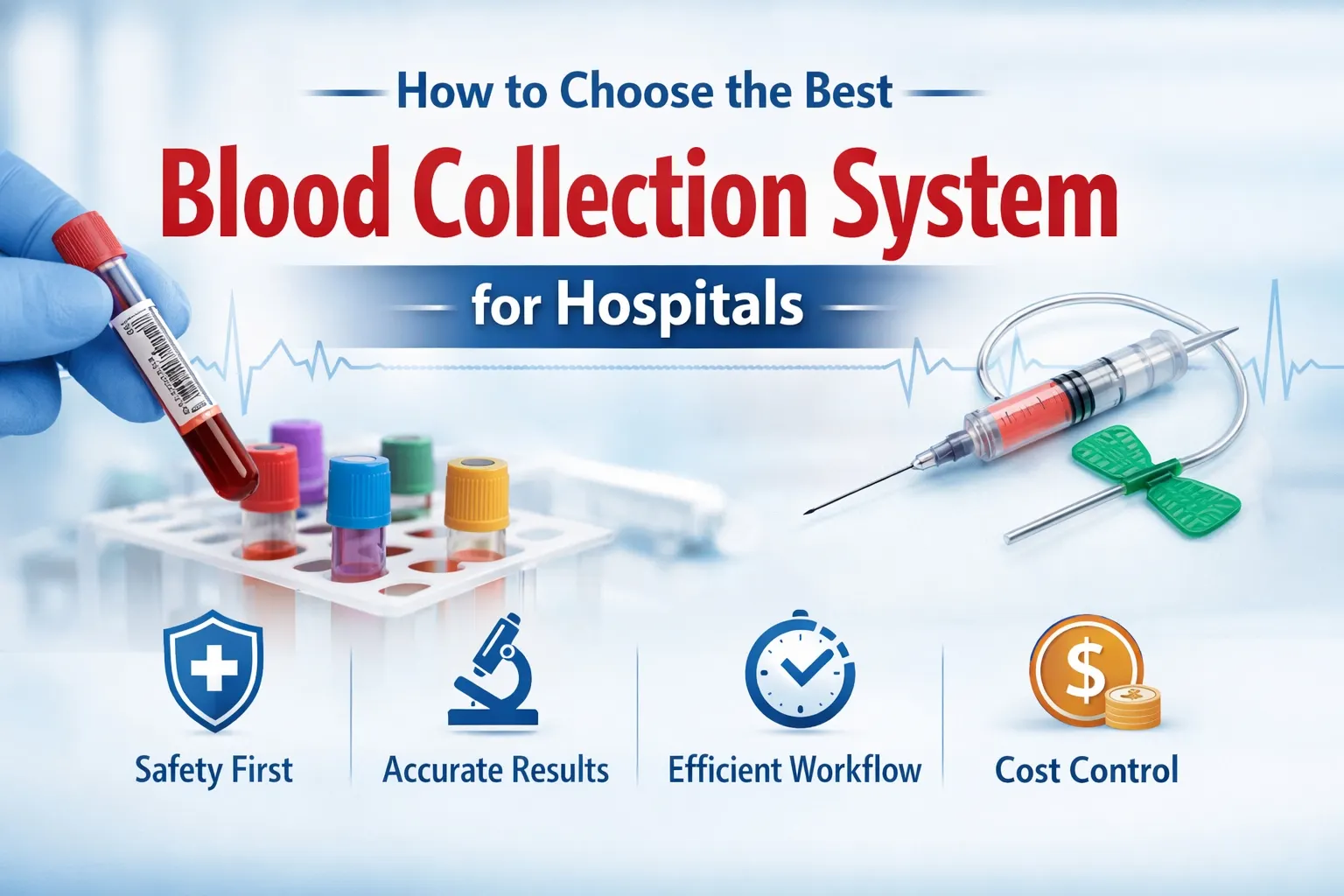
How to choose the best Blood Collection System for hospitals?
The choice of the appropriate blood collection system is one of the most important decisions that hospitals, laboratories, and other healthcare organizations have to make. It directly affects patient safety, sample quality, staff effectiveness, and general accuracy of diagnosis. When there are a number of alternatives (vacuum based systems (Vacutainers), syringe based techniques and winged infusion sets) it is important to know how to select the most appropriate system in the contemporary healthcare operation.
This guide will take you through the most crucial factors, types of systems, and best practices so as to provide hospitals with good decisions.
1. Blood Collection Systems Knowledge.
A blood collection system is a system or equipment that is used to draw, store, and transport blood samples to undergo diagnostic testing. There are two major types namely:
1. Closed Systems (Vacuum-Based)
Vacutainers are closed systems, which require the automatic collection of blood into sealed tubes by pre-evacuation. Through such systems, exposure and contamination risks are reduced.
2. Open Systems (Syringe-Based)
Open systems can make use of manual suction with a needle and syringe, then transferring blood to collection tubes.
👉 In accordance with the best practices in healthcare globally, closed systems are typically the best choice because they are safer and more efficient.
2. The most important factors to consider when selecting a blood collection system.
2.1 Infection Control and Patient Safety.
The primary concern in a hospital setting is safety. The blood collection systems should reduce:
· Needle-stick injuries
· Blood exposure risks
· Cross-contamination
Vacuum systems greatly minimize direct exposure to blood and can contain safety-engineered needles.
2.2.The quality and accuracy of the sample is to be ensured by .
Diagnostic errors are caused by poor-quality blood samples.
· Vacuum systems offer uniform pressure which diminishes the risk of hemolysis.
· Ready-made additives guarantee adequate sample preservation.
· Direct collection eliminates the transfer errors.
Research indicates that the quality of specimens collected using vacuum systems is superior to those collected using syringes.
2.3 Workflow Efficiency
High patient volume hospitals require effective systems.
Vacuum systems allow:
· Several samples of one puncture.
· Faster collection time
· Standardized procedures
This renders them suitable in large hospitals and diagnostics laboratories.
2.4 level of staff Skills and Training.
The various systems demand varying degrees of expertise:
· Syringe systems: Systems that require high operator skill.
· Vacuum systems: More standardized and trainable.
Nevertheless, even a vacuum system needs appropriate training to prevent its abuse.
2.5 Cost and Budget considerations.
Prices are a significant issue, particularly in smaller medical institutions.
· Syringes: Reduced initial price.
· Vacuum systems: More expensive, but more efficient in the long-term.
Syringes are more favorable in smaller clinics and automated systems are more beneficial in large hospitals.
2.6 The product is compatible with laboratory testing, as shown below:
Various tests demand the use of individual tubes and additives (e.g., EDTA, heparin, citrate).
Vacuum tubes are:
· Coded in colors to be easily identified.
· Ready to perform certain tests.
This reduces human error and improves workflow integration.
3. Comparison: Vacutainer vs Syringe Systems.
Function Vacuum System (Vacutainer) Syringe System.
· Safety High (closed system) Lower (open handling)
· Sample Quality Stable, low hemolysis Unstable, technique-sensitive.
· Speed Multi-sample, fast Slower, manual.
· Cost Greater initial cost Less initial cost.
· User Friendliness Standardized Skill-dependent.
· Best Use Hospitals, high volume labs Small clinics, difficult veins
👉 Vacuum systems are increasingly becoming popular in modern hospitals because of their efficiency, safety, and reliability.
4. When to apply various Systems.
4.1 Vacuum Systems (Best for Most Hospitals)
Ideal for:
· Routine diagnostics
· High-volume blood collection
· Standardized hospital workflows
They enable to fill several tubes with one venipuncture, which increases the efficiency and comfort of patients.
4.2 Syringe Systems (Special Cases)
Nevertheless, applicable in certain circumstances:
· Patients who have weak or small veins.
· Pediatric or geriatric care.
· Low-resource settings
Manual control prevents the collapse of the vein in delicate patients.
4.3 Butterfly (Winged Infusion Sets)
Both systems are used with both:
· Difficult venous access
· Pediatric patients
· Precision control
5. Blood Collection Systems Trends.
5.1 Safety-Engineered Devices
Modern systems include:
· Retractable needles
· Needle shields
· Safety features One-hand activation.
These minimize occupational risks.
5.2 Automation and Standardization
Hospitals are shifting towards:
· Complete standardization of collection procedures.
· Connectivity with laboratory automation.
· Barcode-enabled tracking
5.3 Sustainability and Waste Reduction.
Green products and less plastic pollution are emerging as the criteria of choice in procurement.
6. Hospital Best Practices.
To choose the best blood collection system, hospitals should:
✔ Conduct workflow analysis
✔ Evaluate patient demographics
✔ Evaluate the level of staff training.
✔ Take into account long-term cost vs efficiency.
✔ Check that safety regulations are met.
7. Final Recommendation
Vacuum blood collection systems (Vacutainers) are the most suitable option in most of the modern hospitals because:
· Higher safety standards
· Better sample quality
· Improved efficiency
· Reduced contamination risk
Nonetheless, a hybrid system (that incorporates both vacuum systems and syringes and butterfly needles) has the highest degree of flexibility to meet the needs of a wide variety of patients.
Conclusion
The decision on the most appropriate blood collection system is not a universal thing. Hospitals have to strike a balance between safety, efficiency, cost, and patient comfort. Although in current healthcare, vacuum systems are the predominant ones because of their reliability and standardization, syringe systems are still crucial in specific cases.
Through a critical assessment of operational requirements and clinical needs, the hospitals can adopt a blood collection strategy that facilitates correct diagnosis, safer practice and better patient outcomes.