



Updated 5 months ago
What are the advantages of automated Blood Collection Systems?

Admin
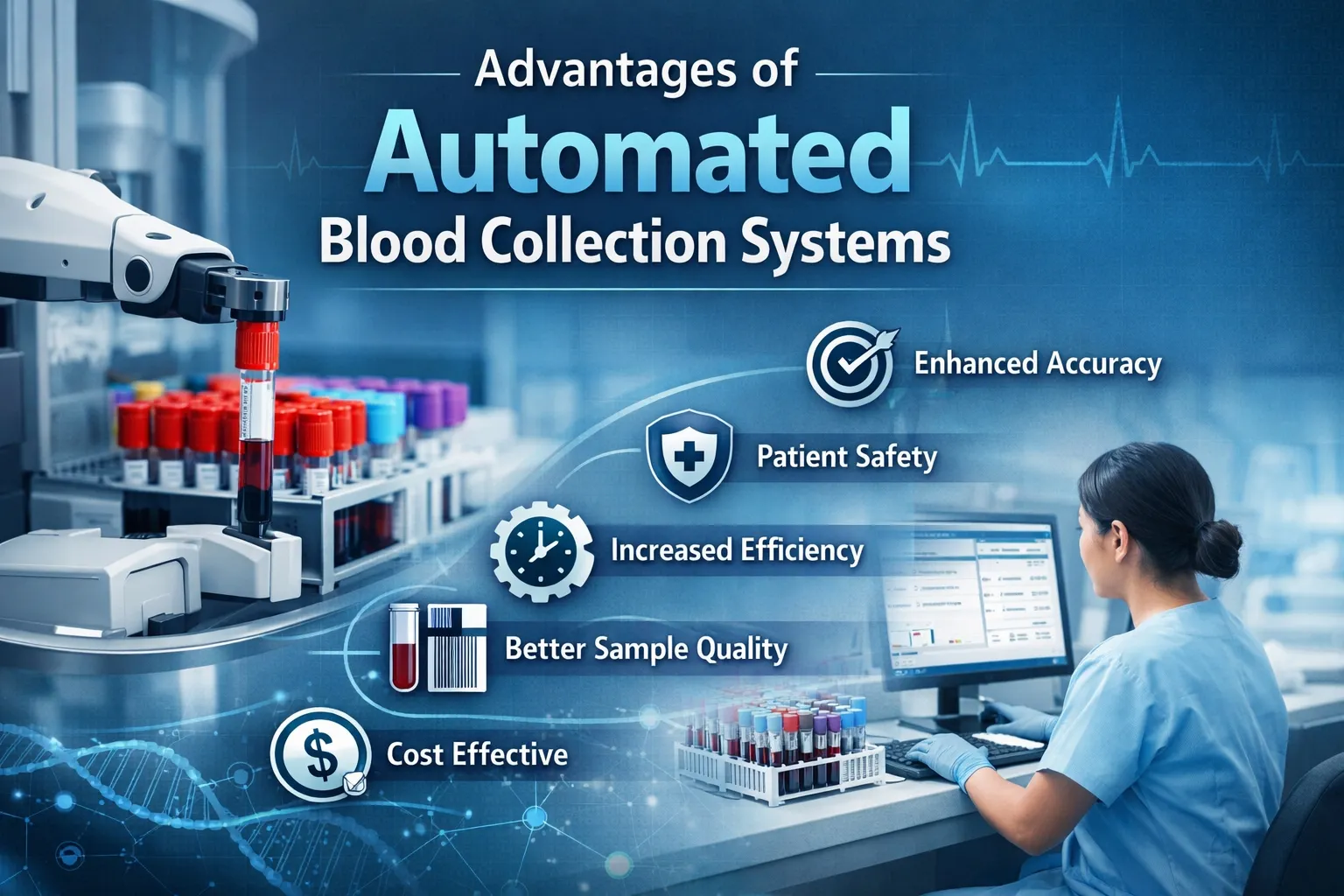
What are the advantages of automated Blood Collection Systems?
Efficiency, accuracy, and patient safety are more essential than ever in the fast-growing healthcare environment nowadays. The Automated Blood Collection System (ABCS) is one of the innovations that are changing the clinical and laboratory workflow. They are meant to simplify the process of collecting, labeling and processing blood samples and minimize the possibility of human error and maximize productivity.
This paper examines the benefits of automated blood collection systems and the reasons why they are becoming very important in a contemporary medical setting.
1. Better Accuracy and Less Human Error.
Automated blood collection systems have one of the most important benefits in that they can reduce human error. Conventional blood collection systems are more manual in nature, including tube labeling, patient data recording, and working with samples. The actions are subject to errors, such as mislabeling or the wrong identification of the patient.
Automated systems are based on barcode scanning, digital verification, and integrated software that provides the accuracy of matching each sample to the patient. This decreases the chances of misdiagnosis and improves the accuracy of test scores.
2. Enhanced Patient Safety
Safety of the patients is one of the first priorities in the healthcare industry and automated blood collection systems are crucial in enhancing it. These systems greatly minimize the possibility of mix-ups of samples, by avoiding a manual handling process and by providing proper identification of the samples.
Moreover, most automated systems are configured to work with closed-loop collection procedures, which would reduce the contact with blood and would decrease the chance of contamination or infection. This is particularly significant in the setting that involves infectious diseases.
3. Improved Productivity and streamlining of work.
Medical institutions are usually characterized by large number of patients and scarce resources. Automated blood collection system facilitates the optimization of the workflow by enhancing the speed of the collection process and minimizing the time used in the administrative work.
For example:
· Automated labeling removes the aspect of writing.
· The use of digital data entry minimizes paperwork.
· Laboratory information systems (LIS) integration will provide a smooth passage of data.
Consequently, medical workers will be able to pay more attention to patients and less to the office work, increasing efficiency in general.
4. Better Sample Quality
The diagnostic results depend on the quality of a blood sample. Automated systems are meant to gather samples whose volume is uniform and has minimum variance.
They also decrease the chances of hemolysis (destruction of red blood cells), which may result because of inappropriate handling. Automated systems enhance the reliability of laboratory tests because of the use of uniform methods of collection.
5. Improved Traceability and Data Management.
In the context of contemporary healthcare, traceability is essential, particularly regarding the ability to comply with the regulatory requirements. Automated blood collection systems offer end to end tracking of the samples, including collection, and analysis.
Key features include:
· Live monitoring of the whereabouts of samples.
· Electronic documentation of time of collection and staff.
· Electronic health records (EHR) integration.
This degree of traceability does not only enhance accountability but it also makes the audit and quality control process easier.
6. Purchase less risk of Needlestick Injuries.
Needlestick injuries are one of the frequent occupational hazards among the healthcare workers. Safety-engineered devices that minimize the chances of accidental exposures to needles are frequently present in automated blood collection systems.
These systems reduce the significance of human interference and apply automated mechanisms that safeguard medical workers and make their work environment safer.
7. Long-run Cost-Effectiveness.
Although the initial cost of the automated blood collection systems can be expensive compared to the traditional systems, they save the company a lot of money in the long run.
Benefits include:
· Less error and related expenses.
· Less frequent repeated tests are required.
· Increased staff productivity
· Less risk of injuries at work.
These are some of the factors that have led to high return on investment (ROI) by healthcare facilities.
8. Improved Patient Experience
Automation does not only provide benefits to healthcare providers but also improves the patient experience. Quick and efficient operations imply a reduced waiting period and less pain to the patient.
There are systems that are patient friendly, and which are built with cutting-edge technologies that make blood collection processes less invasive and easy. This will aid in relieving anxiety particularly to patients who are needle phobic.
9. Standardization between Healthcare Facilities.
The use of automated blood collection systems encourages standardization in that the same procedures are used within the various departments and facilities. This is especially significant to large organizations in the healthcare sector with many branches.
Standardization leads to:
· Consistent sample quality
· Uniform data recording
· Easier staff training
This eventually enhances general healthcare provision and patient outcomes.
10. Digital Healthcare Transformation Support.
Automated blood collection systems are important in helping healthcare to go digital. They can be a useful aspect of smart healthcare ecosystems as they can be integrated with digital platforms, like hospital management systems and lab software.
This integration enables:
· Faster decision-making
· Real-time data access
· Better interdepartmental coordination.
Conclusion
One of the major innovations in the field of healthcare technology is automated blood collection systems. These systems help to overcome most of the problems that are entailed in the traditional blood collection procedures by enhancing accuracy, patient safety and efficiency in workflow.
The use of automated solutions will increase as more healthcare facilities become focused on efficiency and providing quality care. The technology to upgrade blood collection systems to automated blood collection systems is not merely a technological upgrade, but a strategic step towards safer, smarter and more efficient healthcare delivery.