



What is a Blood Collection Needle and how is it used?
Diagnostic testing is important in the modern healthcare environment to detect, monitor, and prevent diseases. Blood collection is one of the most frequently practiced processes in clinics, hospitals and laboratories. The key element of this process is a small but necessary medical device, a blood collection needle. Knowledge about its nature, functioning and its application can make healthcare providers and patients feel more knowledgeable and comfortable about the process.
What Is a Blood Collection Needle?
A blood collection needle is a single use sterile medical device that is uniquely intended to collect blood inside a vein of a patient. It is usually constructed out of stainless steel and designed to be precise and safe and with minimal discomfort.
These needles may be used together with other equipment like:
· Vacuum blood collection tubes.
· Syringes
· Tube holders (or needle holders or adapters)
Blood collection needles come in various sizes, commonly referred to as “gauges.” The gauge number is the diameter of the needle:
· Greater gauge (e.g., 25G): finer needle.
· Less gauge (e.g., 21G): fatter needle.
Gauge is determined by factors like the size of the vein, age of the patient and the kind of test to be performed.
Types of Blood Collection Needles
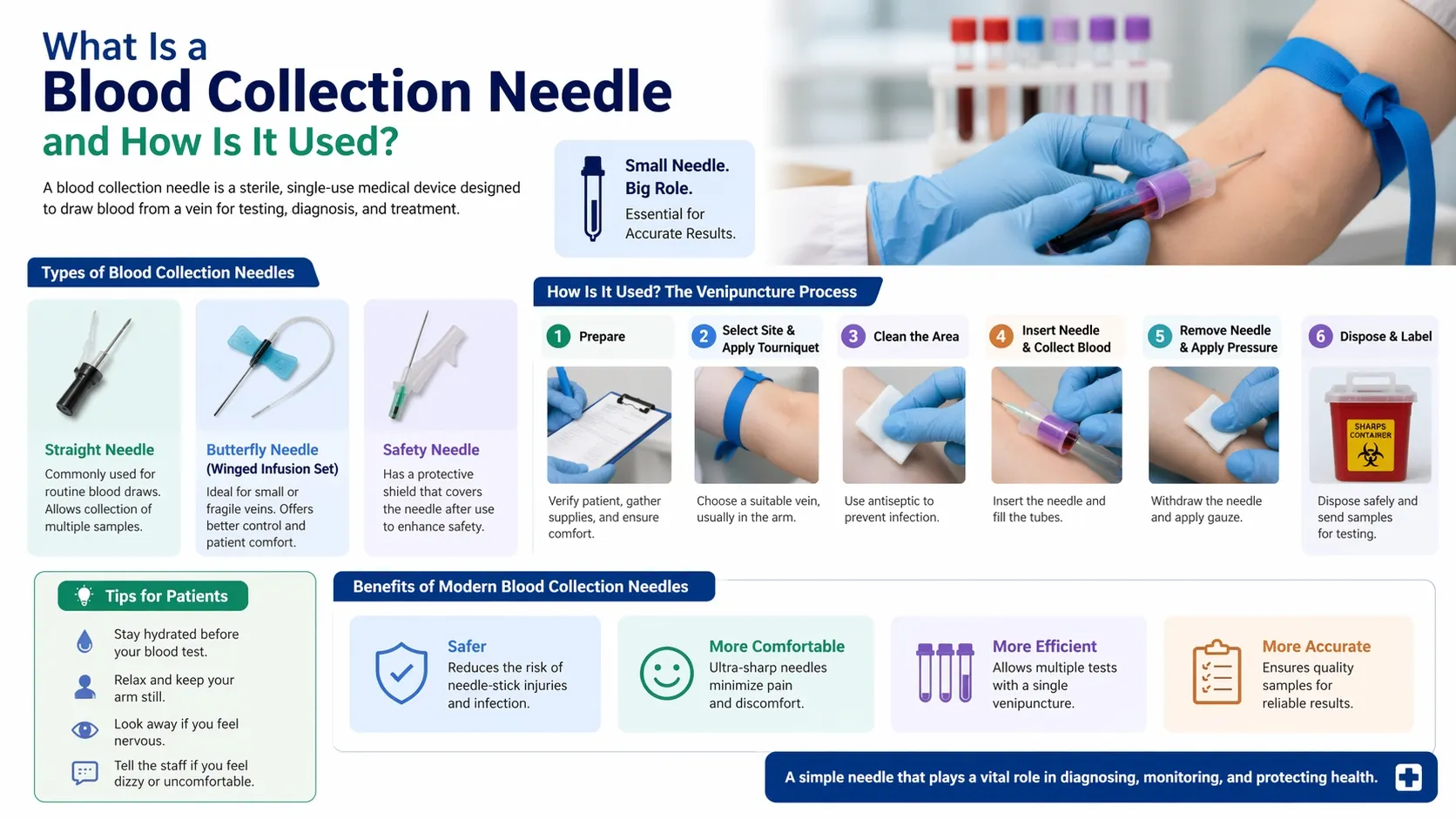
The types of blood collection needles are used in clinical practice and they are designed to be used in particular situations:
1. Straight Needles (Multisample Needles).
These needles are the most popular ones, used to draw blood on a regular basis. They are double-ended:
· On one end of the vein is puncture.
· The other end will be connected to a vacuum tube.
They are best suited to gather numerous samples.
2. Butterfly Needles (Winged Infusion Set)
The butterfly needles are easier to handle and control as they have wings on both sides that are flexible. They are commonly utilized to:
· Patients who have small or weak veins (e.g., children, elderly)
· Difficult venipuncture situations
3. Safety Needles
The safety needles have protective features which envelop the needle after use, avoiding the chances of accidental needle-stick injury. They are common in contemporary health care facilities to enhance the standards of safety.
What is the use of a Blood Collection Needle?
Venipuncture is the procedure of using a blood collection needle. It is usually carried out by skilled individuals like phlebotomists, nurses or doctors. A step-by-step description is given below:
Step 1: Preparation
· The identity of the patient is checked by the healthcare provider.
· The equipment required (needle, tubes, gloves, antiseptic wipes) is set up.
· The patient is seated or lying in a comfortable position.
Step 2: Site Selection
· An appropriate vein is located, typically in the arm (typically the median cubital vein).
· A tourniquet is used to cause the vein to be more visible and reachable.
Step 3: Area Cleaning.
· To avoid infection, the site of puncture is cleansed with an antiseptic solution.
Step 4: Needle Insertion
· The needle is placed at a low angle (15-30 degrees) into the vein.
· The blood starts being pumped into the collection tube / syringe.
Step 5: Blood Collection
· Depending on the necessary tests, one or more tubes are filled.
· The tourniquet is discharged after the blood circulation is restored.
Step 6: Needle Removal
· The needle is carefully withdrawn.
· Gauze is used to apply pressure to the puncture site to prevent bleeding.
Step 7: Disposal and Labeling.
· The needle is then disposed instantly in sharps container.
· Samples are collected and labeled and submitted to analysis.
Safety Considerations
The needles used to collect blood are made with high safety measures to ensure safety of the patients and the involved health care workers. Some of the key safety practices are:
· Single-use only: Needles should not be reused in order to avoid infection.
· Proper disposal: Approved sharps containers should be used to dispose the used needles.
· Utilization of protective measures: There are numerous retractable or shielded designs of many needles.
· Personal protective equipment (PPE): Gloves and other protection equipment are necessary.
Modern Blood Collection Needles advantages.
Medical technology has made a lot of breakthrough in the design and functionality of blood collection needles. Key benefits include:
1. Less Pain and Suffering.
Contemporary needles are extremely sharp and programmed to be easily inserted and cause less pain.
2. Improved Safety
Engineered devices minimize the cross-contamination and risk of needle-stick injuries.
3. Enhanced Efficiency
Multisample needles enable carrying out several tests at a time using a single puncture.
4. Greater Accuracy
Good blood flow and design assists in maintaining high quality samples to yield good test results.
Typical Blood Collection Needle Uses.
Blood collection needles are applicable in a very broad spectrum of medical situations, such as:
· Routine health check-ups
· Diagnostic tests (e.g. glucose, cholesterol, blood count)
· Monitoring of diseases (e.g., diabetes, anemia)
· Blood donation
· Clinical trials and research.
Tips for Patients
In case you are having a blood test, these are some of the tips that can help you in making the process a lot easier:
· Pre-test hydration will help.
· Relax your arm during the procedure
· Avoid looking at the needle if you feel anxious
· Communicate to the medical professional in case you become dizzy or uncomfortable.
Conclusion
A blood collection needle is one of the basic instruments in the modern medicine that allows a precise diagnosis and proper treatment of the patient. Although it might appear to be a mere thing, its design and appropriate use play a significant role in providing safety, effectiveness and reliability in blood tests processes.
Learning about the functioning of blood collection needles and their utilization, patients will feel more comfortable, and healthcare professionals will be able to provide quality care. With technology still in the process of developing all these will be safer, more efficient and comfortable by all the involved.