



biology lab equipment
One of the most interesting learning environments in a high school is the biology laboratory. They enable students to learn about the living organisms, to see shapes at a microscopic level, to do experiments and to learn about science in a practical way. A biology laboratory with the proper equipment aids students in developing analytical skills, enhancing their abilities to make scientific observations, and applying their knowledge in practical terms to reinforce the classroom learning.
Biology laboratory equipment is an indispensable part of science teaching in modern times, ranging from microscopes to petri dishes. Regardless of the study of cells, tissues, microorganisms or plant anatomy, the right tools make experiments accurate, safe and efficient.
In this guide, we take a look at the most crucial biology lab apparatus in high school labs, their functions and applications.
Why Biology Lab Equipment Matters
Practical laboratory sessions in biology education are key due to their ability to promote students' learning to apply theory to everyday life. Good lab equipment enhances the accuracy of experiments, safety of students and the learning atmosphere.
In the modern schools, too, there is emphasis on STEM based learning and laboratory is playing an increasingly significant role. A well-designed biology lab will help students to:
- Understand scientific methods
- Develop observation and measurement skills
- Learn laboratory safety procedures
- Improve critical thinking and problem-solving
- Gain confidence in scientific experiments
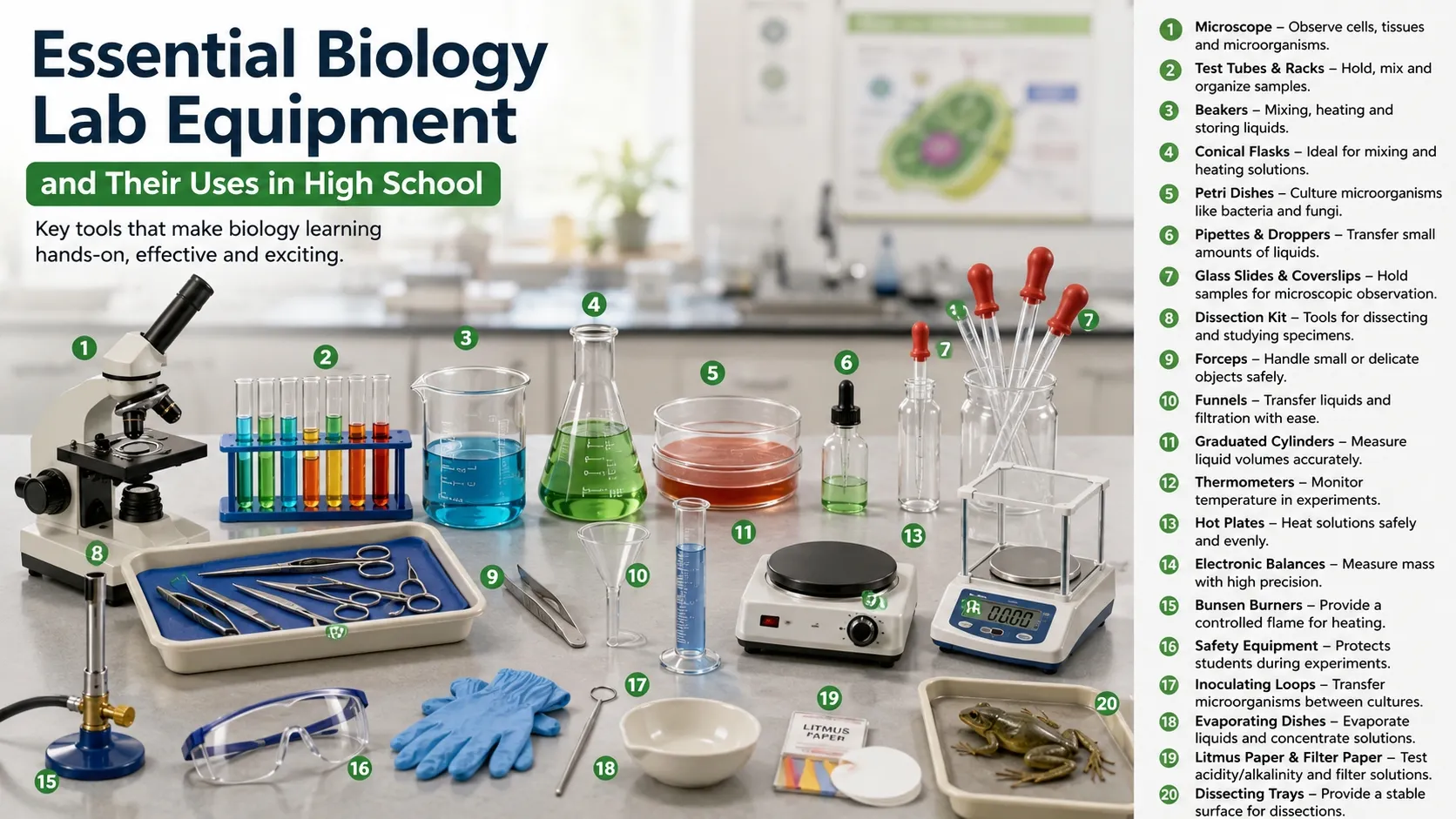
1. Microscope
The microscope is a vital tool used in a biology lab. It lets students see cells, bacteria, tissues and microbes that they can't see without a microscope.
Compound light microscopes are used in most high schools because they are very easy to use and can be used for educational purposes. Plant cells, blood, onion epidermis, and microorganisms are some of the common objects studied using microscopes in school.
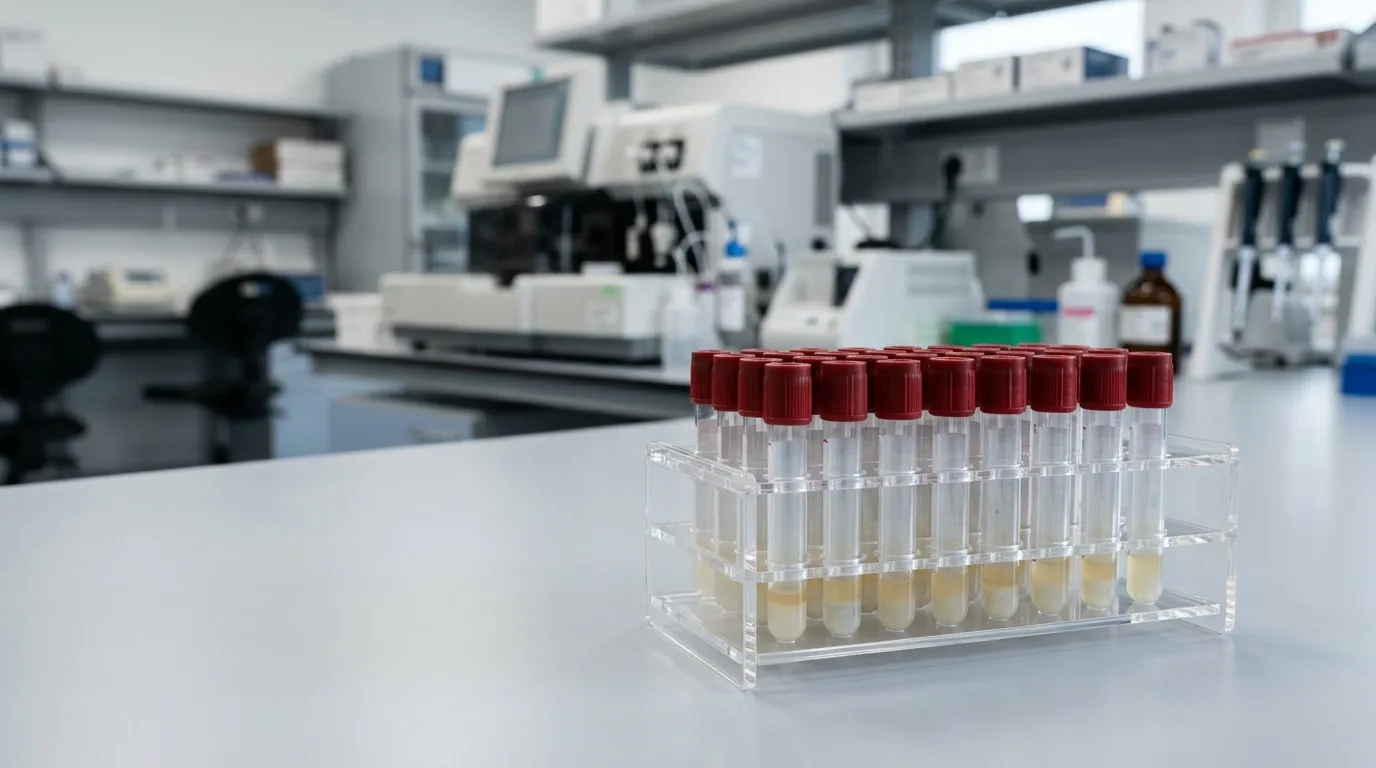
2. Test Tubes and Test Tube Racks
Small, cylindrical glass or plastic containers that are used in experiments to hold, mix, or heat liquid samples. They have applications in biological and chemical testing.
Test tube racks are used for arranging and holding several test tubes during the laboratory experiment. These racks provide a safer working environment for the lab and help to prevent breakage or spills.
3. Beakers
Beakers are vital lab apparatus that is employed for mixing, heating and storing liquids. They come in various sizes and are typically constructed from heat-resistant “borosilicate” glass.
Beakers are commonly used by students in biology for simple experiments with liquids, to collect samples and to prepare solutions.
4. Conical Flasks
Conical flasks (Erlenmeyer flasks) have a narrow neck and a wide base. They can be used to stir liquids together without spilling.
These flasks are often employed in the preparation of solutions, heating experiments and applications in microbiology. A narrow opening also helps to minimize contamination.
5. Petri Dishes
Petri dish is a shallow glass or plastic container that is used to culture microorganisms like bacteria and fungi. They are widely used in microbiology experiments in high school biology labs.
Students will be able to see the process of microbial growth in a petri dish and understand the process of sterilization, contamination and biological cultures.
6. Pipettes and Droppers
Small quantities of liquids are precisely transferred using pipettes and droppers. They are necessary in experiments that need exact measurements of the reagents or biological samples.
Droppers are often used in school laboratories since they are easy to use, cheap and accurate enough for the school laboratory, whereas pipettes are more accurate for advanced practical work.
7. Glass Slides and Coverslips
A microscope slide is a thin piece of rectangular glass on which specimens are placed for microscopic examination. A thin transparent sheet put over the sample for protecting and better visibility.
Students use slides and coverslips to make observations using a microscope of cells, tissues, microorganisms, and biological samples.
8. Dissection Kits
Dissection kits include scalpels, scissors, probes, forceps, pins and more. During the practical sessions of anatomy and dissection these are used.
Dissection activities are useful for students to understand the internal structure of living things, as well as to enhance hands-on learning in biology education.
9. Forceps
The forceps are small, hand-held instruments that are used to handle small or fragile items in experiments. They are particularly helpful in dealing with specimens, tissues or glass slides.
Use of forceps enhances precision and will help minimize student exposure to chemicals or biological material.
10. Funnels
A funnel is a bowl with a narrow neck that is used to pour a liquid or powder into a narrow container without spilling. They are also used in filtration experiments in combination with filter paper.
Solutions are often prepared in biology labs using funnels.Funnels are used extensively in biology labs to prepare solutions as well as to separate samples.
11. Graduated Cylinders
Graduated cylinders are used to measure volume of liquid in an accurate manner. They are more precise than beakers.
In experiments that involve exact amounts of liquid, and precise measurements, students will utilize graduated cylinders.
12. Thermometers
In biological and chemical experiments, thermometers are used to measure temperature. Certain biological reactions need to be conducted at a certain temperature to give a correct result.
A typical modern laboratory thermometer used in school laboratories is a digital thermometer as well as the traditional laboratory thermometer.
13. Hot Plates
Hot plates are used to heat a controlled surface for the use in laboratory experiments. They are not as dangerous as open flames and are frequently employed to heat solutions or glassware.
Some models have magnetic stirrers to ensure uniform heating of liquid components.
14. Electronic Balances
Electronic balances are used for precise measurement of mass of chemicals, biological samples and other materials.
Electronic balances are one of the most important pieces of equipment in any science lab, as it is essential to make accurate measurements in laboratory experiments.
15. Bunsen Burners
A bunsen burner is a source of controlled flame to heat, sterilize and in some biology experiments. They are widely used in microbiology and chemistry practicals.
Open flames are used in the laboratory at a time when supervision and safety are of importance.
16. Safety Equipment
Biological laboratory safety equipment is a must for all biology labs. Common items of safety include:
- Safety goggles
- Lab coats
- Latex or nitrile gloves
- First aid kits
These safety devices minimize hazardous contact, contamination and accidental injury from chemicals during experiments.
17. Inoculating Loops
Inoculating loops are small instruments for transferring microorganisms from culture media to other culture media. They are widely used in microbiology practicals that involves bacterial culture.
Students are taught sterile handling procedures and microbial transfer techniques with these.
18. Evaporating Dishes
Evaporation dishes are containers that can withstand heat and are used to evaporate liquids and to concentrate solutions.
These dishes often have to be used for experiments separating dissolved solids from liquids.
19. Litmus Paper and Filter Paper
Litmus paper is used to determine if a solution is acidic or alkaline by changing color. In filtration, the separation of solids from liquids is done by the use of filter paper.
The materials are simple but are important in various laboratory experiments in biology and chemistry.
20. Dissecting Trays
Dissecting trays have a firm platform for the examination and dissection of specimens. They are there to assist in maintaining sample security during practicals in anatomy.
The trays are often employed as dissection trays in biology classes in high schools involving dissecting frogs, fish, insects, and plants.
Tips for Maintaining a Safe Biology Laboratory
Safety procedures are always to be followed in a biology lab to ensure safety of students and teachers. Schools should ensure:
- Equipment is cleaned after every experiment
- Chemicals are stored correctly
- Students wear protective gear
- Broken glassware is disposed of safely
- Laboratory instructions are clearly followed
In addition to that, having organized laboratory equipment also helps in making the laboratory more efficient and helps to prolong the life of scientific instruments.
Final Thoughts
Biology laboratory equipment is the basis of practical teaching in biology in high school. Every item from the microscope to the petri dish, test tube to safety gear, brings us closer to the knowledge of biological science.
The purchase of good laboratory equipments enables school to provide interesting learning space and promote students' scientific curiosity. Modern biology laboratories will continue to play a vital role in hands-on learning and future scientific advancements as STEM education continues to expand globally.