



chem lab equipment
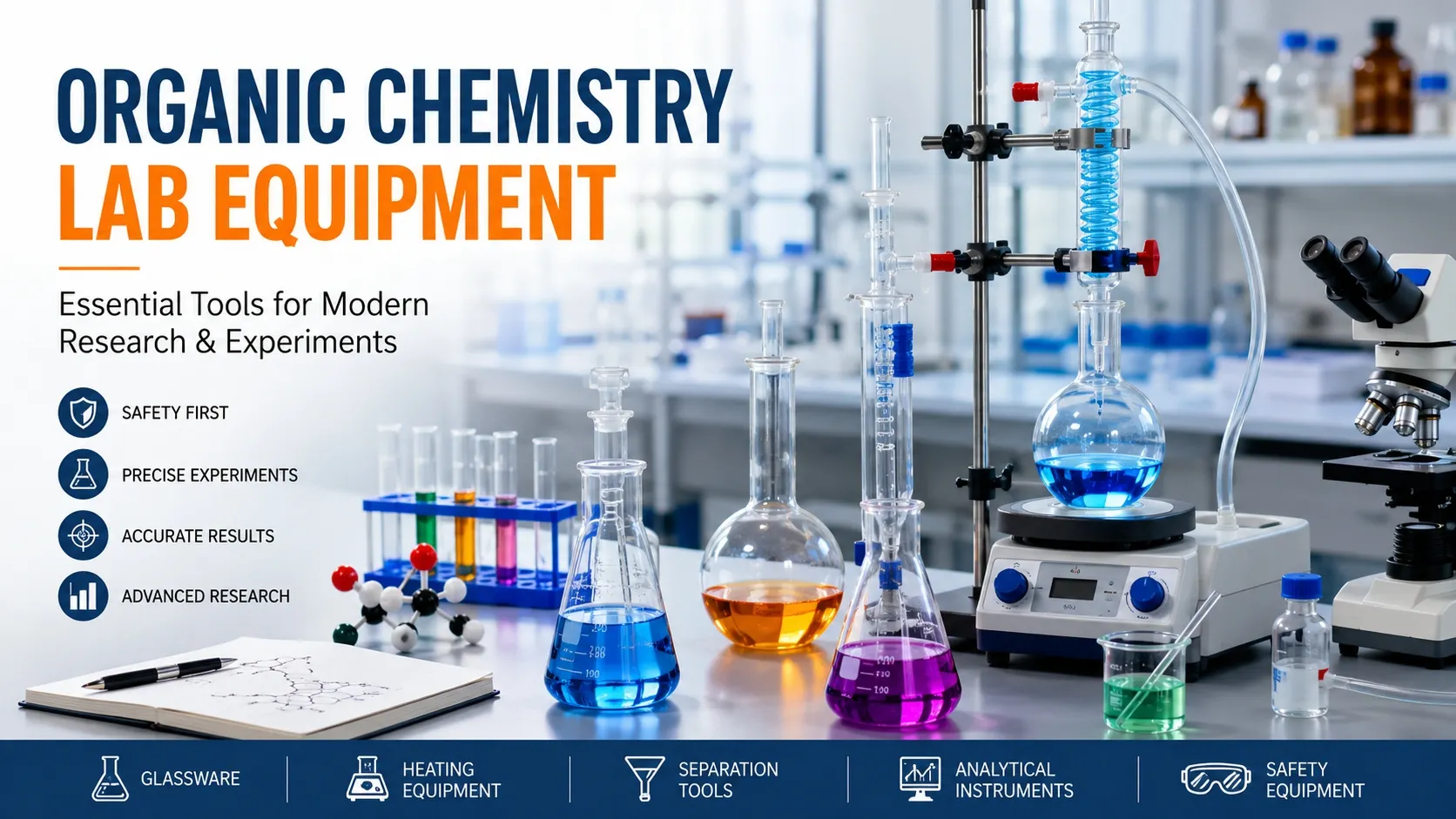
Laboratories are the engine of organic chemistry innovation in the fields of pharmaceuticals, materials science, biotechnology and industrial research. These labs are found in academic institutions and advanced industrial research labs and rely on accurate, dependable and specialized equipment to perform experiments safely and effectively.
This article will discuss the types of organic chemistry lab equipment, their roles, and the importance of each piece of equipment in a successful chemical study.
What Is an Organic Chemistry Laboratory?
In chemistry, an organic chemistry lab is a controlled setting where carbon compounds and the reactions with them are studied. These laboratories are used for the synthesis of new molecules, the analysis of reaction mechanisms and the development of products like drugs, plastics, fuels and cosmetics, etc.
In most cases, organic reactions involve volatile substances, heat sensitive compounds and complex procedures, therefore both safety systems and precision instruments must be available in the laboratory.
Safety Equipment: The First Priority in Any Organic Chemistry Lab
The safety is the basis of all laboratories. Safety systems are necessary in experiments in organic chemistry as they often produce dangerous fumes, flammable solvents and reactive chemicals.
1. Fume Hoods
The fume hood is perhaps one of the most important safety installations in any organic chemistry lab. It safeguards the users from the harmful vapors, toxic gases and airborne chemicals produced during experiments.
Within a fume hood, the air flow is controlled so as to prevent exposure—it is essential for reactions involving solvents such as benzene, or reagents that produce fumes.
2. Personal Protective Equipment (PPE)
Standard PPE includes:
- Lab coats
- Chemical-resistant gloves
- Safety goggles
- Face shields (for high-risk reactions)
These items create a protective barrier between the chemist and hazardous substances.
Core Glassware in Organic Chemistry Labs
The experiments are based on glassware. The chemical resistance and the heat resistance of borosilicate glass make it the most common material used in most organic reactions.
1. Beakers and Erlenmeyer Flasks
Beakers can be used for mixing, heating and for approximate measurements, Erlenmeyer flasks are better for swirling reactions without spilling.
They are used in almost all experiments, as they are widely available.
2. Round-Bottom Flasks
Round-bottom flasks are designed for even heat distribution, making them ideal for:
- Reflux reactions
- Distillation processes
- Controlled heating
Their shape reduces stress points, allowing safer high-temperature reactions.
3. Graduated Cylinders
Unlike a beaker, graduated cylinders allow for more precise measurement of liquids and can be used to prepare solutions and reagents.
4. Condensers
In distillation and reflux setup, the vapor is condensed back to the liquid form. These are commonly: Liebig, Allihn or Graham Condensers.
Reaction Setup Equipment
Controlled reaction environment is a key aspect of organic chemistry. There are several tools needed to put together stable and functional reaction systems.
1. Stands, Clamps, and Rings
Glassware are held by ring stands and clamps during experiments. They inhibit movement, allowing reaction setups to be stable when heated or stirred.
2. Keck Clips
They are small but significant connectors that hold ground glass joints together, so they will not fall apart when pressurized or heated during reactions.
3. Thermometer Adapters
These enable chemists to maintain the temperature of the reaction inside without opening the system seal, allowing accurate thermal control.
Heating and Temperature Control Equipment
The speed of reactions and the nature of the products in organic chemistry reactions are sensitive to temperature.
1. Heating Mantles
Heating mantles give uniform heat to round bottom flasks, without direct flame contact. This decreases the chance of breaking glassware, and enhances safety.
2. Hot Plates with Magnetic Stirrers
Such devices have a heating and mixing capability. Magnetic stir bar inside flask provides continuous stirring, enhancing reaction consistency.
3. Bunsen Burners
Bunsen burners are not as widely used in the more advanced laboratories, but are still used for simple heating and sterilization applications.
Separation and Purification Equipment
Once products have been formed, compounds must be separated and purified to enable the analysis or use of the products.
1. Separatory Funnels
Separatory funnels are used to separate immiscible liquids (such as oil and water layers). These are critical to liquid-liquid extraction processes.
2. Filtration Systems
Common filtration equipment includes:
- Buchner funnels
- Vacuum filtration setups
- Filter paper systems
These tools help isolate solid products from liquid mixtures.
3. Fractionating Columns
Distillation columns are used in distillation, and fractionating columns are used to improve the efficiency of separation by increasing the surface area for vapor condensation and re-evaporation cycles.
Measurement and Analytical Instruments
Precision is critical in organic chemistry. Even small measurement errors can significantly affect results.
1. Analytical Balances
These high-precision scales measure mass down to milligrams or even micrograms, ensuring accurate reagent preparation.
2. Thermometers and Digital Probes
Temperature monitoring tools help control reaction conditions and ensure reproducibility.
3. pH Meters
pH meters measure acidity or alkalinity, which is essential for reaction control and product stability.
Advanced Organic Chemistry Instruments
Modern laboratories rely on sophisticated analytical tools to identify and characterize compounds.
1. Gas Chromatography (GC)
GC separates volatile compounds and is widely used to analyze reaction purity and composition.
2. High-Performance Liquid Chromatography (HPLC)
HPLC is used for separating, identifying, and quantifying compounds in liquid mixtures with high precision.
3. Infrared Spectroscopy (IR)
IR spectroscopy identifies functional groups in molecules by analyzing infrared light absorption patterns.
4. Nuclear Magnetic Resonance (NMR)
NMR is one of the most powerful tools in organic chemistry, used to determine molecular structure and bonding.
Storage and Laboratory Organization Equipment
Proper storage improves efficiency and safety in laboratory environments.
1. Chemical Storage Cabinets
These cabinets safely store volatile and corrosive chemicals, reducing accident risk.
2. Desiccators
Desiccators protect moisture-sensitive compounds by maintaining a dry environment using drying agents.
3. Lab Refrigerators
Used for storing temperature-sensitive reagents and biological samples.
Supporting Tools and Accessories
Smaller tools also play a vital role in daily laboratory operations:
- Pipettes and droppers for liquid transfer
- Spatulas for solid handling
- Stirring rods for manual mixing
- Test tubes for small-scale reactions
- Volumetric flasks for solution preparation
- Lab notebooks for documentation
The Importance of Proper Lab Equipment Design
A well-designed organic chemistry lab improves:
- Safety compliance
- Experimental accuracy
- Workflow efficiency
- Research productivity
Ergonomic benches, chemical-resistant surfaces and modular storage solutions are becoming the norm for modern laboratories, enabling them to streamline their workflows and meet the demands of advancing science.
Final Thoughts
Organic chemistry lab equipment is the basis of scientific discovery in chemistry. Whether it's a simple glassware piece or a sophisticated spectroscopic apparatus, each serves a unique and crucial function to ensure safe, accurate and efficient experimentation.
No matter whether it's a new lab or an upgrade to an existing lab, it is important to invest in quality, purpose designed equipment for long-term success in research and innovation.