



20 Common School Science Laboratory Equipment
Science learning is truly effective if students are able to do practical activities that are not only in the book. The well-equipped school laboratory enables students to investigate biological, chemical, and physical aspects in real time. For this to be possible, there are many laboratory tools that are used for observation, measurement, heating, mixing and analysis.
In this guide, we will discuss the 20 most commonly used laboratory apparatus and their applications in a science lab, with the aim to equip the students, teachers and institution with knowledge about the importance of these apparatuses in the modern era of science education.
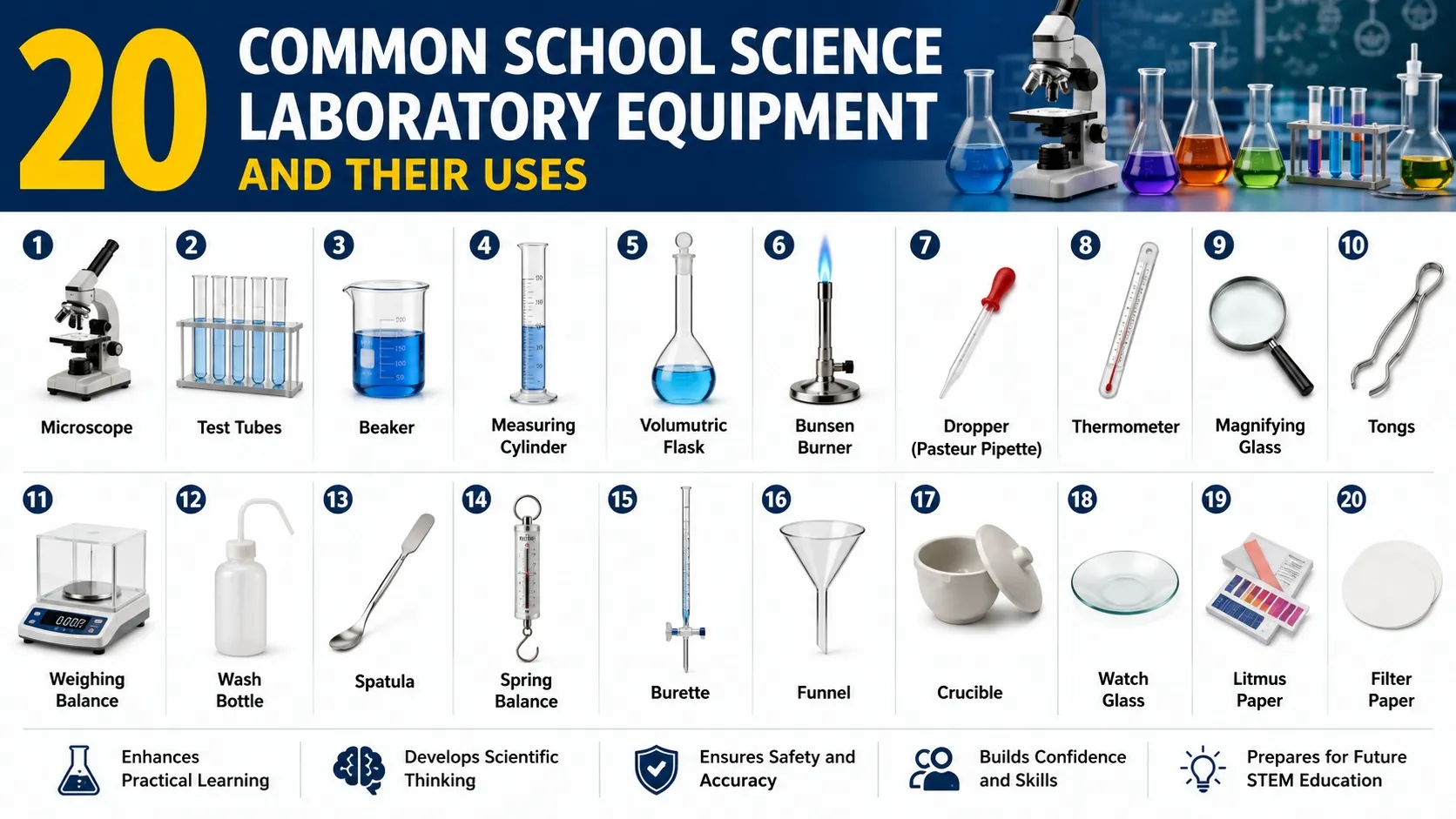
1. Microscope
One of the most important tools in the biology lab is a microscope. It lets you observe objects that are invisible to the naked eye, like cells, bacteria and microorganisms. Microscopes are used to magnify samples and give students a detailed understanding of the structure of living organisms.
2. Test Tubes
Test tubes are small cylindrical glass vessels used to hold, mix and heat a small amount of chemicals. These are commonly used in small-scale controlled reactions in experiments.
3. Beakers
Beakers are plain glass bottles with a flat bottom and spout. They are used to stir, mix and heat liquids. Not very accurate to use for most measurements, but perfect for most lab applications.
4. Measuring Cylinders
Volumes of liquids are accurately measured using measuring cylinders. These are “graduated” with exact divisions, and are more precise than beakers in measuring liquids.
5. Volumetric Flasks
Volumetric flasks are used to make solutions of known concentration. They have a small neck so that they can be used for accurate liquid measurement, which is important in chemistry experiments.
6. Bunsen Burner
A flame used to heat substances in an experiment, but controlled, is called a Bunsen burner. Commonly uses gas for power and is necessary for sterilization and combustion reactions.
7. Dropper (Pasteur Pipette)
Liquid is transferred small quantities at a time with the help of dropper known as droppers. They are particularly convenient for situations where exact volumes of liquids are needed in chemical reactions.
8. Thermometer
A thermometer is used for measuring the temperature in experiments. Thermometers are a necessary instrument in the laboratory for many scientific reactions that need particular temperatures.
9. Magnifying Glass
The magnifying glass is used to make small things appear larger than they actually are. It can also be used in early lessons of biology, to study insects, plants and surface features.
10. Tongs
Tongs are used to safely pick up or move hot or hazardous materials. They keep consumers safe from burns and chemical exposure from heated objects.
11. Weighing Balance
The mass of substances is measured with very high precision by a weighing balance. For chemical accuracy, very small amounts must be measured, which can be accomplished by analysing balances.
12. Wash Bottle
Wash bottles are filled with distilled water or cleaning solutions and are used to wash glassware. They are used to keep experiments clean and free of contamination.
13. Spatula
Solid chemicals are transferred by means of a laboratory spatula. It is constructed with corrosion and heat resistant materials to guarantee safe handling of materials.
14. Spring Balance
Hooke's Law is used in a spring balance to measure force/weight. Its use is a common method in physics experiments to illustrate force and elasticity.
15. Burette
A burette is a long glass tube graduated at intervals with a valve at the bottom. The major use of it is in titration experiments to measure accurate volumes of liquids.
16. Funnel
Funnels are used to pour liquids or powder into a container that has a small opening. They are also used with filter paper to separate solids from liquids.
17. Crucible
A crucible is a high-temperature resistant container that is used to heat materials at high temperature. It is generally made from porcelain or ceramic substance.
18. Watch Glass
A short, round glass plate that can be used to hold small amounts of liquid to evaporate or to hold a sample during an experiment.
19. Litmus Paper
Litmus paper is used to check if a substance is acidic or alkaline. It varies in colour depending on the pH of a solution.
20. Filter Paper
In filtration process filter paper is used to separate the solids from the liquid. The essential tool used in chemical and biological experiments.
Importance of Laboratory Equipment in Schools
There is no doubt that proper laboratory equipment is vital in developing scientific knowledge. The following instruments will enable students to:
- Conduct safe and controlled experiments
- Improve observation and analytical skills
- Understand scientific theories practically
- Develop problem-solving abilities
- Prepare for advanced STEM education
Without proper laboratory equipment, science education remains theoretical and less effective.
How School Laboratories Improve Learning
Modern school laboratories are designed to encourage curiosity and innovation. When students interact directly with scientific instruments, they gain:
- Better retention of concepts
- Increased engagement in STEM subjects
- Practical understanding of abstract theories
- Teamwork and collaboration skills
Hands-on experiments also help students connect classroom learning with real-world applications.
Conclusion
The practical education is based on the school's science laboratories. Every piece of equipment is essential in educating the student on the scientific principle. Schools can make learning more interactive and effective by educating students on these 20 frequently used laboratory tools and the ways they are used.
Investing in equipment is not solely an investment in infrastructure; it's an investment in the future of scientists, engineers, and innovators.