



science lab equipment list
The essential things that are crucial to modern-day lab are precision, safety, and efficiency, which are crucial to achieving accurate scientific outcomes. From a school science lab, a research lab, a medical lab or a science testing lab, it is important that you get the right science equipment to ensure that you have smooth operations during the working day. Whether you are working in a basic science lab or a more sophisticated lab, there are many pieces of laboratory equipment that support scientific endeavors and experiments.
A well-equipped lab can streamline the workflow process and make it easier for researchers, students, and technicians to conduct experiments and research safely and precisely. In nearly every laboratory setting, there are some basic equipment items that are considered essential: microscopes, beakers, pipettes, balances, and safety equipment.
Why Laboratory Equipment Matters
Scientific equipment enables scientists to measure, observe, analyse and control experiments with accuracy. Lab equipment allows for the collection of high quality data, the reduction of error, and repeatable science results. Every chemistry, biology, physics, medicine and environmental science lab needs specialized equipment to operate effectively.
The advantages of a good laboratory equipment are:
- Improved experimental accuracy
- Enhanced laboratory safety
- Faster and more efficient workflows
- Better reproducibility of results
- Reduced contamination risks
- Long-term cost savings through durability
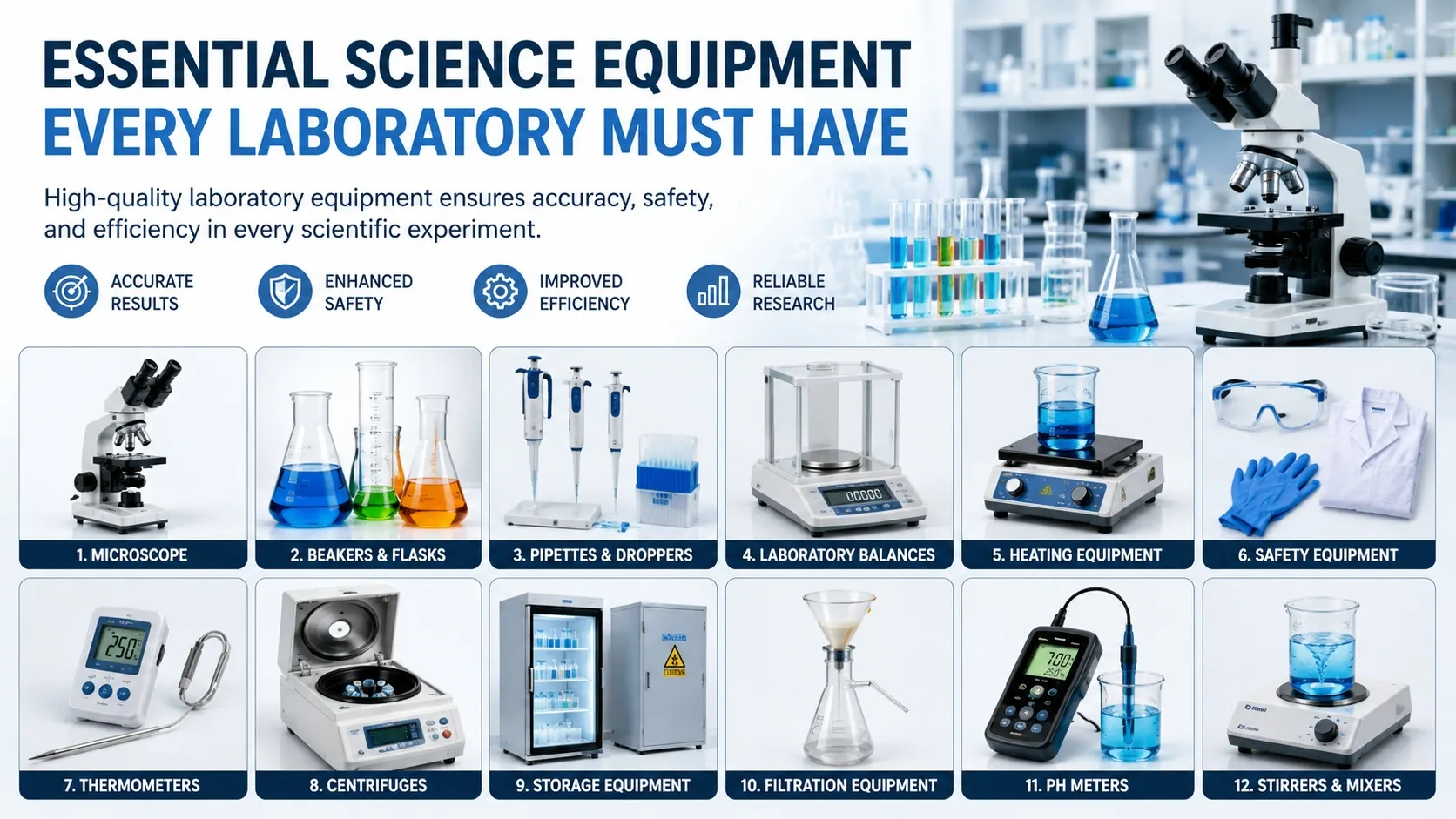
1. Microscopes
The microscope is one of the most valuable laboratory instruments. They enable researchers to see very small objects that are too small to be seen by the naked eye such as cells, bacteria, tissues, and microorganisms.
There are many types of microscopes, some of which are used for specific purposes:
- Light microscopes for biological observation
- Stereo microscopes for dissections and surface analysis
- Electron microscopes for ultra-high magnification research
The microscope is a very common instrument in microbiology, pathology, education and medical diagnosis. It is important to select a microscope with the suitable magnification and resolution for observing the object.
2. Beakers and Flasks
Beakers and flasks are simple laboratory glassware for mixing, heating, storing and transferring liquids. The heat resistance and durability of borosilicate glass are often the preferred traits for use.
In the lab, the following glassware is generally used:
- Beakers
- Erlenmeyer flasks
- Volumetric flasks
- Test tubes
- Graduated cylinders
These tools are essential in chemistry experiments, solution preparation, and chemical reactions.
3. Pipettes and Droppers
Pipettes are used for accurate measurement and transfer of liquid. In biological studies, pharmaceutical testing, and chemical analysis, precision pipetting plays a crucial role.
There are several types of pipettes, such as:
- Micropipettes
- Volumetric pipettes
- Graduated pipettes
- Transfer pipettes
High-quality pipettes help minimize contamination and improve experimental consistency. Another key usage of disposable pipette tips is to ensure sterile environments for laboratories.
4. Laboratory Balances
Mass is measured accurately using laboratory balances. Balances are essential instruments in scientific experiments that demand very accurate measurements.
Common types of balances are:
- Analytical balances
- Precision balances
- Electronic balances
Analytical balances offer high precision for weighing small quantities of samples and electronic balances are used routinely in the laboratory for weighing.
5. Heating Equipment
There are many experiments that demand controlled heating. Laboratory heating equipment can maintain uniform temperature for chemical reactions and sample preparation.
Some popular heating tools include:
- Bunsen burners
- Hot plates
- Heating mantles
- Water baths
Hot plates are becoming popular due to their lack of open flames and the increased safety in the laboratory. The temperature-controlled heating systems are used to control the experimental conditions.
6. Safety Equipment
Always, safety comes first in all laboratory settings. The use of the proper protective equipment significantly minimizes risk of accidents, chemical exposure and contamination.
The following laboratory equipment is important for all labs:
- Lab coats
- Safety goggles
- Gloves
- Face shields
- Fire extinguishers
- Eye wash stations
- Fume hoods
Nitrile gloves are the most commonly used gloves because they are more resistant to chemicals than standard latex gloves. When working with hazardous chemicals, it becomes especially critical to use the appropriate ventilation system or fume hood.
7. Thermometers and Temperature Monitoring Devices
The issue of temperature control is very important in scientific experiments. Thermometers and digital temperatures sensors are used in labs to track reactions, storage place, and incubation.
Common options include:
- Glass thermometers
- Digital thermometers
- Infrared thermometers
- Temperature probes
Digital monitoring systems offer more accurate readings and faster reading than the old glass thermometer.
8. Centrifuges
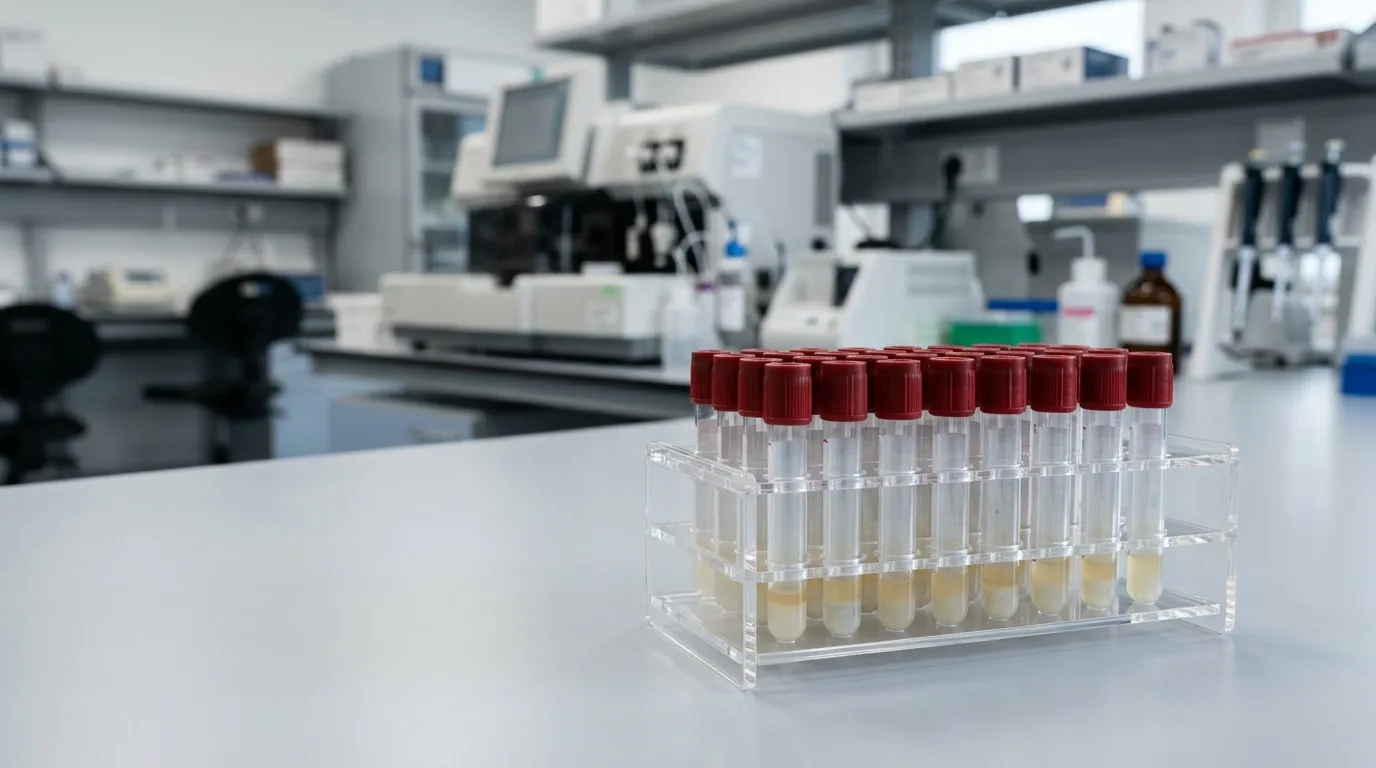
A centrifuge separates materials by density by rotating at high speeds. They are widely employed in medicine, molecular biology and pharmaceutical research in medical laboratories.
Applications include:
- Blood sample separation
- DNA extraction
- Protein purification
- Cell isolation
Digital speed control and automatic balancing systems are common features in modern centrifuges for ease of use and safety.
9. Laboratory Storage Equipment
Organizing the laboratory and ensuring its safety is essential when storing chemicals. Storage systems prevent contamination and damage of samples, chemicals and scientific instruments.
Valuable storage devices are:
- Chemical storage cabinets
- Refrigerators and freezers
- Sample racks
- Desiccators
- Storage shelves
Specialized cabinets are often required for flammable or corrosive chemicals.
10. Funnels and Filtration Equipment
Funnels can help the easy transfer of liquids and powders in containers that have a narrow opening. The separating of solids from liquids is a common procedure in experiments, and it is done using a filtration system.
Some of the commonly used filters are:
- Buchner funnels
- Filter paper
- Vacuum filtration systems
- Membrane filters
These tools are widely used in chemistry, microbiology, and environmental testing laboratories.
Factors to Consider When Choosing Laboratory Equipment
Before purchasing science equipment, laboratories should evaluate several important factors:
Quality and Durability
High-quality equipment lasts longer and produces more reliable results. Durable materials like borosilicate glass and stainless steel are ideal for laboratory environments.
Accuracy and Precision
Scientific research depends on accurate measurements. Choosing calibrated instruments ensures reliable experimental outcomes.
Safety Compliance
Laboratory equipment should comply with industry safety standards and regulations to minimize operational risks.
Ease of Maintenance
Easy-to-clean and maintain equipment improves laboratory efficiency and reduces downtime.
Budget and Scalability
Both the cost and long-term benefits of a laboratory should be considered. Investing in “scalable” equipment means that the investment will allow for future growth without having to replace the basic systems.
The Future of Laboratory Equipment
The use of digital and automated technologies in labs is growing to enhance efficiency and data management. In the field of laboratory systems, smart systems are now becoming more common, with sensors, cloud connection and automation helping to achieve more precise control of experiments. The modern laboratories also make use of advanced analytical instruments that provide more precise and quicker results.
Follows are some of the current trends in laboratories:
- Automated liquid handling systems
- Smart laboratory monitoring
- AI-assisted data analysis
- Digital laboratory management platforms
- Environmentally sustainable laboratory designs
Conclusion
Science equipment plays a crucial role in any successful laboratory, providing the tools necessary for research, testing, and education. Basic scientific equipment like microscopes, pipettes, balances, glassware and safety equipment are the basis of efficient scientific work. Opt for top-tier laboratory tools to achieve greater accuracy, boost safety, and ensure sustained performance.
From constructing a new school lab to enhancing a research or industrial testing lab, the importance of having the proper lab equipment is vital to ensure scientific excellence. Knowing the purpose and importance of each tool, laboratories can develop safe, efficient, and future-proof workplaces.