



Updated 1 week ago
Flat Bottom Tube for DNA, RNA, Plasma and Serum Storage: Application Requirements Explained

Trustlab
The author is a specialist at Ningbo Trustlab Instruments Co., Ltd., a leading provider of laboratory and medical consumables since 2015. With extensive experience in global healthcare and laboratory markets, they focus on delivering high-quality, innovative solutions and professional support to laboratories, hospitals, and distributors worldwide. Trustlab’s products are trusted in over 100 countries, reflecting the company’s commitment to reliability, excellence, and customer satisfaction.

Flat Bottom Tube
Selecting a Flat Bottom Tube for biological sample storage is not simply a matter of choosing a capacity and temperature rating. DNA, RNA, plasma, and serum differ in degradation mechanisms, freeze-thaw sensitivity, working volume, contamination risk, and downstream analytical requirements.
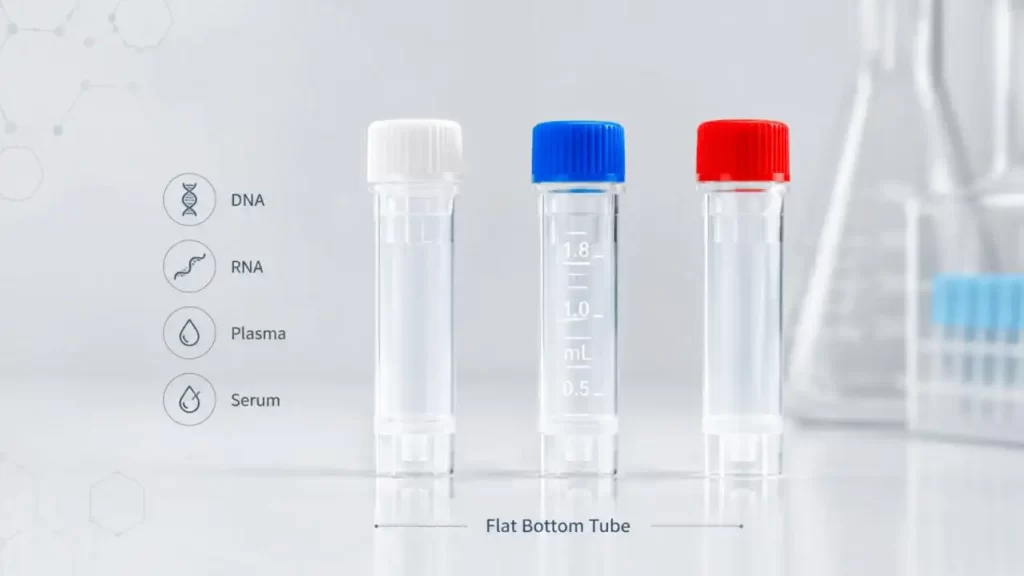
For this reason, a reliable Flat Bottom Tube should be evaluated as part of the complete sample-management workflow: sample type → storage temperature → tube material → closure integrity → aliquot volume → identification → retrieval.
How Storage Requirements Differ by Sample Type
Different specimens place different demands on the tube and handling process.
| Sample | Main Storage Risk | Key Flat Bottom Tube Requirement | Workflow Priority |
| DNA | Adsorption, contamination, evaporation | Stable PP body and secure closure | Recovery and concentration |
| RNA | RNase degradation, temperature exposure | Clean handling and reliable seal | Rapid processing and aliquoting |
| Plasma | Analyte change during storage | Leak resistance and suitable volume | Minimize repeated thawing |
| Serum | Protein/analyte stability | Secure closure and low-temperature integrity | Long-term aliquot management |
A Flat Bottom Tube should therefore be selected according to the specimen and intended assay rather than treated as a universal storage container.
DNA Storage: Material and Sample Recovery Matter
DNA is more stable than RNA, but tube selection will still impact sample quality over time, particularly with low-volume or low-concentration samples.
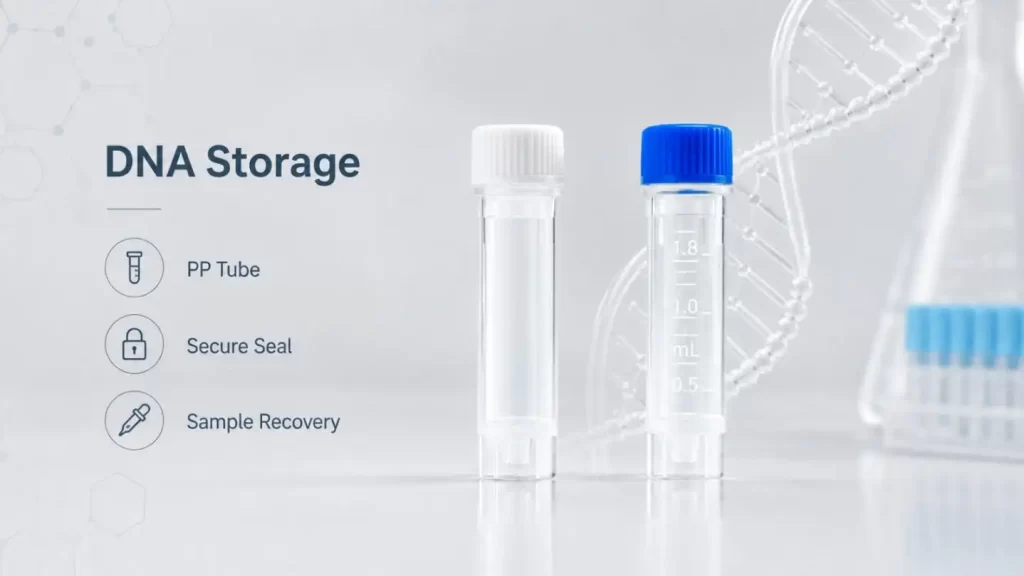
The Basic Features of DNA
For storage, a Flat Bottom Tube for DNA should offer:
•Chemically stable tube materials
•Low temperature dimensional stability
•Reliable cap-to-tube engagement
•Minimal evaporation during long-term storage
•Adequate area for labels
•Sufficient space for the DNA aliquot
In tubes used for biologic samples, PP has become the material of choice, due to the combination of resistance to many chemicals, strength, and good performance at lower temperatures.
At Trustlab, we opt for medical-grade PP for the tube body, and PE for the caps. This makes up a good choice of material for storage of biological samples.
Selecting the right tube is only one part of the process. For extremely low concentration DNA, labs must also consider the risk of adsorption, the length of time the buffer is stored, how many times the sample is transferred to a different container, and the buffers used.
RNA Storage: The Tube Cannot Replace Good Handling Practice
RNA requires tighter process control because RNase contamination and inappropriate temperature exposure can rapidly compromise sample integrity.
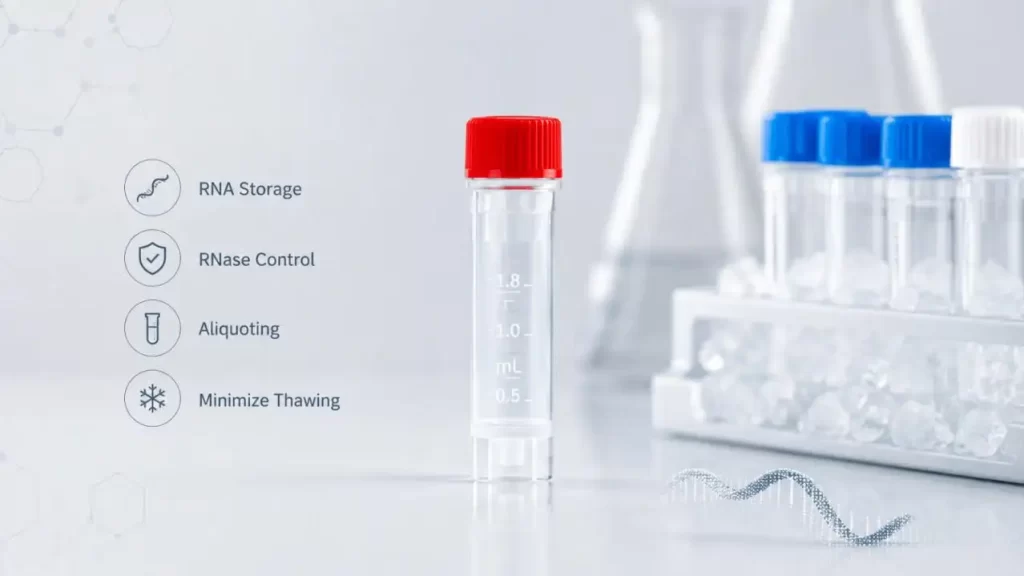
A Flat Bottom Tube for RNA storage should support, rather than replace, a controlled RNA workflow.
Important RNA Storage Controls
•Use clean handling procedures
•Reduce exposure at room temperature
•Select an appropriate aliquot volume
•Close the tube immediately after dispensing
•Limit unnecessary freeze-thaw cycles
•Avoid repeatedly opening the primary sample
For RNA, smaller aliquots can be particularly useful. Instead of repeatedly thawing a large stock tube, the sample can be divided according to expected downstream consumption.
This means Flat Bottom Tube capacity should be selected around actual test volume, not maximum available capacity.
Plasma and Serum: Design the Storage Strategy Around Aliquots
Plasma and serum are often grouped together, but their preparation processes differ. Plasma retains components associated with anticoagulated blood, while serum is obtained after clot formation and separation.
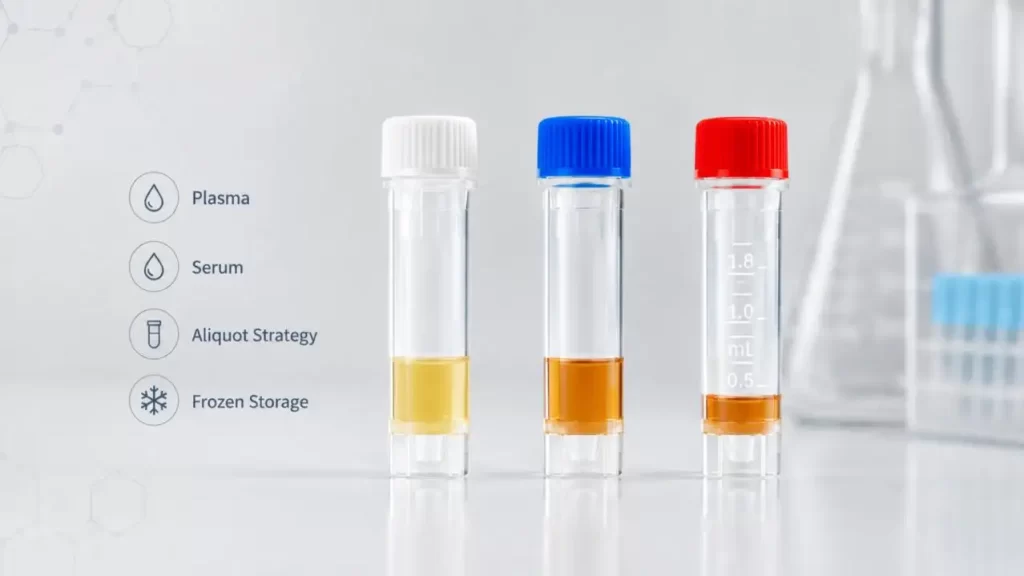
Once stored, however, both require careful control of:
•Storage temperature
• Container closure
•Aliquot volume
•Freeze-thaw frequency
•Identification
•Downstream assay requirements
Why Tube Volume Matters
A larger Flat Bottom Tube doesn't necessarily make it more practical.
| Storage Situation | Recommended Selection Logic |
| Small molecular aliquots | Which will result in unused capacity. |
| Plasma/serum testing | Match is consumed per assay |
| Repeat testing | Appropriate number of aliquots should be prepared. |
| Archive samples | Consider tube volume in relation to sample storage volume. |
| Higher volume biological samples | The balance is between sufficient volume and limiting headspace. |
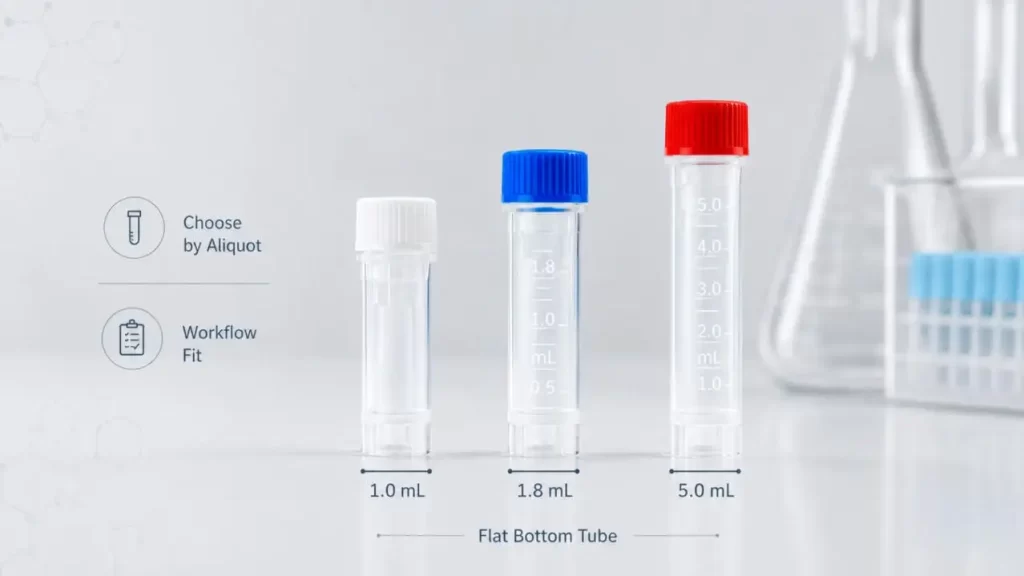
Trustlab's cryogenic tubes hold 1 mL, 1.8 mL, and 5 mL of sample, so distributors and labs can better match their biological storage tubes.
Why Flat-Bottom Geometry Matters
A Flat Bottom Tube has a base that is flat, which makes it functionally different from other tubes.
Stable Bench Handling
Because a flat base allows a tube to remain upright:
•Manual pipetting
•Sample aliquoting
• Reagent addition
•Label application
•Temporary bench storage
•Sample inspection
•It makes sample workflows more efficient.
Flat Bottom vs. Conical Bottom
The two geometries should not be treated as interchangeable.
| Design Factor | Flat Bottom Tube | Conical Bottom Tube |
| Upright bench stability | Strong advantage | Usually rack-dependent |
| Manual handling | Convenient | Application-dependent |
| Liquid collection at bottom | Broader bottom area | Concentrated at tip |
| Maximum residual recovery | May be less efficient | Often advantageous |
| Centrifugation suitability | Must verify tube specification | Common in centrifuge workflows |
A Flat Bottom Tube is therefore particularly useful when stable placement and routine handling are priorities, while centrifugation-intensive workflows should also consider rotor and tube geometry compatibility.
Tube Body and Cap Must Function as One Sealing System
Low-temperature performance depends on more than the polymer used for the tube.
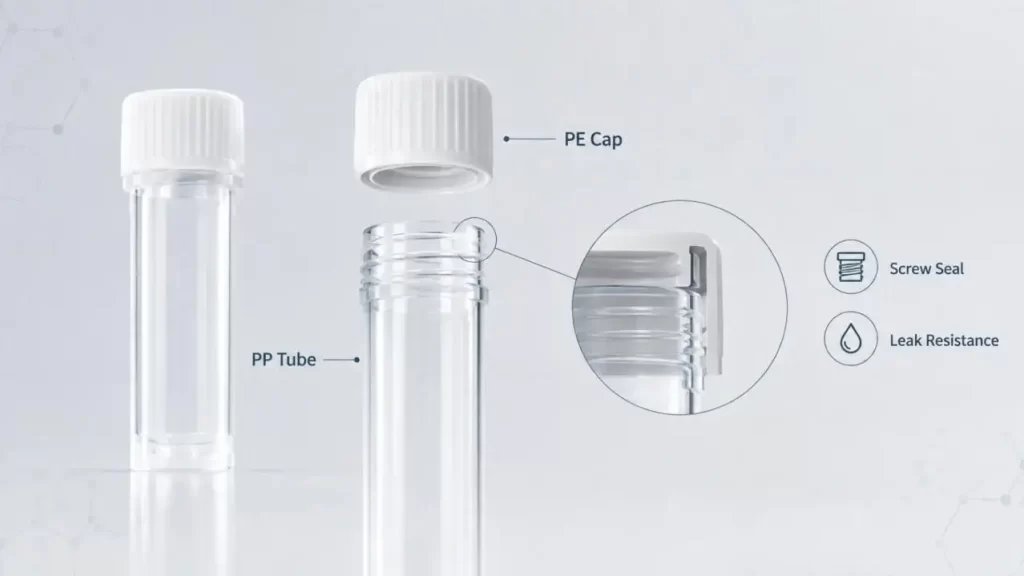
The sealing interface includes:
Tube Wall + Neck Geometry + Thread Profile + Cap Material + Closure Engagement
Any dimensional inconsistency can affect leakage, evaporation, or how reliable you can rely on it during handling.
Trustlab's cryogenic tube design uses a PP tube with a PE screw cap, and the closure is meant to give secure containment when dealing with biological samples in handling and storage.
When evaluating a Flat Bottom Tube, buyers should review:
•Tube-wall consistency
•Neck and thread dimensions
•Cap engagement
•Resistance to loosening
•Low-temperature material behavior
•Leakage performance
•Batch-to-batch dimensional consistency
These factors become increasingly important for long storage periods and repeated temperature transitions.
Freeze-Thaw Resistance Has Two Different Meanings
A common mistake is to treat "freeze-thaw resistance" as a single performance characteristic.
In practice, there are two separate issues.
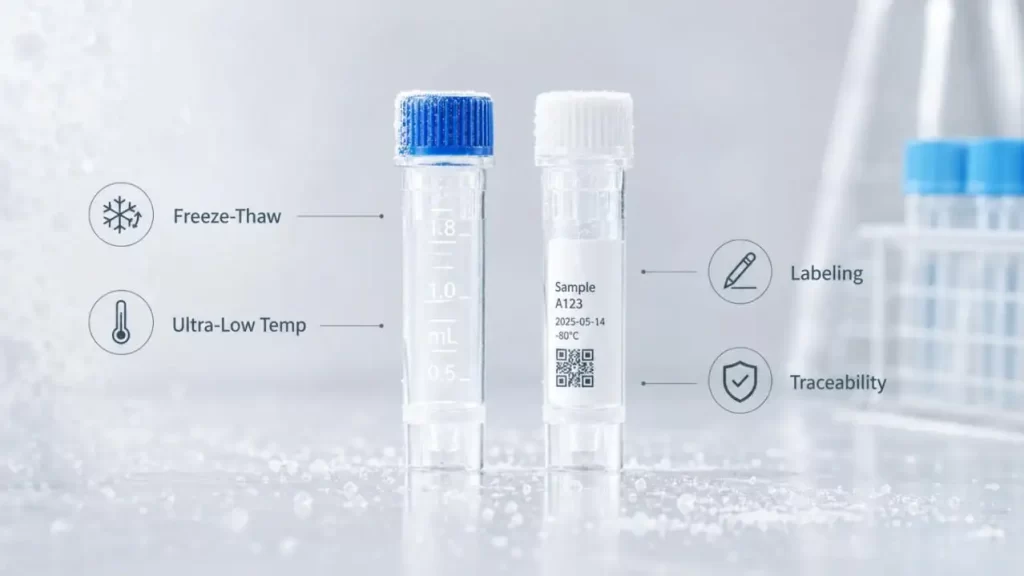
1. Tube Integrity
The Flat Bottom Tube must resist:
•Cracking
•Wall deformation
•Cap loosening
•Seal failure
•Leakage after temperature cycling
Trustlab's cryo tubes are designed for ultra-low-temperature sample-storage applications, including environments down to approximately –196°C where the specified cryogenic workflow permits.
2. Sample Integrity
While a tube might hold up mechanically, the contents of the tube will be damaged from repeated freezing and thawing, including:
•RNA
•Proteins
•Enzymes
•Antibodies
•Metabolites
•Other temperature-sensitive compounds.
Tubes should never be treated as durable enough to support sample thawing.
Graduation and Sample Identification
A tube with graduation can aid a technician in estimating sample volume. However, graduation lines are not accurate enough to define a volumetric measure.
Trustlab is able to provide configurations with and without graduation. As such, we are able to provide a tube configuration that accommodates the unique laboratory processes.
For clinical laboratories and biobanks, sample identification should also accommodate information such as:
•Sample ID
•Specimen type
•Collection or processing date
•Aliquot number
•Storage location
•Batch or study reference
Compatibility with cryogenic racks and storage boxes should be checked together with tube diameter, height, cap geometry, and freezer layout.
Matching the Flat Bottom Tube to the Complete Workflow
There is no single Flat Bottom Tube specification that is ideal for every DNA, RNA, plasma, or serum application. The correct configuration depends on how the sample is prepared, divided, frozen, identified, stored, retrieved, and analyzed.
With medical-grade PP tube construction, PE closures, multiple volume options, graduation choices, and cryogenic-storage-oriented designs, Trustlab can support different biological sample-storage requirements. For laboratories and distributors evaluating a Flat Bottom Tube, providing the intended sample type, storage temperature, aliquot volume, labeling method, and storage system is the most practical starting point for defining an appropriate configuration.
FAQs
Q1. What materials does Trustlab use for Flat Bottom Tube production?
Flat Bottom Tubes can be manufactured using medical-grade polypropylene (PP) for the tube body and polyethylene (PE) for screw-cap components. PP is well suited for many low-temperature biological sample storage due to its chemical resistance and dimensional stability.
Q2. What Flat Bottom Tube capacities are available from Trustlab?
Trustlab provides cryogenic tubes in the common capacities of 1 mL, 1.8 mL and 5 mL. Versus the other considerations for selecting an appropriate tube, volume should be determined by the aliquot size, the anticipated assay consumption, the storage box's compatibility, and the required headspace.
Q3. Can Trustlab supply Flat Bottom Tube products for DNA and RNA storage?
Trustlab can supply Flat Bottom Tubes for storage of DNA and RNA. With the required specification of the sample type, storage temperature, the working volume, and downstream analysis, the tubes can be customized to suit sample management.
Q4. Are Trustlab Flat Bottom Tubes acceptable for plasma and serum storage?
Yes, Trustlab can supply the Flat Bottom Tubes for plasma and serum aliquot storage. The tubes can be designed to meet storage requirements and the laboratory can consider preparing smaller aliquots to minimize freeze-thaw cycles.
Q5. How does Trustlab control Flat Bottom Tube sealing performance?
Sealing performance is not dependent on a cap alone as the complete closure system is equally important. At Trustlab, we design the neck of tube, cap engagement, tube wall, and material to provide reliable closure during storage and use.
Written by
Trustlab
The author is a specialist at Ningbo Trustlab Instruments Co., Ltd., a leading provider of laboratory and medical consumables since 2015. With extensive experience in global healthcare and laboratory markets, they focus on delivering high-quality, innovative solutions and professional support to laboratories, hospitals, and distributors worldwide. Trustlab’s products are trusted in over 100 countries, reflecting the company’s commitment to reliability, excellence, and customer satisfaction.


