


Updated 3 weeks ago
Colloidal Gold Rapid Test Manufacturer: How to Choose the Right OEM Partner
trustlabofficial

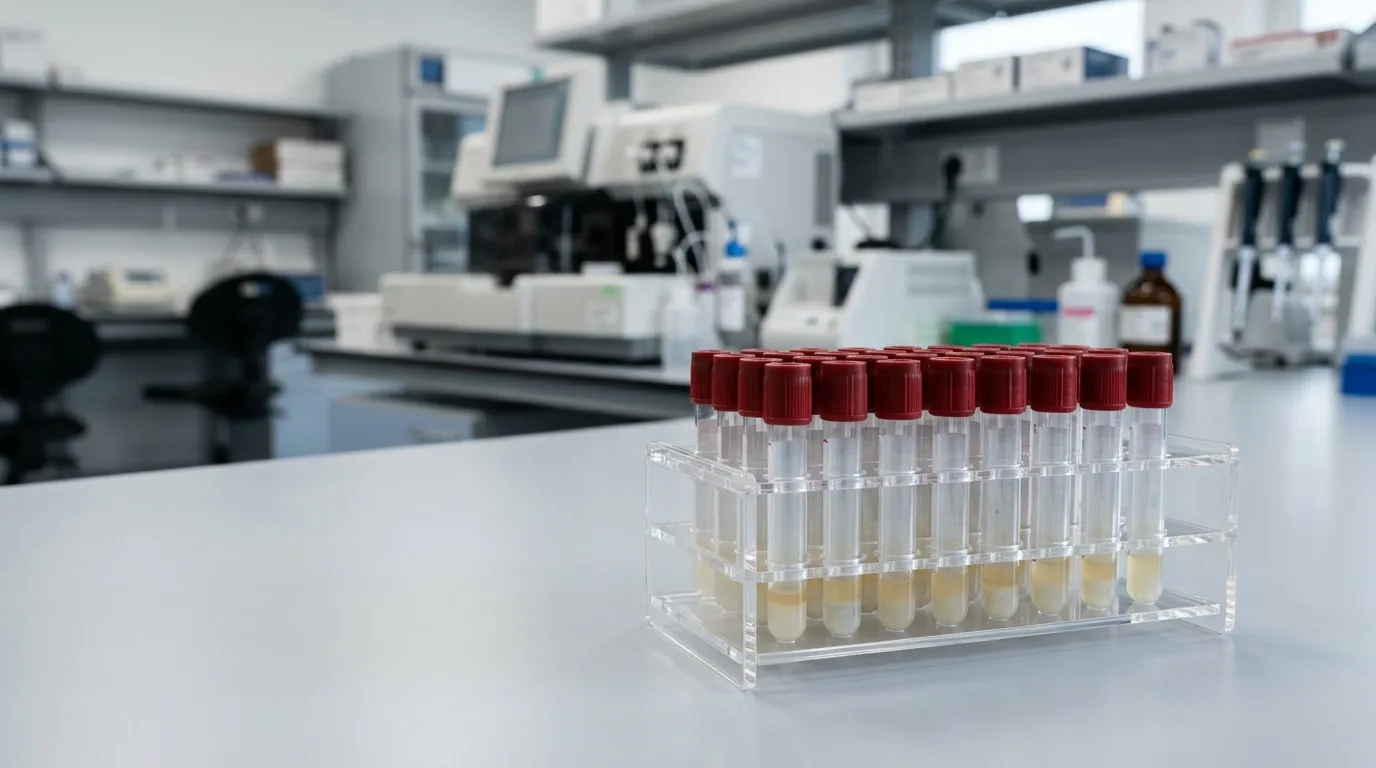
White rapid test cassettes in sealed pouches being evaluated at a laboratory bench.
Choosing a colloidal gold rapid test manufacturer for an OEM or private-label program is a decision that will follow you well past the initial order. Test consistency problems, missing regulatory documentation, and delayed supply all trace back to how carefully you evaluate a potential manufacturing partner in the first place.
A structured evaluation of any colloidal gold rapid test manufacturer should cover four areas: technology expertise, manufacturing quality and quality assurance, regulatory documentation, and commercial terms. Work through each one systematically, and you will be able to compare suppliers on evidence rather than on marketing claims.
Trustlab, a manufacturer and supplier of medical and laboratory products, offers a global health rapid testing portfolio that includes the hcg combo rapid test, hiv and syphilis test kit, and dengue test. The evaluation framework below applies to any manufacturer you assess — Trustlab included.
How Colloidal Gold Rapid Tests Work
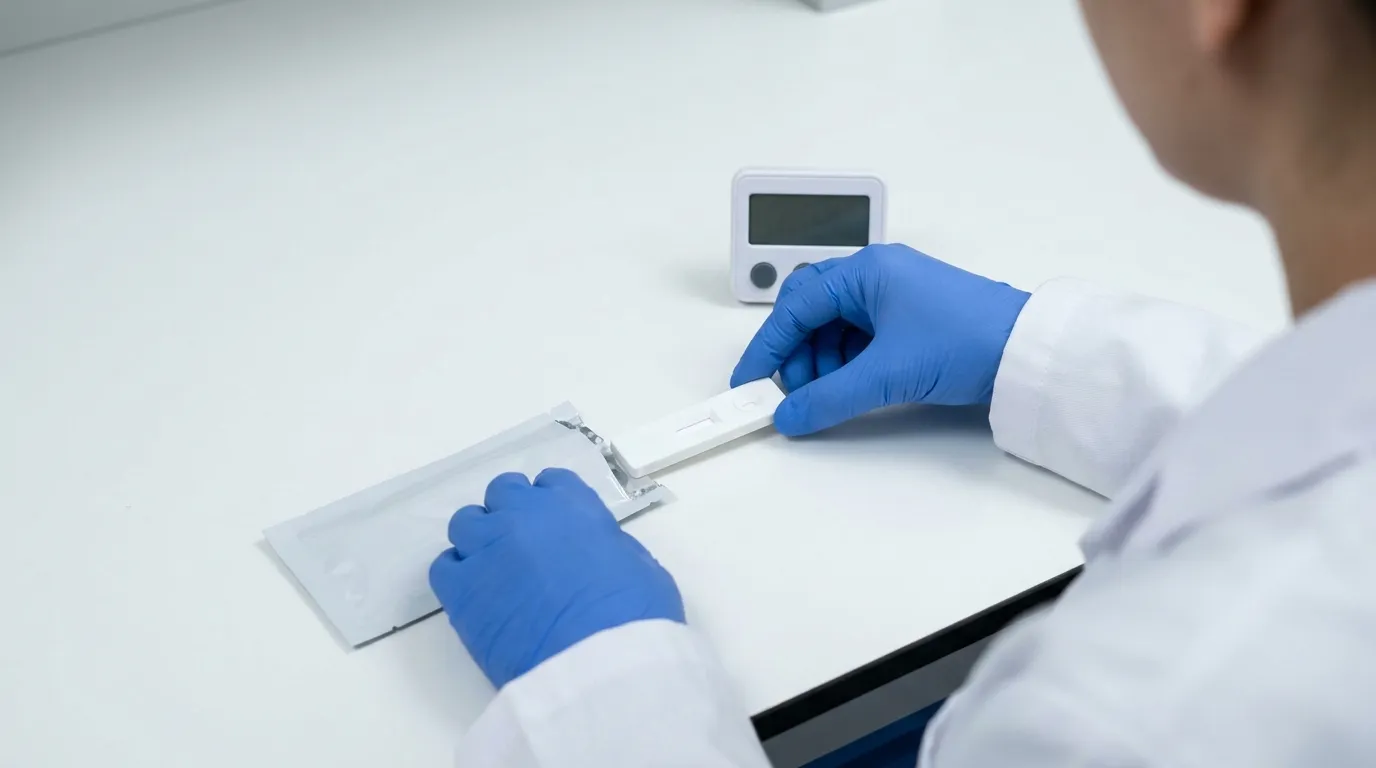
Colloidal gold immunochromatography is the technology behind most lateral flow rapid tests. A sample — blood, serum, plasma, or another specimen — is applied to a test strip, where it mixes with gold nanoparticles conjugated to antibodies specific to the target analyte. The liquid migrates along the strip by capillary action, passing through a nitrocellulose membrane that contains immobilized capture reagents at the test and control lines. If the target analyte is present, it binds to the gold-labeled antibody and is captured at the test line, producing a visible colored signal. Results are read visually, typically within 10–15 minutes [1].
This design makes colloidal gold rapid tests well suited to point-of-care and field settings where laboratory equipment and trained technicians are not available. The test requires no instrumentation, produces a qualitative result, and is inexpensive to manufacture at scale.
For an OEM buyer, understanding the assay format matters because it directly affects what you can expect from a manufacturer.
Assay Formats and What They Tell You About a Manufacturer
Three immunoassay formats dominate the colloidal gold rapid test market. Each serves a different analytical purpose:
| Assay Format | Typical Target | How the Result Is Read | Common Applications |
|---|---|---|---|
| Sandwich | Large molecules with multiple binding sites (hCG, viral antigens) | Test line appears when analyte is present | Pregnancy tests, dengue antigen tests, many infectious disease tests |
| Competitive | Small molecules with a single binding site (drugs, toxins, some hormones) | Test line disappears or weakens when analyte is present | Drug-of-abuse screening, some therapeutic drug monitoring |
| Indirect | Antibodies produced by the body in response to infection | Test line appears when specific antibodies are present | HIV, syphilis, and other serological tests |
A manufacturer that consistently produces reliable tests across all three formats demonstrates a deeper command of conjugate chemistry, membrane selection, and assay optimization than one that only assembles kits around a single reagent set. When you evaluate a supplier, ask which assay formats they have in production and which disease areas they cover. The breadth of their platform is one signal of technology maturity.
What Makes a Colloidal Gold Rapid Test Manufacturer Credible?
A supplier's credibility rests on more than the quality of their product brochure. Buyers should evaluate three layers of capability: technology expertise, manufacturing quality control, and the quality management system that ties them together.
Technology expertise. Does the manufacturer control the critical variables that determine assay performance? Gold nanoparticle size and uniformity, antibody conjugation efficiency, membrane selection, and blocking chemistry all influence sensitivity and specificity. A manufacturer with genuine in-house expertise can discuss these parameters in technical detail — not just quote final product specifications. They should also be able to demonstrate experience across sample types (whole blood, serum, plasma, swab, urine) and across different assay formats.
Manufacturing quality control. Batch-to-batch consistency is the difference between a test that performs well once and a test you can stake your brand on. Ask manufacturers how they monitor in-process quality during production, how they validate each batch before release, and what release testing they conduct. Stability testing under realistic storage conditions is another indicator of manufacturing maturity. A supplier that cannot produce batch records or certificate-of-analysis documentation during evaluation is unlikely to deliver consistent quality at scale.
The quality management system. A credible manufacturer operates under a formal quality management system, such as ISO 9001 or ISO 13485. The distinction matters: an ISO 13485 certificate applies to the company's quality management system for medical devices, not automatically to every product's regulatory approval. When you review a manufacturer's certificate, check its actual scope — what activities it covers, the sites it applies to, and whether it is current. Do not assume a QMS certificate is the same as product-level CE marking, FDA clearance, or a WHO prequalification. These are separate forms of evidence and are covered in the next section.
Production capacity claims deserve particular scrutiny. Some manufacturers state production volumes in the millions of tests per day. Capacity claims are meaningful only if they can be verified — through independent audits, site visits, batch records, or a combination. A supplier that is reluctant to support its capacity claims during commercial due diligence is a risk you do not need to take.
A practical buyer's checklist for manufacturer credibility:
- What assay formats does the manufacturer produce in-house?
- What gold nanoparticle and conjugation parameters do they control?
- What in-process and release testing is performed on each batch?
- What stability data exists, and under what storage conditions was it generated?
- Which QMS certificates does the manufacturer hold, and what is the exact scope of each?
- Will they accommodate a site audit before contract signing?
- Can they provide batch records and certificates of analysis for reference batches?
Regulatory Documentation Every OEM Buyer Should Request

Regulatory documentation is the area where OEM programs most often stall. A private-label test kit cannot reach the market without the documentation that supports its intended use, performance claims, and regulatory status. Buyers should request the following from any manufacturer they are seriously evaluating.
Quality management system certificates. ISO 9001 and ISO 13485 certificates demonstrate that the manufacturer operates under a recognized quality management system. Verify the certificate's scope, issuing body, and validity. A QMS certificate is a company-level credential; it does not by itself prove that a specific product is CE-marked or FDA-approved.
Product-level regulatory registrations. CE marking for the European market, WHO prequalification, FDA registration or clearance, and national registrations are product-specific. A manufacturer may hold CE marking for some tests and not for others. Ask for the registration certificate for each specific product you plan to private-label.
Instructions for use (IFU). The IFU defines the test's intended use, specimen types, testing procedure, result interpretation, limitations, and storage conditions. It is the primary document that governs how a test is used and what claims can be made about it. Review it carefully — the claims in your product labeling must match what the IFU supports.
Certificate of analysis. This document provides batch-specific quality data, confirming that a specific production run met its release specifications. It is your evidence that the batch you are buying is consistent with the product that was validated and registered.
Stability and shelf-life data. Ask for real-time stability data that supports the claimed shelf life and storage conditions. If a manufacturer can only provide accelerated stability data, understand the limitations of that evidence.
When you request documentation, be specific. "Send me your certificates" is too broad. Instead, ask for the QMS certificate, the CE or WHO registration for each specific product code you plan to buy, the IFU for each product, a certificate of analysis for a recent representative batch, and the stability summary for each claimed shelf life. A manufacturer that responds with complete, product-specific documentation is demonstrating its readiness to support OEM and private-label partners.
Commercial and Supply Considerations for OEM and Private-Label Programs
Technical and regulatory diligence is only half the evaluation. The commercial relationship determines whether the program remains viable over multiple years.
Customization scope. Private-label programs vary widely in how much customization they include — from simple packaging and labeling changes to custom assay formulation and development. Confirm what the manufacturer actually supports. If you need custom labeling, multiple language versions, or unique packaging configurations, those requirements should be documented before you choose a partner.
Minimum order quantities and lead times. MOQ and lead time are basic commercial terms, but they are also a reflection of the manufacturer's production planning. Ask for realistic lead times that account for raw material sourcing, production scheduling, quality control release, and shipping. A supplier whose lead-time commitments are consistently optimistic will create problems for your inventory planning.
Sample support. Before committing, request evaluation samples of the test products you intend to private-label. Test them under your own conditions. Sample evaluation is a normal part of the procurement process, and reputable manufacturers expect this request.
Intellectual property and labeling. Clarify ownership of any custom formulations, packaging designs, or labeling developed for your program. If the manufacturer already holds a registration for the product you plan to private-label, understand what your rights are in each target market.
Post-sale technical support. Rapid test buyers sometimes need support after the sale — troubleshooting, documentation updates, regulatory questions, or training materials. Confirm what level of ongoing support the manufacturer provides before you sign.
Questions to ask a potential manufacturer before signing:
- What customization options are available — packaging, labeling, language, formulation?
- What is the MOQ for each product configuration?
- What are the current production and shipping lead times?
- Can evaluation samples be provided before commitment?
- How are intellectual property and labeling ownership handled?
- What post-sale technical and regulatory support is available?
- Which exact products and specifications does this agreement cover?
Risks Buyers Should Know Before Choosing a Manufacturer
Every OEM program carries risk, but the risks are manageable when you know what to look for. The following issues are worth taking seriously during manufacturer evaluation.
Regulatory enforcement risk. Public health regulators actively monitor the rapid test market. The U.S. Food and Drug Administration, for example, has issued warnings against distributors of unapproved colloidal gold rapid tests. In one case, the FDA advised the public not to use a SARS-CoV-2 antigen rapid test (colloidal gold) distributed by Skippack Medical Lab because the test was not authorized, cleared, or approved by the FDA [2]. Buyers who are considering a manufacturer's product for a regulated market must verify product-level regulatory status independently rather than accepting a supplier's general claims of compliance.
Control-line failure and procedural errors. Even well-manufactured tests can produce invalid results when procedural errors occur. Manufacturer instructions typically state that an absent control line indicates an invalid test, commonly caused by insufficient buffer volume, poor technique, or test components that have not been stored correctly [3]. This distinction matters: a control-line failure does not automatically mean the product is defective. That said, a manufacturer that provides thorough IFU documentation and training support reduces the frequency of procedure-related invalid results.
Unverified capacity and experience claims. Some manufacturer websites publish production capacity figures and experience claims that cannot be independently verified. Treat these claims as marketing information until they are supported by documentation, site visits, or third-party audits.
Certification scope gaps. The most common due-diligence mistake is accepting a QMS certificate as proof of product-level approval. Check every certificate and registration for the product code you are buying and the market you are targeting. A gap between what the manufacturer claims broadly and what the product registration actually covers can delay your market launch significantly.
Choosing a Manufacturing Partner: Putting the Framework into Practice
The selection process for a colloidal gold rapid test OEM or private-label partner starts with the four-part framework — technology expertise, manufacturing quality, regulatory documentation, and commercial terms — and ends with a conversation. Take the time to evaluate every candidate against the same criteria, request the same documents from each, and visit or audit the factories that make it to your shortlist.
A manufacturer that can discuss assay design in detail, show you batch records, provide product-specific regulatory documentation, and answer commercial questions transparently is demonstrating exactly the behavior you need in a long-term partner.
Trustlab's rapid test portfolio — which includes the hcg combo rapid test, hiv and syphilis test kit, and dengue test — sits within its broader global health rapid testing offering. If you are evaluating colloidal gold rapid test manufacturers for an OEM or private-label program, contact Trustlab to discuss your requirements and request the documentation you need for your evaluation.
[1] nanoComposix, "Colloidal Gold for Diagnostics." https://nanocomposix.com/pages/colloidal-gold
[2] U.S. Food and Drug Administration, "Do Not Use Skippack Medical Lab SARS-CoV-2 Antigen Rapid Test (Colloidal Gold)." https://content.govdelivery.com/accounts/USFDA/bulletins/3170860
[3] JOYSBIO, "SARS-CoV-2 Antigen Rapid Test Kit (Colloidal Gold) Instructions for Use." https://en.joysbio.com/wp-content/uploads/2021/11/IFU-JOYSBIO-SARS-COV-2-Antigen-Rapid-Test-Kit.pdf