



how to test for malaria
Malaria is a disease of the genus Plasmodium which is transmitted to man from infected female Anopheles mosquitoes. It continues to be a major public health problem especially in tropical and subtropical countries. Prompt and precise diagnosis is crucial for timely treatment, and preventing complications and/or mortality. This blog offers a detailed explanation of the concept of malaria testing, what tests are available, how they work and their importance in various geographic regions.
Why Malaria Testing is Crucial
Malaria symptoms may be shared with other common diseases like influenza, dengue and typhoid fever. Most common symptoms include high fever, chills, sweating, headache and tiredness, but these symptoms do not necessarily mean someone has malaria. Testing plays a key role in several aspects:
- Accurate Diagnosis: Ensures the patient receives the correct treatment.
- Prevention of Drug Resistance: Avoids unnecessary use of antimalarial drugs, which can lead to resistance.
- Epidemiological Monitoring: Helps health authorities track malaria prevalence and outbreaks, particularly in high-risk regions.
Types of Malaria Tests
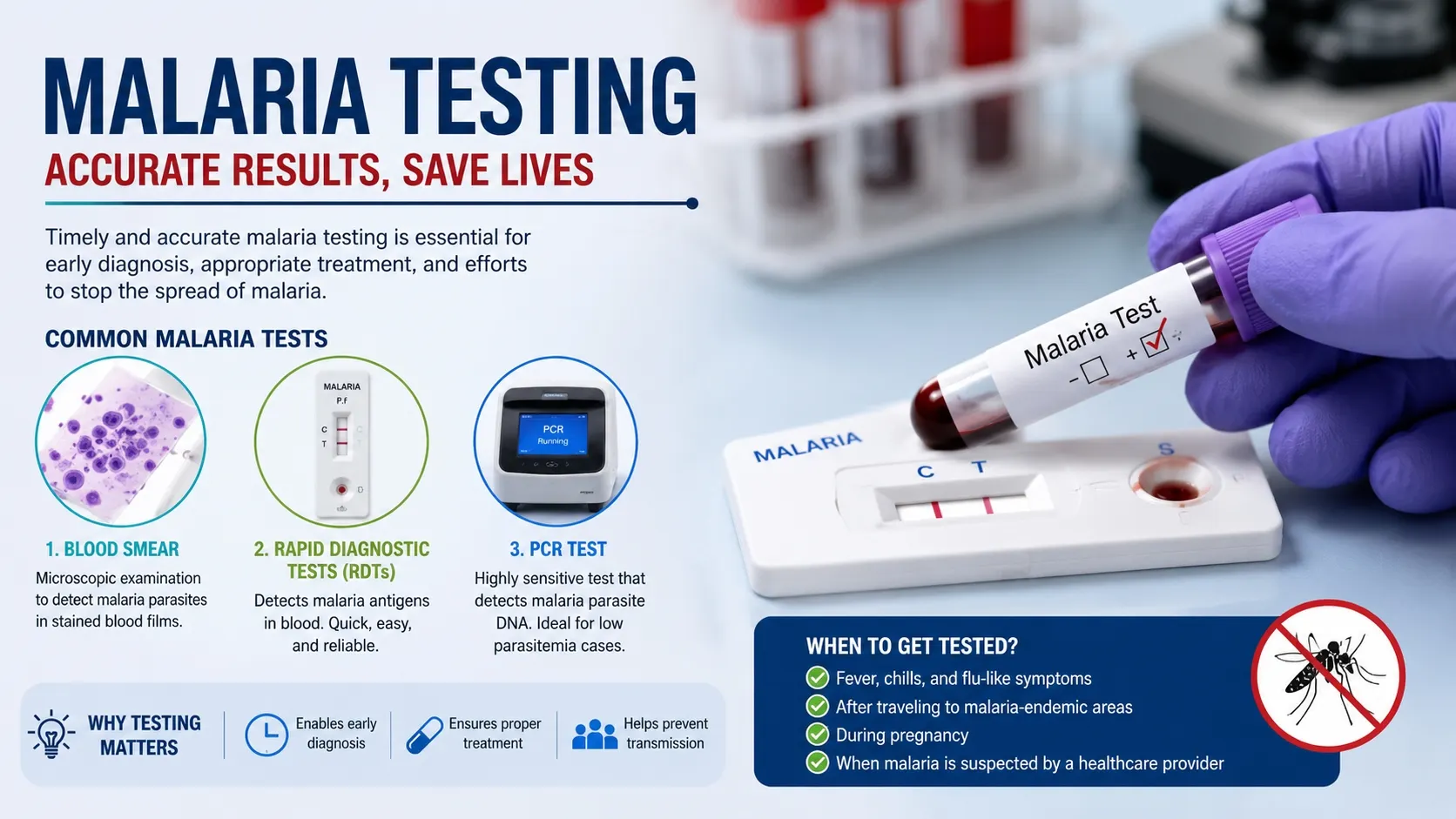
Malaria can be detected with a number of laboratory tests. The selection of the test will be dependent on the availability of resources, speed of diagnosis required, and the type of Plasmodium species suspected.
1. Microscopic Examination (Blood Smear)
In most health care settings, the gold standard for the diagnosis of malaria is microscopy. Thin or thick smear of the patient's blood is examined under the microscope in a trained laboratory to look for malaria parasites.
- Thick Smear: Used for detecting the presence of parasites and estimating parasite density.
- Thin Smear: Helps identify the specific Plasmodium species.
Advantages: High accuracy and ability to determine parasite type.
Limitations: Requires skilled technicians and laboratory equipment.
2. Rapid Diagnostic Tests (RDTs)
Rapid diagnostic tests are immunochromatographic strips that identify malaria antigens in the blood. RDTs can provide results in 15–30 minutes, making it appropriate for clinics and remote settings where there are not advanced laboratory facilities available.
Advantages: Fast, easy to use, and does not require specialized equipment.
Limitations: Slightly less accurate than microscopy, and some RDTs may not detect all Plasmodium species.
3. Polymerase Chain Reaction (PCR)
To detect the presence of malaria parasites, their DNA can be detected using PCR testing. High sensitivity of the molecular method allows for the detection of low concentration of parasites, it is useful in research or when there is an unclear diagnosis.
Advantages: High sensitivity and specificity.
Limitations: Expensive and requires specialized laboratory facilities, not practical for routine field use.
4. Serological Tests
There are serological tests that can be used to identify antibodies to malaria parasites. They are useful for epidemiological studies, but are not appropriate for diagnosis of the acute infection, since antibody levels can remain high for many years after the infection has resolved.
Advantages: Helpful in understanding malaria exposure in a population.
Limitations: Cannot confirm active infection.
How Malaria Tests are Performed
Step 1: Sample Collection
Blood is usually drawn from a vein or a finger prick, depending on the test type.
Step 2: Laboratory Analysis
- For microscopy, a smear is prepared, stained, and examined under a microscope.
- For RDTs, blood is applied to the test strip with a buffer solution.
- For PCR, DNA extraction and amplification occur in a laboratory setting.
Step 3: Result Interpretation
- Positive test: Indicates malaria infection; the specific species and parasite density may guide treatment.
- Negative test: Malaria is unlikely, but repeat testing may be recommended if symptoms persist.
Geographic Considerations in Malaria Testing
The numbers of malaria cases are quite different in various areas. The high-risk regions are Southeast Asia, Oceania, South America and Sub-Saharan Africa. Testing strategies can vary by resources, endemic species and healthcare capabilities.
- Sub-Saharan Africa: High burden of Plasmodium falciparum. RDTs and microscopy are commonly used.
- Southeast Asia: Presence of multiple Plasmodium species; PCR may be used in specialized centers.
- Travelers and Non-Endemic Areas: Rapid testing is crucial for early detection in returning travelers presenting with fever.
Importance of Early Detection
Malaria may rapidly deteriorate from mild to severe, such as cerebral malaria, anemia or organ failure. If the disease can be diagnosed early, proper testing can help identify the problem and treat it the moment it happens, thereby avoiding complications and death.
Follow-Up and Monitoring
A positive malaria diagnosis should be followed by monitoring of treatment response particularly in severe cases and in the treatment of infections with Plasmodium falciparum. A repeat test may be done to make sure all parasites are eliminated from the blood.
Preventive Measures Alongside Testing
While testing is essential, prevention remains the first line of defense against malaria. Key preventive strategies include:
- Use of Insecticide-Treated Nets (ITNs): Reduce mosquito bites while sleeping.
- Indoor Residual Spraying (IRS): Applying insecticides to walls to kill mosquitoes.
- Prophylactic Medications: For travelers to high-risk areas.
- Environmental Control: Eliminating mosquito breeding sites near homes.
Conclusion
One of the most important components of good disease management in malaria is to test for malaria. There are different roles for microscopy, rapid diagnostic tests, PCR and serological tests in the diagnosis and monitoring of malaria. Early and accurate detection means early treatment, containment and saving lives.
Knowing the kinds of malaria tests, what they're used for and what factors to consider regionally is critical for both healthcare providers and travelers. For every village in Africa and every city around the world, the ability to get a good test for malaria can mean the difference between life and death.