



Updated 2 weeks ago
Medical Consumable Supplies: OEM vs. Standard Products for Hospital and Distributor Procurement

Trustlab
The author is a specialist at Ningbo Trustlab Instruments Co., Ltd., a leading provider of laboratory and medical consumables since 2015. With extensive experience in global healthcare and laboratory markets, they focus on delivering high-quality, innovative solutions and professional support to laboratories, hospitals, and distributors worldwide. Trustlab’s products are trusted in over 100 countries, reflecting the company’s commitment to reliability, excellence, and customer satisfaction.

Medical Consumable Supplies
For hospitals and distributors, OEM procurement of Medical Consumable Supplies should start with a specification gap, not with a request for "full customization." A change in tube diameter, draw volume, polymer, anticoagulant, cap design, or sterile packaging can affect equipment compatibility, sample quality, production tooling, sterilization, and validation.
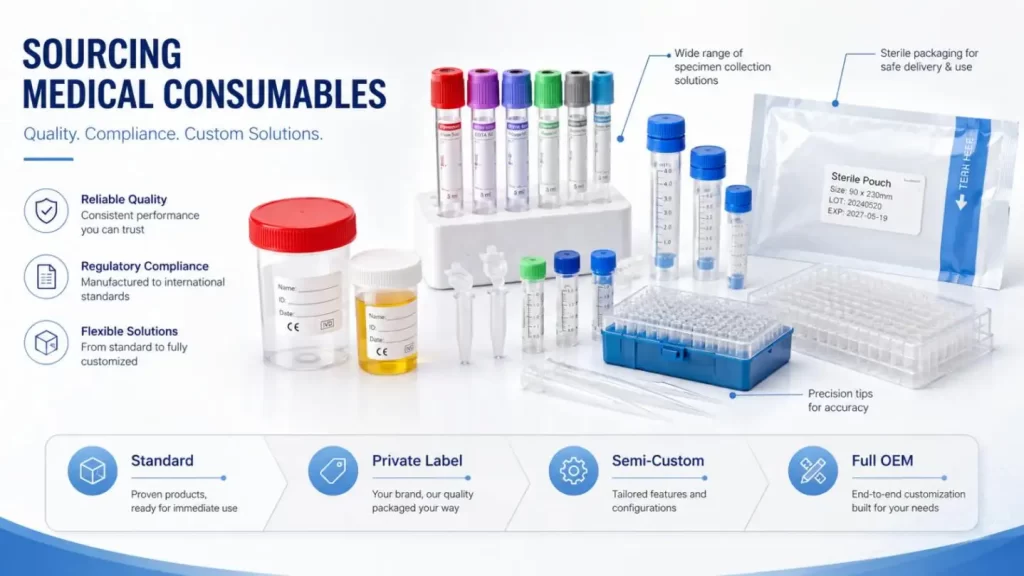
Trustlab's existing Medical Consumable Supplies provide useful standard platforms for evaluating how much OEM engineering is actually required.
Define the Specification Gap Before Starting OEM
A buyer should first identify which parameter prevents a standard product from being used:
• Incorrect collection or working volume;
• Incompatible tube or container dimensions;
• Wrong anticoagulant or additive;
• Unsuitable closure or thread design;
• Insufficient automation compatibility;
• Different sterile/non-sterile requirement;
• Customized unit pack, label, carton, or private-label format.
The deeper the change moves into the material–geometry–function chain, the greater the engineering and validation burden.
OEM Design Requirements by Medical Consumable Category
The following examples show how OEM decisions differ across major Medical Consumable Supplies categories.
| Category | Trustlab Standard Base | Important OEM Design Variables |
| Blood Collection Tubes | PET/glass; 13×75, 13×100, 16×100 mm; approximately 1–10 mL depending on type | Tube size, draw volume, vacuum, additive, cap identification, label, pack |
| Specimen Containers | PP cup + PE cap; 30–120 mL depending on product | Capacity, mouth diameter, graduation, cap seal, spoon, label, sterile pack |
| Micro/Centrifuge Tubes | PP; 0.5/1.5/2 mL and 10/15/50 mL ranges | Capacity, bottom geometry, graduation, cap type, rack/rotor fit |
| Cryogenic Tubes | 0.5–5.0 mL; external thread; self-standing options | Volume, diameter, thread, base, graduation, label area, color ring |
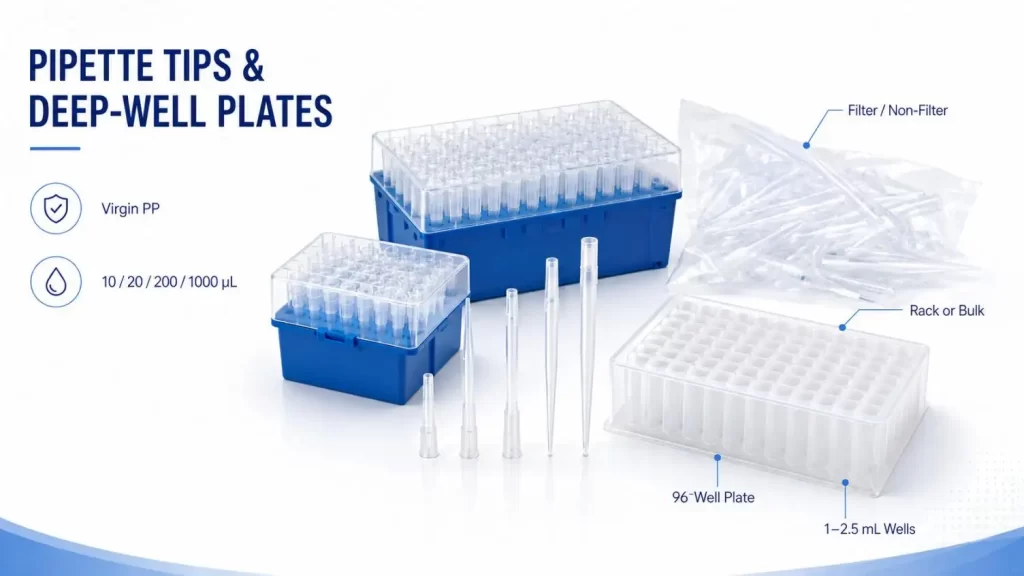
| Pipette Tips | Virgin PP; 10/20/200/1000 µL | Pipette fit, volume, tip geometry, filter, purity grade, rack/bulk pack |
| Deep-Well Plates | Medical-grade PP; 96-well; 1–2.5 mL listed formats | Well volume, bottom geometry, sealing, automation compatibility |
| Blood Collection Needles | 19G–27G depending on design; EO sterile | Gauge, needle configuration, safety mechanism, packaging |
Blood Collection Tubes: OEM Means More Than Changing the Cap Color
Blood collection tubes are among the most specification-sensitive Medical Consumable Supplies.
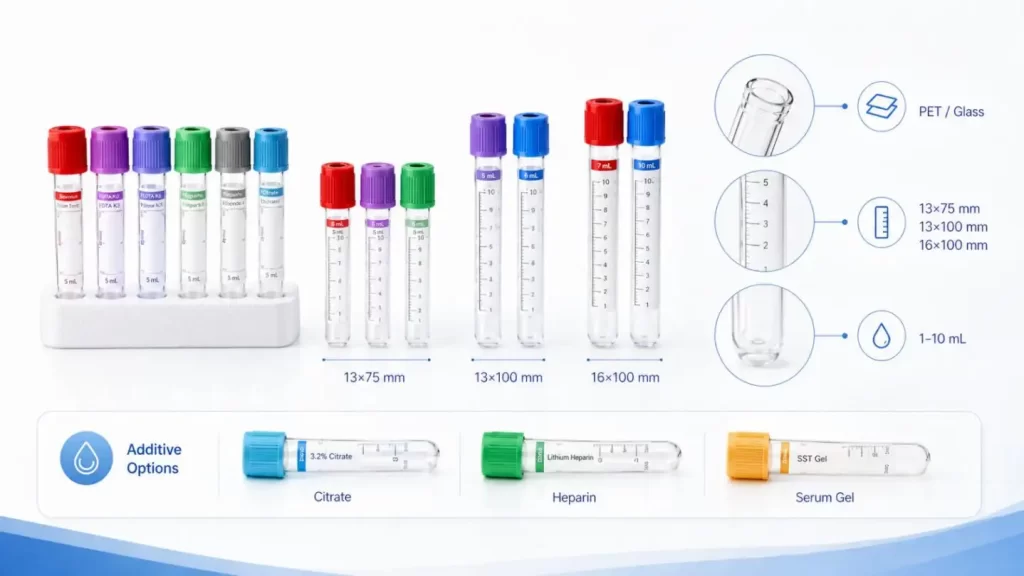
Trustlab's current vacuum-tube range includes PET or glass formats such as:
• 13×75 mm: Typically lower draw-volume configurations;
• 13×100 mm: Commonly used for higher volumes;
• 16×100 mm: Available for larger-volume applications;
• 1–10 mL: Depending on tube type and configuration.
The additive must be designed around the intended test:
Coagulation Tubes
Trustlab lists 3.2% sodium citrate, with 13×75 mm tubes covering 1–4 mL and 13×100 mm versions covering 5–7 mL. Here, OEM design must control draw volume and citrate-to-blood ratio together; changing only vacuum fill without reviewing additive proportion can change pre-analytical performance.
Heparin Tubes
Available configurations include lithium or sodium heparin in PET/glass tubes, with listed 1–4 mL and 5–7 mL formats. OEM decisions should define anticoagulant type, internal coating, required plasma volume, tube size, and analyzer compatibility.
Serum Separator Tubes
Trustlab lists gel + clot activator formats from 1–4 mL up to 7–10 mL across 13×75, 13×100, and 16×100 mm tubes. Here, gel quantity, separator behavior, tube geometry, centrifugation workflow, and shelf-life stability must be considered as one system.
Specimen Containers: Capacity, Closure and Transport Must Be Designed Together
For urine and specimen collection, Trustlab uses PP bodies with PE caps. Published configurations include 40 mL and 60 mL urine containers, while stool and formalin container ranges extend from approximately 30 to 120 mL.
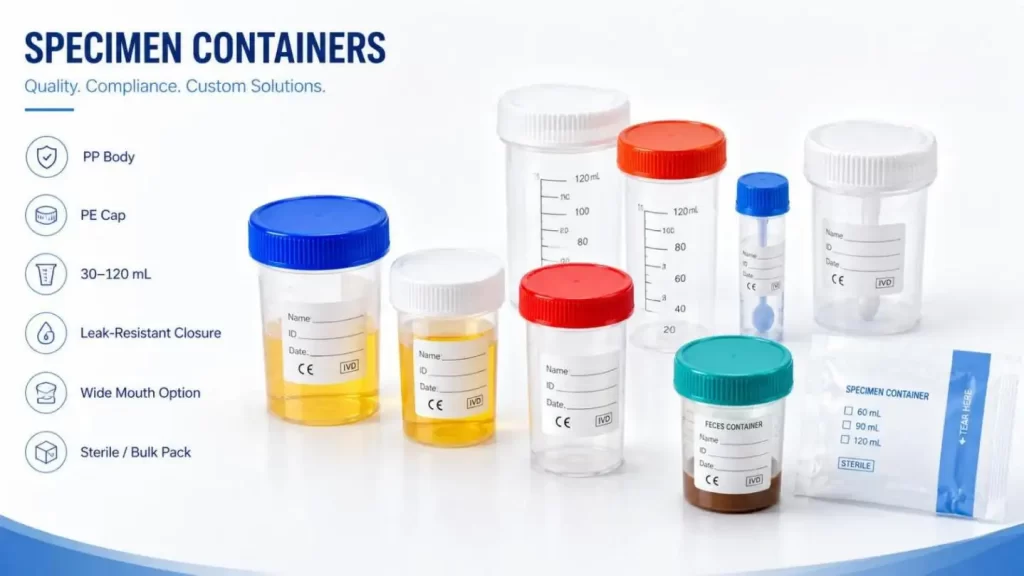
OEM specifications should define:
• Nominal and usable volume;
• Cup diameter and height;
• Wide-mouth or standard opening;
• Molded or printed graduations;
• PE screw-cap sealing geometry;
• Integrated sampling spoon where required;
• Transparent or opaque body;
• Sterile individual pack or bulk pack;
• Custom patient-identification label.
For transport applications, increasing capacity without reviewing thread engagement and headspace can increase leakage risk. Capacity and closure therefore cannot be specified independently.
Centrifuge, Cryogenic and Pipette Consumables Require Equipment Matching
Trustlab's PP microcentrifuge tubes are available in 0.5, 1.5 and 2 mL, while screw-cap centrifuge tubes include 10, 15 and 50 mL configurations. Bottom design can include conical or self-standing formats.
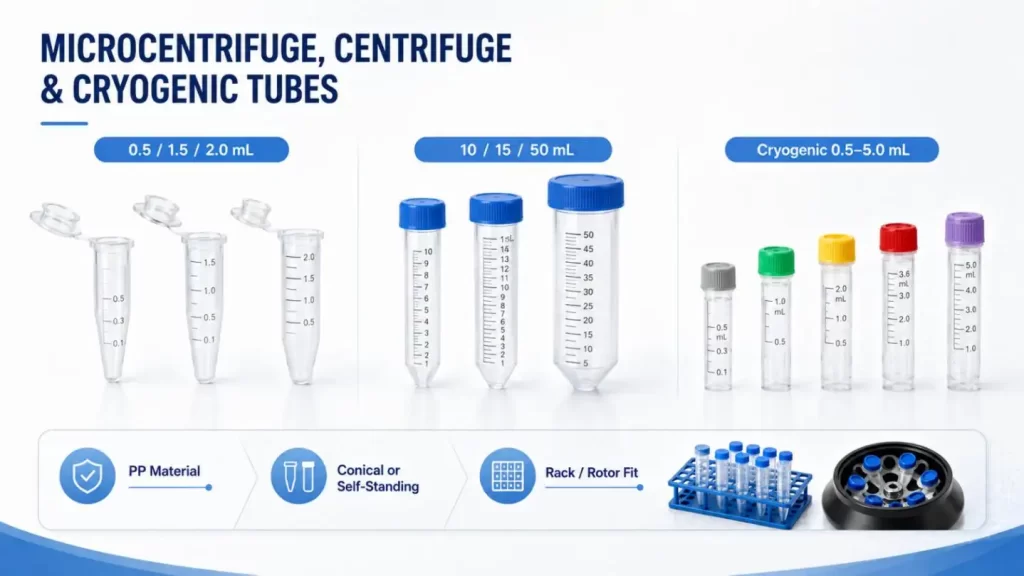
For OEM supply, buyers should specify:
• Maximum working volume;
• Tube OD and overall height;
• Conical, round or self-standing bottom;
• Snap cap vs screw cap;
• Graduation and writing area;
• Rotor/rack compatibility;
• Required centrifugal performance.
Cryogenic tubes require additional control of thread geometry, sealing and storage-system compatibility. Trustlab lists 0.5, 1.5, 1.8, 2.0 and 5.0 mL formats, including Φ10×47 mm, approximately Φ12×46 mm and larger 5 mL configurations.
Pipette tips use virgin PP and are currently listed in 10, 20, 200 and 1000 µL ranges. OEM design should prioritize pipette-cone fit, sealing position, tip length, orifice geometry and filter requirement before changing external appearance.
Standard, Private Label or Technical OEM?
| Requirement | Preferred Route |
| Existing material, size and function fit | Standard |
| Only logo/carton/label changes | Private Label |
| Volume, packaging or selected geometry changes | Semi-Custom |
| New material, interface or functional specification | Full OEM |
For Medical Consumable Supplies, semi-custom development often provides a better balance than redesigning every component.
Validate the Parameters That Actually Changed
OEM qualification should follow the changed characteristic:
• Material change: Biological evaluation, sterilization compatibility, aging.
• Dimension change: Tooling capability, fit, functional verification.
• Additive change: Concentration, filling accuracy, test performance.
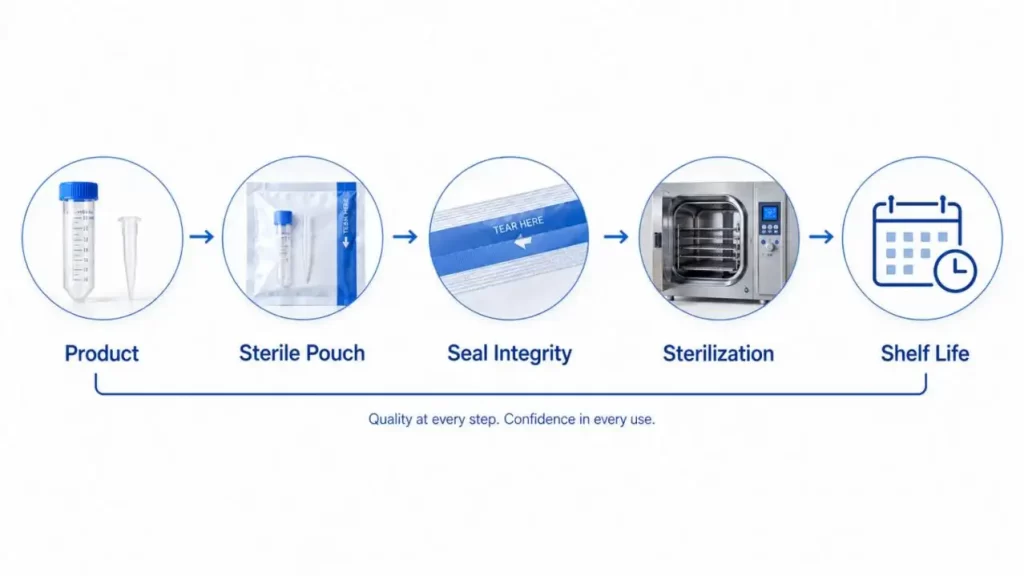
• Sterile packaging change: Seal integrity, sterilization and shelf life.
• Needle change: Gauge, connection, safety and sterile-package performance.
• Automation-related change: Rack, rotor, analyzer or liquid-handler compatibility.
Incoming inspection should then control critical dimensions, labels, seals, lot identity and packaging condition, while repeat orders require clear batch traceability and supplier change notification.
Select OEM Depth by Technical Need, Not Marketing Preference
The correct procurement decision is therefore not simply "OEM or standard Medical Consumable Supplies."
Hospitals and distributors should first provide Trustlab with the product category, material, dimensions, capacity, functional additive, equipment interface, sterile requirement, pack format, target market and annual demand. Trustlab's existing blood collection, sampling, centrifuge, cryogenic, pipette and life-science consumable platforms can then be used to determine whether the project should remain standard, move to private label, require selected specification changes, or justify a deeper OEM design.
This approach keeps customization tied to measurable clinical and procurement requirements rather than adding unnecessary manufacturing and validation complexity.
FAQs
Q1. What Medical Consumable Supplies does Trustlab provide?
Trustlab offers Medical Consumable Supplies in blood collection, sterile specimen collection, centrifuge tubes, cryogenic tubes, pipette tips, PCR, life science lab and research consumables, and others.
Q2. Can Trustlab provide OEM Medical Consumable Supplies?
Availability of OEM Medical Consumable Supplies is decided on a case to case basis depending upon the extent of modification needed. Prior to finalizing the OEM route, Trustlab’s team can discuss the requirements on dimensional aspects, capacity, packaging, labeling, functional configuration, and the required specifications.
Q3. Can Trustlab modify the sizes of medical consumables?
Dimensional modification is possible for certain Medical Consumable Supplies. These may include tube diameter, tube length, tube container size, tip size and shape, closure size, interfaces of equipment, and others. Tooling and validation would be determined based upon the extent of the modification.
Q4. What range of sizes are available for Trustlab Medical Consumable Supplies?
Depending on the category, the range of sizes available differs. Trustlab provides consumables where the working volume is in the micro range, to centrifuge tubes, to larger tubes, to cryogenic tubes, and specimen containers, and blood collection tubes, as well as pipette tips and other consumables.
Q5. Can Trustlab adjust the additives of blood collection tubes?
Select blood collection tubes can have additives such as sodium citrate, heparin, and clot activator, and separation gel, based on the requirements. An OEM modification would need to examine the draw volume, additive concentration, and the tubes in relation to the intended testing.
Written by
Trustlab
The author is a specialist at Ningbo Trustlab Instruments Co., Ltd., a leading provider of laboratory and medical consumables since 2015. With extensive experience in global healthcare and laboratory markets, they focus on delivering high-quality, innovative solutions and professional support to laboratories, hospitals, and distributors worldwide. Trustlab’s products are trusted in over 100 countries, reflecting the company’s commitment to reliability, excellence, and customer satisfaction.


