



Updated 3 weeks ago
Bulk EDTA Tubes for Distributors: Sizes, Additives, and Supply Planning
trustlabofficial

Unbranded EDTA blood collection tubes arranged for distributor procurement
For distributors sourcing bulk EDTA tubes, the main purchasing questions are usually practical: which sizes and additives are needed, what specifications should be checked, and what documentation should a supplier provide before a large order is placed?
EDTA tubes are commonly used for hematology specimens because EDTA prevents clotting by binding calcium ions. This page focuses on the distributor’s buying decision: tube configurations, K2 and K3 EDTA differences, specification checks, bulk supply planning, and supplier documentation. For broader product categories, see different types of vacuum blood collection tubes.
What Are EDTA Tubes and Why Do Distributors Stock Them?
An EDTA blood collection tube contains an EDTA anticoagulant that prevents the collected blood from clotting. EDTA tubes are primarily associated with complete blood count (CBC) and other hematology workflows, where maintaining suitable cellular characteristics is important. They may also be used in other laboratory workflows when the applicable method or product documentation supports their use.
Common distributor customers include:
- Clinical laboratories ordering routine hematology tubes
- Hospitals and clinics managing recurring blood collection demand
- Diagnostic laboratories using EDTA specimens for validated workflows
- Laboratory supply wholesalers serving multiple tube-size requirements
- Procurement teams that need consistent lots, packaging, and documentation
The exact suitability of a tube depends on its additive, nominal draw volume, material, vacuum, closure, labeling, and the requirements of the downstream laboratory method. A tube listed as “EDTA” should not automatically be treated as interchangeable with every other EDTA tube.
EDTA Tube Specifications: Sizes, Materials, and Additives
Distributors should evaluate EDTA tubes by configuration rather than by the word “EDTA” alone. The most relevant attributes include:
- Additive formulation: K2 EDTA, K3 EDTA, or another specified variant
- Nominal draw volume
- Tube dimensions
- Tube material, such as PET or glass
- Closure and stopper design
- Vacuum specification
- Cap color and labeling
- Sterility status, where applicable
- Package quantity and case configuration
- Lot identification and expiry information
Published manufacturer ranges differ. For example, BOENMED lists EDTA tube options from 1 mL to 10 mL and includes PET and glass variants, while other manufacturers list different combinations of volumes and dimensions. These figures should be treated as manufacturer-specific examples rather than universal industry ranges. See the BOENMED product information and the KDLNC specification guide for examples of how suppliers present these attributes:
| Specification | Why it matters to distributors | What to verify |
|---|---|---|
| Additive | Determines the anticoagulant formulation supplied to the customer | K2, K3, or another specified EDTA variant |
| Nominal draw volume | Helps match the tube to the customer’s collection and testing workflow | Confirm the stated volume and fill requirement |
| Tube dimensions | Affect rack, holder, transport, and workflow fit | Verify length and diameter from the exact product data |
| Material | Affects handling, shipping weight, and breakage risk | Confirm PET, glass, or another stated material |
| Vacuum | Controls the intended draw volume | Request the manufacturer’s vacuum specification or test information |
| Fill line | Helps assess whether the tube has been filled correctly | Confirm visible marking and acceptable fill range |
| Closure | Supports containment and handling requirements | Verify stopper and cap configuration |
| Sterility status | Determines whether the product may be used in a workflow requiring sterile collection components | Confirm from the product documentation; do not infer from “clean” or “hygienic” wording |
| Packaging | Affects storage, transport, inventory, and resale | Confirm tubes per bag, box, and case |
| Traceability | Supports complaint handling, recalls, and lot management | Verify lot number, expiry date, and CoA availability |
PET vs. Glass: Material Comparison for Bulk Buying
PET tubes are commonly selected when shatter resistance, lower shipping weight, and easier handling are priorities. Glass tubes may still be preferred for particular laboratory workflows or customer specifications.
For distributors, material selection affects:
- Breakage risk during international transport
- Shipping weight and freight cost
- Warehouse handling requirements
- Customer preference and existing equipment
- Packaging and protective-case requirements
Material should remain a separate specification from additive type and volume. A PET K2 tube and a glass K3 tube are different configurations even if they have the same nominal draw volume.
K2 EDTA vs. K3 EDTA: What Distributors Need to Know
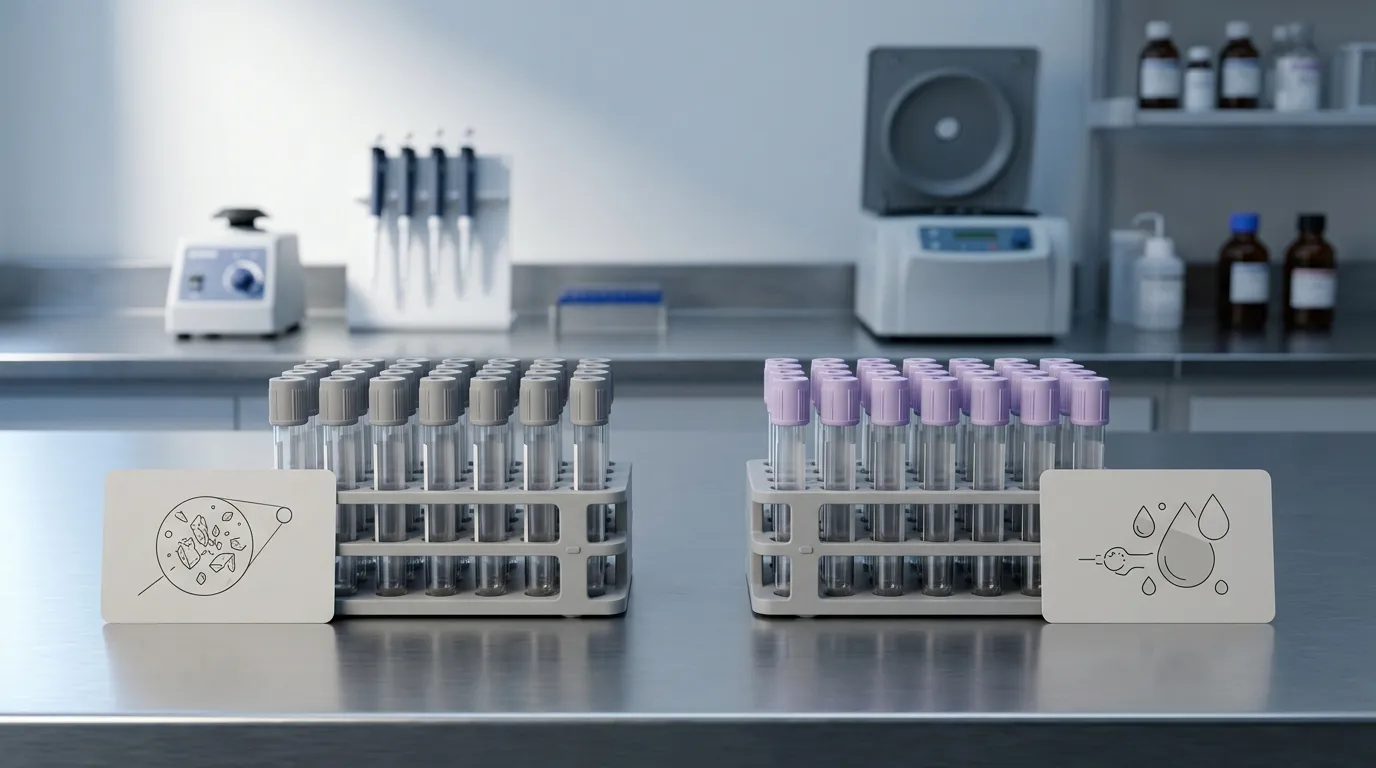
K2 EDTA is generally supplied as a spray-dried additive, while K3 EDTA is generally supplied in liquid form. The liquid additive in K3 tubes can introduce greater sample dilution than a spray-dried formulation. Both formulations appear in commercial product ranges, and the appropriate choice depends on the customer’s laboratory method, analyzer requirements, and purchasing specification.
| Comparison point | K2 EDTA | K3 EDTA |
|---|---|---|
| Additive form | Commonly spray-dried | Commonly liquid |
| Sample dilution consideration | Designed to minimize additive-related dilution | Liquid additive can create greater dilution |
| Common purchasing question | Preferred by some laboratories for hematology workflows | Requested by some customers and manufacturers |
| Distributor implication | Confirm whether the customer specifies K2 | Confirm whether the customer specifies K3 |
| Evidence needed | Product-specific additive and dosage information | Product-specific additive concentration and dosage information |
K2 and K3 should not be presented as universally interchangeable or as having one winner for every laboratory. KDLNC presents K2 as a preferred formulation in its comparison guidance, while Nasmed Diagnostic promotes a K3 product and gives product-specific K3 parameters. These are manufacturer positions and should not be treated as a universal consensus.
For example, Nasmed states a K3 formulation of 15% w/v with a stated dosage of 1.5 mg/mL for its product. That figure belongs to the cited product and should not be transferred to other manufacturers or Trustlab products without exact documentation. Its page also provides product-specific information about vacuum tolerance, sterilization, and sample stability:
Some product ranges also list EDTA NA2. If a customer requests NA2, the distributor should confirm the exact additive designation, dosage, intended workflow, and product documentation rather than treating it as a substitute for K2 or K3.
For a wider comparison of vacuum tube categories, use vacuum blood collection tubes.
Specifications That Matter for Bulk Procurement
Before committing to a large order, distributors should verify the specifications that can affect specimen quality, handling, and customer acceptance.
Vacuum and Fill Volume
The tube’s vacuum is intended to draw a defined amount of blood. The resulting blood-to-additive ratio depends on both the additive dosage and the amount of blood collected.
A tube that is underfilled may contain too much additive relative to the blood volume. Overfilling can also create problems if the tube exceeds its intended capacity. For this reason, distributors should request the supplier’s stated draw-volume tolerance and confirm how fill accuracy is controlled.
Nasmed reports a vacuum tolerance of ±10% for the specific product described on its page. This should be treated as a product-specific manufacturer claim, not a universal value for all EDTA tubes.
Additive Concentration and Blood-to-Additive Ratio
The additive must be appropriate for the intended nominal draw volume. Distributors should verify:
- Additive type
- Additive concentration or dosage
- Nominal draw volume
- Acceptable fill range
- Mixing instructions, if supplied
- Product-specific storage and expiry information
Tube components and additives can influence laboratory measurements. A peer-reviewed review in PubMed Central discusses how blood collection tube components can interfere with clinical chemistry assays, supporting the need to evaluate tube design and materials rather than selecting only by price: Interferences from blood collection tube components on clinical chemistry assays.
Sterilization and Sterility Documentation
If a product is described as sterile, the claim should be supported by product-specific documentation. Distributors should ask:
- Is the tube sterile or non-sterile?
- What sterilization method was used?
- Was sterilization validated for the product and packaging?
- Is a sterility assurance level documented?
- Does the documentation apply to the exact product and lot?
EO and gamma sterilization are different processes. Nasmed describes EO sterilization to a stated SAL of 10−6 for its product. That information should remain attached to the cited product and must not be generalized to another supplier’s tube.
“Clean,” “hygienic,” and “contamination-free” are not substitutes for a verified sterile status.
Labeling and Traceability
For distribution, clear labeling is as important as the tube specification itself. Verify that the packaging identifies:
- Product name and additive
- Nominal draw volume
- Lot or batch number
- Expiry date
- Manufacturer or responsible supplier
- Storage conditions
- Package quantity
- Applicable warnings or handling information
The label, outer carton, specification sheet, and CoA should describe the same product configuration. If they do not match, resolve the discrepancy before placing a bulk order.
Bulk Supply Planning for Distributors
Bulk purchasing requires more than comparing a unit price. The order should fit the distributor’s customer demand, warehouse capacity, product mix, and replenishment schedule.
Plan Inventory by Configuration
Do not forecast only “EDTA tubes.” Separate the expected demand by:
- K2, K3, or other additive variant
- Nominal draw volume
- PET or glass
- Cap and label configuration
- Sterile or non-sterile status, where applicable
- Package and case quantity
- Destination-market labeling requirements
A distributor may need several EDTA configurations even when customers use the same general tube category. Mixing variants in one inventory line can lead to incorrect fulfillment or slow-moving stock.
Confirm MOQ and Pricing Structure
Wholesale directories show wide variation in minimum order quantities. Made-in-China listings include examples ranging from 10,000 to 100,000 pieces, but directory listings are not a universal benchmark or a commitment from any particular supplier.
Ask each supplier to confirm:
- MOQ for each exact configuration
- Whether mixed sizes or additives can be combined in one order
- Price breaks by volume
- Packaging quantity and case dimensions
- Sample-order terms
- Production and dispatch timing
- Reorder conditions
- Documentation supplied with each lot
Do not assume that a larger order automatically provides better value. Storage cost, expiry management, slow-moving variants, and customer-specific requirements can offset a lower unit price.
Test Samples Before a Large Commitment
Sample evaluation can reduce the risk of ordering a configuration that does not meet customer or laboratory requirements. Before approving a bulk order, distributors should compare the sample against the agreed specification, including:
- Tube material and dimensions
- Additive designation
- Nominal draw volume
- Cap and stopper fit
- Label readability
- Vacuum and fill behavior, where testing is available
- Packaging integrity
- Lot and expiry information
- Customer or laboratory acceptance criteria
Any laboratory testing should follow the applicable method, equipment instructions, and customer quality requirements. A sample check does not replace product-specific regulatory or technical documentation.
Plan for Supply Continuity
A reliable supply plan should identify:
- Expected monthly or quarterly demand
- Minimum stock level
- Reorder trigger
- Alternative approved configuration, if one exists
- Documentation required for each new lot
- Procedure for handling a delayed or nonconforming shipment
A substitute tube should not be introduced simply because it has the same nominal volume. The additive, material, dimensions, closure, vacuum, sterility status, and customer acceptance requirements must also be reviewed.
Supplier Documentation: What to Request Before Ordering

Before ordering bulk EDTA tubes, distributors should request a Certificate of Analysis, batch traceability information, product specifications, sterilization documentation where applicable, and evidence supporting any claimed certification or conformity status.
Recommended Documentation Checklist
| Document or record | What it should help verify |
|---|---|
| Product specification sheet | Additive, volume, dimensions, material, closure, and packaging |
| Certificate of Analysis | Lot-specific quality results and release information |
| Batch or lot traceability record | Link between shipment, production lot, and quality records |
| Sterilization documentation | Process and validation evidence for a product described as sterile |
| Label and packaging artwork | Product identity, lot number, expiry, and package quantity |
| Storage and shelf-life information | Conditions required to preserve product integrity |
| Applicable certificate | Scope, holder, product or management-system coverage, and validity |
| Technical or usage document | Handling, filling, mixing, storage, or other applicable instructions |
A quality-management certificate such as ISO 13485 applies to the certified management-system scope. It should not automatically be rewritten as product-level CE approval, FDA status, clinical validation, sterility evidence, or proof that every item in a catalog meets a particular standard.
The FDA has published documentation for a BD K2EDTA blood collection tube product, illustrating how product-specific regulatory documentation is tied to a defined product and manufacturer rather than to all EDTA tubes generally: BD Vacutainer K2EDTA product document.
For a broader supplier-quality framework, see how to evaluate blood collection system supplier quality.
Common Bulk Buying Mistakes and How to Avoid Them
Choosing by Unit Price Alone
A low price does not confirm that the tube has the required additive, vacuum, material, documentation, packaging, or lot consistency. Compare the complete specification and documentation package.
Ordering the Wrong EDTA Formulation
K2, K3, and NA2 should remain separate inventory options unless the customer’s requirements confirm that they are interchangeable for the intended workflow. Confirm the formulation before quoting or substituting.
Ignoring Nominal Volume and Fill Requirements
A tube’s dimensions do not establish its draw volume. Verify the nominal volume, fill line, and acceptable fill range from the exact product specification.
Treating Certification Language as Proof of Product Approval
Ask what the certificate covers, who holds it, which products or sites are included, and whether it is a QMS certificate or product-level conformity documentation.
Skipping Sample Evaluation
A sample order allows the distributor and customer to identify issues with labeling, closure fit, vacuum behavior, packaging, or documentation before a larger commitment.
Failing to Track Lots and Expiry Dates
Bulk stock should be managed by lot and expiry, not only by product name. This supports customer queries, complaint handling, and controlled rotation of inventory.
Mixing Supplier Data with Trustlab Data
Specifications published by BOENMED, KDLNC, or Nasmed should not be presented as Trustlab specifications. If a distributor is evaluating Trustlab EDTA tubes, request the current Trustlab specification sheet and exact product documentation for the required configuration.
Sourcing Bulk EDTA Tubes for Your Distribution Business
Trustlab’s website presents a broader blood collection system portfolio, but the exact EDTA tube sizes, additives, packaging, certifications, and commercial terms must be confirmed from current product-specific documentation.
When contacting Trustlab about bulk EDTA tubes, provide:
- Required K2, K3, or other additive
- Nominal draw volumes
- Preferred PET or glass material
- Expected order quantity
- Destination market
- Packaging and labeling requirements
- Required quality or regulatory documents
- Sample-testing requirements
- Expected replenishment schedule
Request the specification sheet, current quotation, sample information, and applicable documentation for each exact configuration before approving a bulk order. This keeps the purchasing decision tied to the product, variant, and evidence actually supplied rather than to general category language.