


Updated 1 month ago
Medical Consumables for Hospitals: Advanced Materials Guide
Arafatshuvo

Medical Consumables for Hospitals
For Medical Consumables for Hospitals, material selection is not simply a question of choosing "medical-grade plastic." In products that contact blood or diagnostic specimens, the tube polymer, closure, additive, separator gel and needle must function as one system.
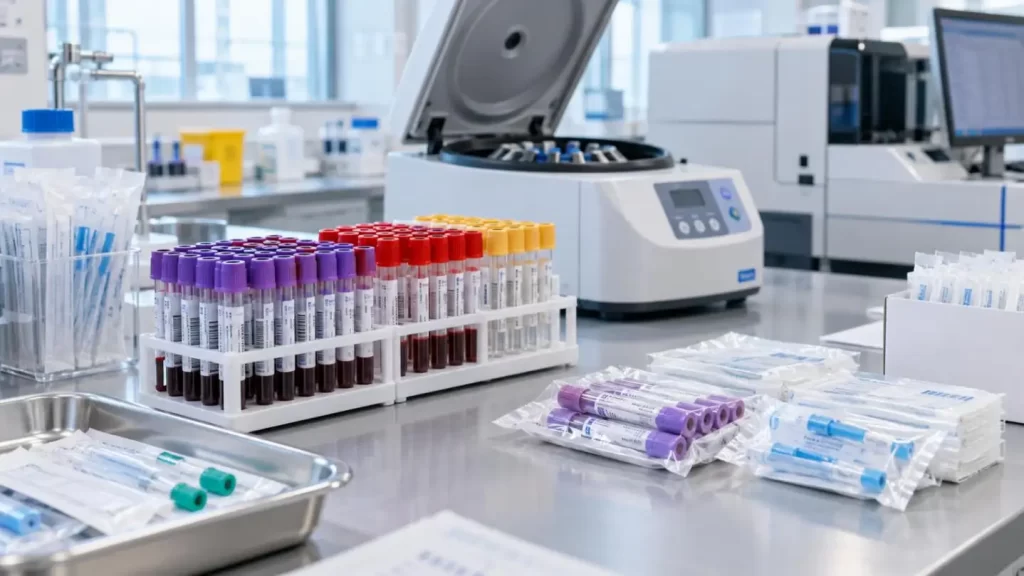
This is especially clear in blood collection. A tube may appear mechanically simple, but its material must maintain vacuum, resist breakage, remain compatible with additives and preserve the specimen until analysis. At Trustlab, the blood collection range illustrates how these engineering variables translate into practical product specifications: PET or glass tubes, 13×75 mm, 13×100 mm and 16×100 mm formats, with nominal draw volumes of approximately 1–10 mL depending on tube type.
Why PET and Glass Behave Differently in Blood Collection
Among Medical Consumables for Hospitals, evacuated blood tubes place unusual demands on material barrier properties.
The main attraction of PET is its lightweight and shatter resistance. Glass provides better chemical inertness and more effective barriers to the passage of air and moisture. With regard to blood collection, the barrier must remain capable of retaining a sufficiently strong negative pressure to collect and contain blood for the length of time that the container is expected to be serviceable.
For procurement teams, this means tube material cannot be evaluated independently from draw-volume stability.
Key questions include:
•Does the tube maintain its specified vacuum after storage and transportation?
•Is the polymer compatible with the additive or separation gel?
•Will tube dimensions fit centrifuges, racks and automated analyzers?
•Has the complete tube-and-closure system been validated, rather than the raw material alone?
For Trustlab blood collection tubes, the three published dimensions—13×75, 13×100 and 16×100 mm—also provide different usable ranges for specimen volume and laboratory workflow.
Draw Volume Is a Functional Specification, Not Just Capacity
A common mistake when sourcing Medical Consumables for Hospitals is treating nominal draw volume as container capacity.
In an evacuated blood collection tube, these are different parameters. The nominal volume is the amount of blood that the vacuum system is designed to draw. This matters particularly for anticoagulant tubes, because changing the blood volume changes the effective blood-to-additive ratio.
Consider coagulation testing.
Trustlab offers 3.2% sodium citrate tubes in:
| Tube Size | Published Draw Volume |
| 13×75 mm | 1–4 mL |
| 13×100 mm | 5–7 mL |
Trustlab's specifications link tube size, vacuum fill and additive configuration rather than treating them as independent options.
For coagulation specimens, 3.2% sodium citrate is commonly used at a 9:1 blood-to-citrate volume ratio. Significant underfilling leaves proportionally too much citrate, which can alter calcium-dependent coagulation measurements.
The engineering relationship is therefore:
Vacuum retention → Collected blood volume → Additive ratio → Specimen quality → Analytical result
This is why vacuum consistency is a performance parameter, not merely a convenience feature.
Separator Gel Is Also an Engineered Material
Advanced materials in Medical Consumables for Hospitals include more than the tube wall.
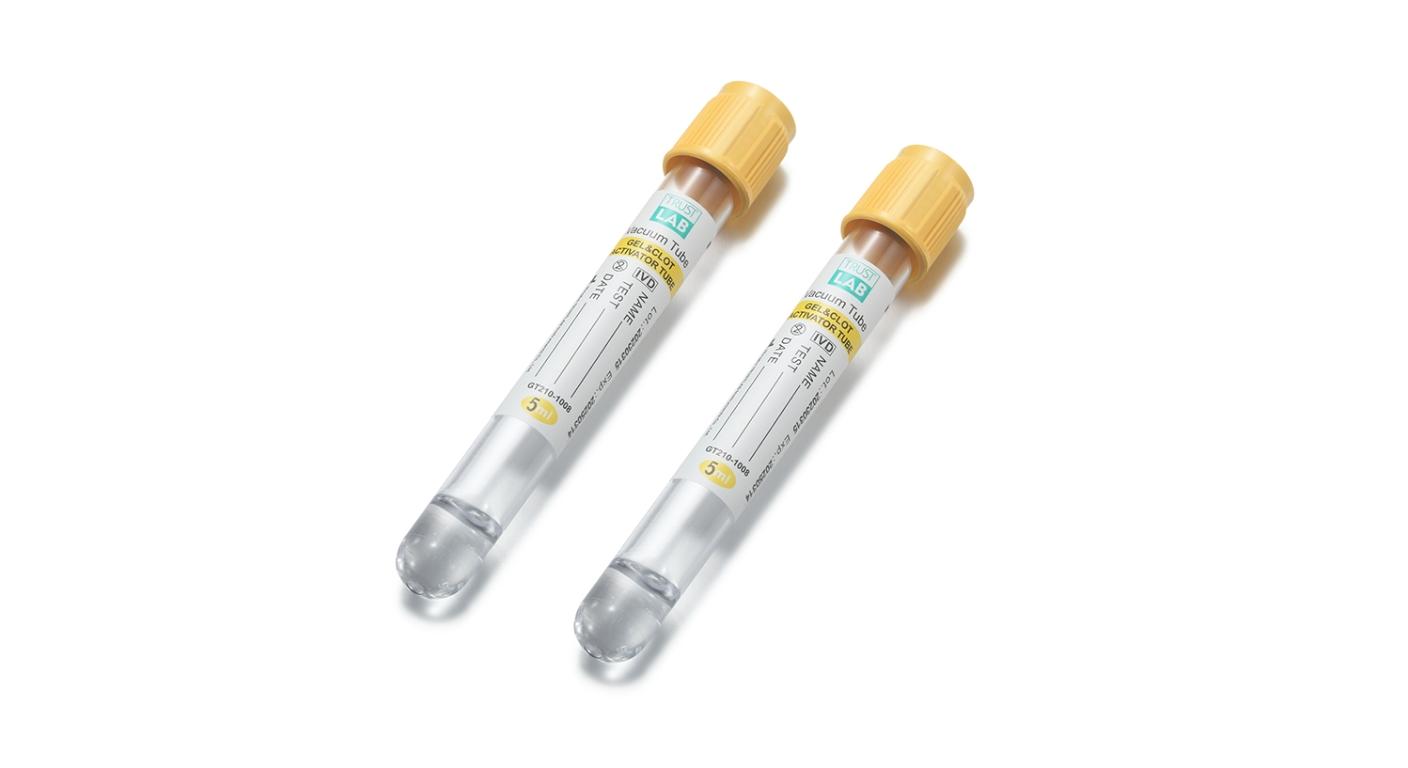
Trustlab's SST configuration combines a clot activator and separator gel. Published specifications include:
| Tube | Material | Draw Volume |
| 13×75 mm | PET / Glass | 1–4 mL |
| 13×100 mm | PET / Glass | 5–7 mL |
| 16×100 mm | PET / Glass | 7–10 mL |
The tubes are listed with a 4–25°C storage temperature and packaging of 1,200 pieces per carton.
During centrifugation, the separator gel moves toward the interface between serum and cellular components. Its formulation must therefore work with tube geometry, specimen density and the intended centrifugation protocol. Once positioned correctly, the barrier helps reduce remixing during downstream handling.
For buyers, "gel tube" is consequently not a complete specification. Gel behavior, tube material, nominal volume and laboratory centrifugation conditions should be assessed together.
Needle Geometry Must Match the Collection System
The needle is another material-and-geometry decision within Medical Consumables for Hospitals.
Trustlab's multi-sample blood collection needle is available in 19G, 20G, 21G, 22G, 23G, 24G, 25G and 27G and is supplied EO sterile.
Gauge selection affects blood-flow characteristics and must match the vein, specimen requirement and clinical workflow. Therefore, a hospital purchasing a blood collection system should evaluate the needle, holder and evacuated tube as an integrated system rather than qualifying each component in isolation.
Material Performance Still Requires Standards-Based Verification
Advanced materials do not automatically make Medical Consumables for Hospitals compliant.
For venous blood specimen containers, ISO 6710:2017 specifies requirements and test methods for evacuated and non-evacuated single-use containers and remains current after confirmation in 2023.
Other relevant frameworks include:
•ISO 13485:2016 for medical-device quality management systems.
•ISO 10993-1:2025 for biological safety evaluation within a risk-management process when applicable to device contact and exposure.
•CLSI PRE02 for standardized venous blood specimen collection practices.
For hospital and distributor procurement, documentation should therefore extend beyond a statement that a polymer is "medical grade." Buyers should verify the finished product specification, material traceability, additive configuration, sterilization status, dimensional tolerances and intended clinical application.
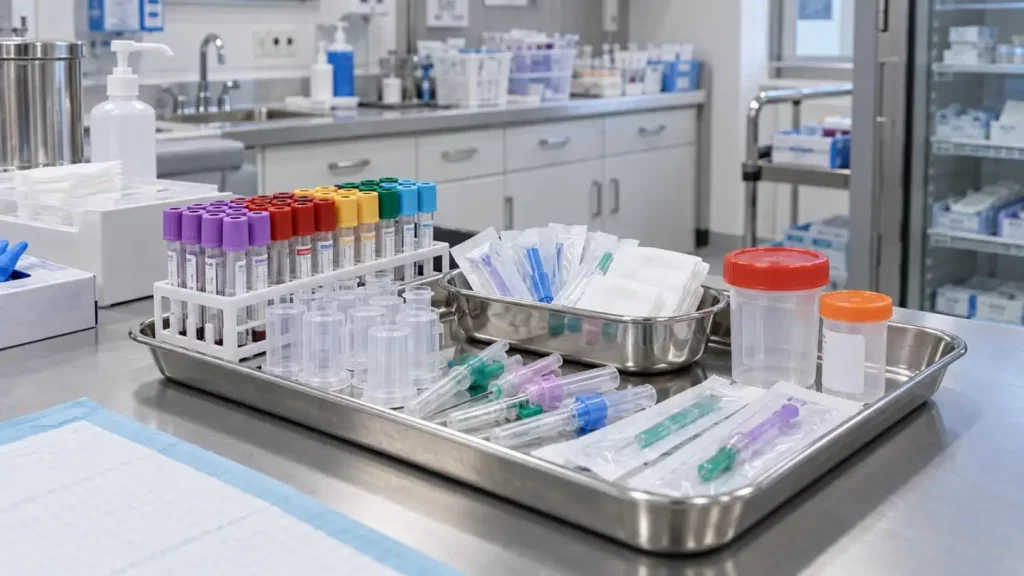
Engineering Medical Consumables as Complete Systems
The performance of Medical Consumables for Hospitals increasingly depends on interactions between materials rather than on one material property alone.
A blood collection tube demonstrates this clearly: PET or glass affects mechanical and barrier behavior; vacuum determines draw volume; the additive controls specimen chemistry; separator gel affects post-centrifugation stability; and needle geometry influences collection workflow.
Trustlab's Blood Collection System brings these components into a portfolio covering vacuum and non-vacuum tubes, micro blood collection tubes, blood collection needles, safety collection sets and ESR products. Its tube configurations provide PET/glass options, multiple standardized dimensions and approximately 1–10 mL draw-volume choices for different laboratory requirements.
For hospitals, laboratories and distributors evaluating Medical Consumables for Hospitals, reviewing these specifications at system level is more useful than comparing products only by material name or unit price. Trustlab's Blood Collection System provides a practical starting point for matching tube material, volume, additive and collection components to specific diagnostic workflows.
FAQs
Q1. What Medical Consumables for Hospitals does Trustlab provide?
Trustlab's blood collection portfolio includes vacuum blood collection tubes, non-vacuum tubes, micro blood collection tubes, blood collection needles, safety blood collection sets, and ESR tubes and racks. These products are intended for clinical blood collection and laboratory workflows.
Q2. What materials are used in Trustlab blood collection tubes?
Trustlab offers blood collection tubes manufactured from PET and glass. PET provides lower weight and better resistance to breakage, while glass offers high chemical inertness and stronger gas and moisture barrier properties.
Q3. What blood collection tube sizes does Trustlab offer?
Trustlab offers the standard tube dimensions including:
•13 × 75 mm
•13 × 100 mm
•16 × 100 mm
These dimensions support different draw volumes, additives, and laboratory workflows.
Q4. What draw volumes are available for Trustlab blood collection tubes?
Trustlab's blood collection tube portfolio covers approximately 1–10 mL, depending on tube type and dimensions. For its Gel & Clot Activator SST tube, the configurations are 1–4 mL for 13×75 mm, 5–7 mL for 13×100 mm, and 7–10 mL for 16×100 mm.
Q5. How does Trustlab's Gel & Clot Activator Tube work?
The tube combines a clot activator with separation gel. The clot activator promotes coagulation, while centrifugation moves the gel to the interface between serum and cellular components, creating a physical barrier that helps maintain separated serum. Trustlab offers it for clinical chemistry, serology, immunology, and routine hospital sample processing.