


Updated 1 month ago
PPE Medical Consumables: PP, SMS & SMMS Material Selection

Trustlab
The author is a specialist at Ningbo Trustlab Instruments Co., Ltd., a leading provider of laboratory and medical consumables since 2015. With extensive experience in global healthcare and laboratory markets, they focus on delivering high-quality, innovative solutions and professional support to laboratories, hospitals, and distributors worldwide. Trustlab’s products are trusted in over 100 countries, reflecting the company’s commitment to reliability, excellence, and customer satisfaction.

PPE Medical Consumables
For PPE Medical Consumables, selecting a nonwoven material by GSM alone is a common sourcing mistake. A 40 GSM fabric tells us its mass per unit area—it does not tell us how the fibers are distributed, how much meltblown material is present, how the web is bonded, or how the finished gown or shoe cover will perform.

At Trustlab, we look at PPE Medical Consumables as a complete material–product–process system. The practical question is not simply "SMS or SMMS?" but:
What material structure delivers the required barrier, mechanical strength, comfort and converting stability for the finished PPE product?
PP, SMS and SMMS Are Not Equivalent Material Categories
PP is polypropylene, the polymer from which many disposable medical nonwovens are produced. SMS and SMMS describe how PP fibers are arranged into multilayer structures.
• S — Spunbond: continuous, relatively larger fibers providing tensile strength, abrasion resistance and dimensional stability.
• M — Meltblown: much finer fibers producing a denser and more tortuous pore structure.
• SMS: Spunbond / Meltblown / Spunbond.
• SMMS: Spunbond / Meltblown / Meltblown / Spunbond.
• SSMMS: additional spunbond layers may improve surface integrity and processing behavior.
This distinction matters when specifying PPE Medical Consumables. "100% PP" describes polymer composition; it does not define barrier performance.
Why GSM Cannot Be Used as a Protection Rating
ISO 9073-1 defines a method for determining mass per unit area of nonwovens. GSM is therefore an important production-control parameter, but it is not a protection classification.
Two fabrics at the same GSM can differ because of:
• Meltblown-to-spunbond ratio;
• Fiber diameter and pore distribution;
• Cross-web basis-weight uniformity;
• Thermal-bond pattern and bonding area;
• MD/CD tensile properties;
• Hydrophobic or other surface treatment;
• Converting damage during cutting or welding.
For PPE Medical Consumables, a more useful specification combines material construction with measurable finished-product requirements.
Parameters We Consider Together
| Parameter | Engineering Impact | Procurement Risk if Ignored |
| GSM | Material mass, strength, cost | Over-specification or insufficient strength |
| M-layer distribution | Barrier uniformity | Local weak areas |
| MD/CD tensile strength | Garment durability | Tearing during wear |
| Hydrostatic resistance | Liquid barrier | Unexpected fluid penetration |
| Air permeability | Thermal comfort | Excessive heat and moisture |
| Surface treatment | Wetting/repellency behavior | Incorrect application performance |
| Seam integrity | Finished-product barrier | Fabric passes but garment fails |
SMS vs. SMMS: More Layers Do Not Automatically Mean Better PPE
SMMS gives manufacturers more opportunity to distribute meltblown material across multiple layers, but layer count alone does not establish performance.
A controlled SMS with adequate meltblown content and uniform formation may outperform an SMMS construction with thinner, inconsistent M layers.
This is particularly important in PPE Medical Consumables procurement, where material names are sometimes treated as grades.
A more technical comparison is:
Polymer → Fiber formation → Layer ratio → Pore structure → Bonding → Finishing → Converting → Finished-product test
Not simply:
SMS < SMMS < SSMMS
Matching Material Architecture to PPE Medical Consumables
At Trustlab, material selection follows the application rather than applying one fabric across every disposable PPE category.
| PPE Application | Material Direction | Primary Design Requirement |
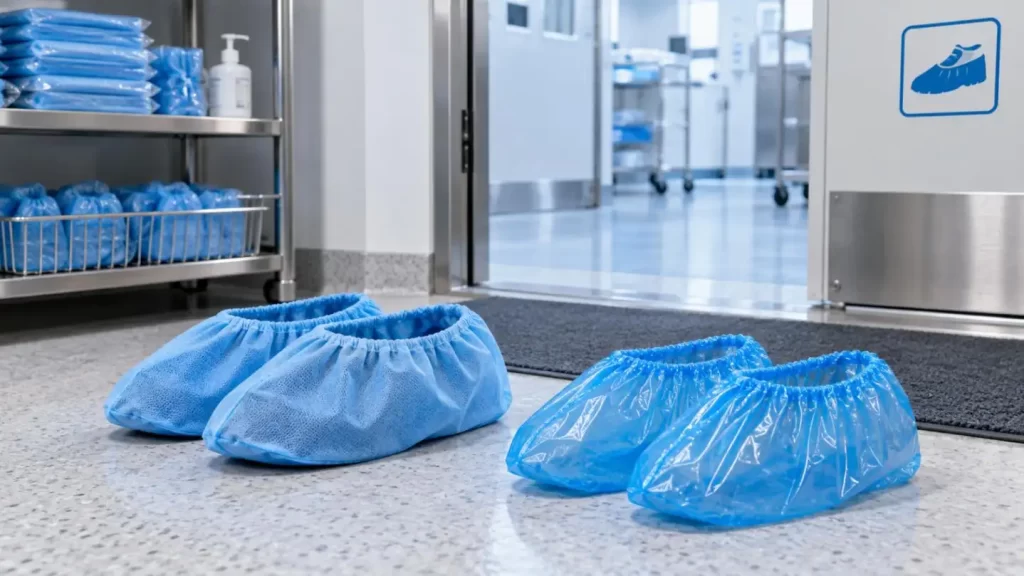
| Basic shoe cover | PP spunbond | Breathability, strength, economy |
| Isolation/patient gown | SMS | Barrier–comfort balance |
| Higher-fluid-exposure apparel | SMMS/advanced laminate* | Enhanced barrier design |
| Waterproof footwear protection | CPE film | Liquid impermeability |
| Caps/light hygiene products | Lightweight PP | Comfort and particle control |
*Final material selection should be based on the required product standard and validated configuration.
These are different PPE Medical Consumables because the exposure conditions—and therefore the material engineering priorities—are different.

Converting Can Change the Performance of a Good Nonwoven
Material qualification does not end when a roll passes incoming inspection.
During production, manufacturers must control:
• Roll width and edge condition;
• Web tension and alignment;
• Cutting accuracy;
• Ultrasonic welding energy and pressure;
• Horn/anvil condition;
• Seam geometry;
• Elastic attachment.
Too much ultrasonic energy can thin or perforate the bonding zone. Too little energy can create an incomplete seam.
This is why changing from 35 GSM SMS to another GSM—or replacing SMS with SMMS—should trigger process re-evaluation, not only a material-price comparison.
Barrier Tests Must Match the Actual Risk
Different tests measure different failure mechanisms.
ISO 16603 evaluates resistance to penetration by synthetic blood and remains current following its 2025 review. ANSI/AAMI PB70:2022 addresses liquid-barrier performance and classification of protective apparel and drapes used in healthcare facilities.
For buyers of PPE Medical Consumables, three distinctions are essential:
• High GSM ≠ high protection classification
• Water resistance ≠ blood/viral penetration resistance
• Passing fabric ≠ passing finished garment
Seams, closures, critical zones and product construction must be considered together with the base material.
What Should Be Included in a PPE Medical Consumables RFQ?
Instead of requesting "40 GSM SMS, best price," a technical RFQ should define:
• Intended product and use environment;
• Material structure and polymer;
• GSM and tolerance;
• Dimensions and size range;
• Required barrier performance;
• Tensile or mechanical requirements;
• Surface treatment;
• Sterile/non-sterile condition;
• Packaging configuration;
• Destination market and applicable standard;
• Documentation required: TDS, COA and relevant test reports.
At Trustlab, our published manufacturing approach emphasizes strict quality control, professional product development and adaptation to specific application scenarios.
That approach is especially important for PPE Medical Consumables, where a small change in material, thickness, dimensions or converting conditions can change the performance of the finished product.
From Material Specification to a Stable PPE Product
Good PPE Medical Consumables engineering starts with the actual exposure risk, translates that risk into measurable material and product requirements, and validates the complete finished configuration.
For distributors, healthcare suppliers and OEM projects, Trustlab can use its existing PP nonwoven, SMS and CPE-based PPE Medical Consumables as reference platforms when discussing material, dimensions, packaging and application-specific configurations.
Rather than selecting a product from GSM alone, start with the performance you need. Explore Trustlab’s medical and laboratory solutions and share your target product specification with the Trustlab team for technical evaluation.
FAQs
Q1. What PPE Medical Consumables does Trustlab supply?
Trustlab supplies disposable PPE Medical Consumables for medical, laboratory, cleanroom and hygiene applications. The products include SMS patient surgical gowns, PP nonwoven shoe covers and waterproof CPE shoe covers, alongside a broader medical and laboratory consumables portfolio.
Q2. What material does Trustlab use for its disposable surgical gowns?
Trustlab's Patient Surgical Gown is specified as 100% polypropylene SMS nonwoven fabric. It is disposable and non-sterile, with S, M, L and XL size options.
Q3. How does Trustlab select materials for PPE Medical Consumables?
Material selection should consider the intended use, required barrier level, mechanical strength, comfort, dimensions and converting requirements. Trustlab describes its manufacturing approach as combining strict quality control, professional product development and precise adaptation to application scenarios.
Q4. Can buyers request private-label packaging from Trustlab?
Trustlab supports OEM and private-label discussions for medical consumables. Packaging, labeling and branding requirements should be defined during the RFQ stage so that they can be evaluated together with product specifications and manufacturing requirements.
Q5. Can Trustlab provide customized PPE Medical Consumables?
Trustlab publicly describes OEM customization as a case-by-case process depending on the extent of modification required. Relevant variables can include dimensions, material configuration, packaging, labeling and functional requirements.
Written by
Trustlab
The author is a specialist at Ningbo Trustlab Instruments Co., Ltd., a leading provider of laboratory and medical consumables since 2015. With extensive experience in global healthcare and laboratory markets, they focus on delivering high-quality, innovative solutions and professional support to laboratories, hospitals, and distributors worldwide. Trustlab’s products are trusted in over 100 countries, reflecting the company’s commitment to reliability, excellence, and customer satisfaction.