


Updated 1 week ago
ODM Rapid Diagnostic Tests: From Product Brief to Export
trustlabofficial

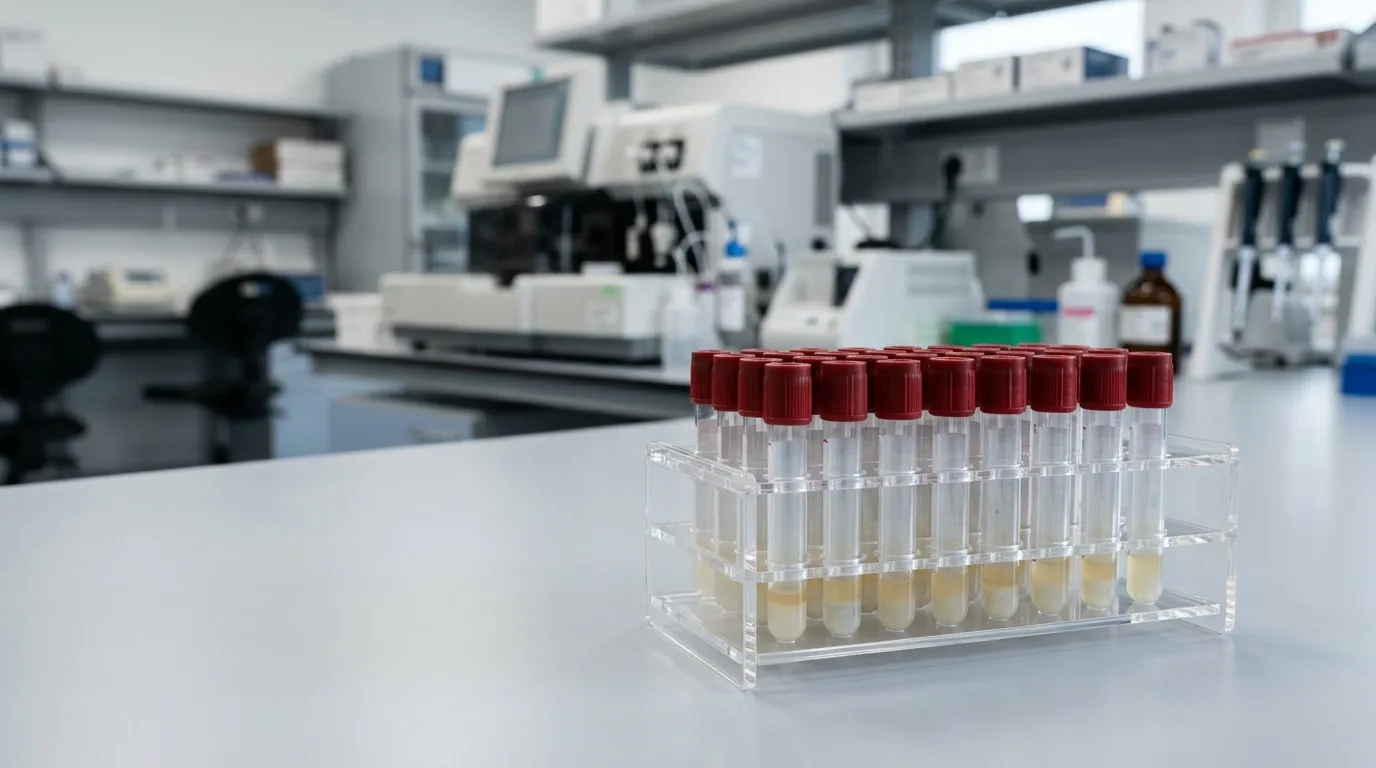
Unbranded ODM rapid test cassette with blank packaging and export documents on a lab procurement desk.
ODM rapid diagnostic tests are rapid tests designed and manufactured by a supplier according to a buyer's product brief—so the buyer can sell the finished tests under its own brand. The "ODM" in this context stands for Original Design Manufacturer, not the unrelated CDISC ODM standard used for clinical data exchange. This guide follows the practical path: what ODM means for rapid tests, how to write a clear product brief, how the manufacturing workflow works, and what documents you need before the tests leave the factory and enter your market.
What Is an ODM Rapid Diagnostic Test?
An ODM manufactures a product designed by the manufacturer itself, but tailored to a buyer's specifications. In the rapid diagnostic test (RDT) market, that usually means a supplier takes your product brief—target marker, specimen type, packaging, private-label branding and target market—and handles the design, production and supporting documentation needed to turn that brief into a sellable product.
The buyer does not need to own the underlying test design. Instead, the buyer is responsible for defining the intended use, choosing the target market, verifying the documentation and taking responsibility for distribution and post-market activities in its own territory.
ODM is different from buying a ready-made, white-label product. A white-label transaction usually means the supplier already has a standard item and simply applies your label. With ODM, the supplier may adjust the format, packaging, instructions for use (IFU) and even aspects of the test itself to match your requirements. In practice, the boundary between ODM and private labeling is not always sharp. Suppliers use the terms differently, so the product brief and the written agreement must clarify who owns the design and exactly what customization is included.
ODM vs. OEM: Which Model Fits Your Private-Label Program?
| Factor | OEM | ODM |
|---|---|---|
| Who usually owns or provides the basic design | Buyer provides an existing design or specifies an existing reference product | Supplier designs and manufactures to the buyer's requirements |
| Typical buyer | Buyer with in-house technical specifications or an existing product moving into a new market | Buyer with market knowledge and a clear product brief but no existing test design |
| Customization | More limited; often limited to labeling and packaging | Can include test format, specimen type, packaging, IFU and related elements |
| Speed to market | Can be faster because the design already exists | May take longer because the design is adapted or developed for the buyer |
| Main questions to ask | Can I use this exact design under my brand? Who owns design changes? | Can you meet my target performance, intended use and regulatory needs? Who owns the final design? |
There is no universal best model. OEM makes sense when the buyer has a specific existing product design or wants a currently registered product under its own label. ODM makes sense when the buyer wants the supplier to translate a market need into a product that carries the buyer's brand.
Before you choose, ask the supplier which model it uses for the term "ODM." Some suppliers use OEM, ODM and private-label interchangeably. The article that matters is not the vocabulary but the agreement: which party controls the design, which party owns changes to the design, and which party holds the regulatory files for the final product.
How to Write an RDT Product Brief That Gets Useful Quotes
A vague brief produces vague quotes. A precise brief helps the supplier understand whether your request is feasible, what documentation you need and what the project will cost.
A useful RDT product brief should include the following:
| Brief Element | Why It Matters | What to Specify |
|---|---|---|
| Target analyte or disease marker | Defines the clinical question the test is intended to help answer | Example: HCG, HIV, HBsAg, HCV, malaria, dengue, FOB, or another marker. Confirm the marker with your local guidelines. |
| Test format | Determines the product's physical design and how it is used | Strip, cassette, midstream, panel, or multi-analyte device; single test or professional-use pack |
| Intended use | Separates screening, diagnosis, monitoring and other uses | State the clinical or public-health purpose, the setting, and the user: laboratory, clinic, community health worker, or consumer |
| Specimen type | Affects test design, IFU, performance claims and training materials | Whole blood, serum, plasma, urine, saliva, stool, or another matrix |
| Performance expectations | Helps you compare supplier claims with evidence | Ask for sensitivity and specificity data from the specific product's IFU and validation file, not only marketing statements |
| Regulatory target market | Determines which certificates and registration documents the supplier must provide | Name the countries or regions where you intend to distribute the product |
| Packaging and branding | Ensures the supplier can quote artwork and labeling work | Private-label name, language, pack size, outer carton, unit label, IFU language |
| Order context | Helps the supplier suggest an appropriate manufacturing program | Estimated annual volume, initial order size, desired lead time, and any seasonality |
| Supporting documents required | Prevents a surprise at the export or registration stage | IFU draft, certificate of analysis, technical data, CE/FDA/WHO documentation if applicable |
You do not need to design the test yourself. You do need to tell the supplier how you plan to use it, who will be tested, what sample type will be used and where the product will be sold.
The supplier should come back with questions rather than a vague confirmation. If a manufacturer accepts a two-line product brief and sends an immediate quote, that is a warning sign—the brief probably did not contain enough information for a reliable technical and regulatory assessment.
Sensitivity and Specificity: What to Ask Your Supplier For
Two performance terms appear in almost every RDT conversation: sensitivity and specificity. They describe different things.
Sensitivity is the ability of a test to detect the target marker when the marker is present according to a reference method. Specificity is the ability of a test to report a negative result when the marker is absent.
A test can have high sensitivity and still produce false positives in a low-prevalence population. It can have high specificity and still miss early infections. Predictive values depend on how common the condition is in the population being tested, not simply on the sensitivity and specificity printed in a specification sheet. The U.S. National Library of Medicine's MedlinePlus page on rapid tests explains this distinction in plain language.
When you ask a supplier for performance data, ask precise questions:
- Which reference method was used in the evaluation?
- Which specimen types were tested?
- What was the sample size in the clinical evaluation?
- Are the sensitivity and specificity values in the product IFU or were they calculated from a separate internal study?
- What is the detection limit or cut-off if the product is quantitative?
- Were the studies performed with fresh or frozen specimens?
- Does the product meet the performance criteria used by your local regulator or public-health program?
Sensitivity and specificity values are not universal for a rapid test "family." Each test, each target marker and each specimen type needs its own evidence. A supplier that answers with a catalogue-wide claim such as "our tests are very accurate" has not yet answered the question.
The ODM Workflow: From Sample Request to Bulk Production
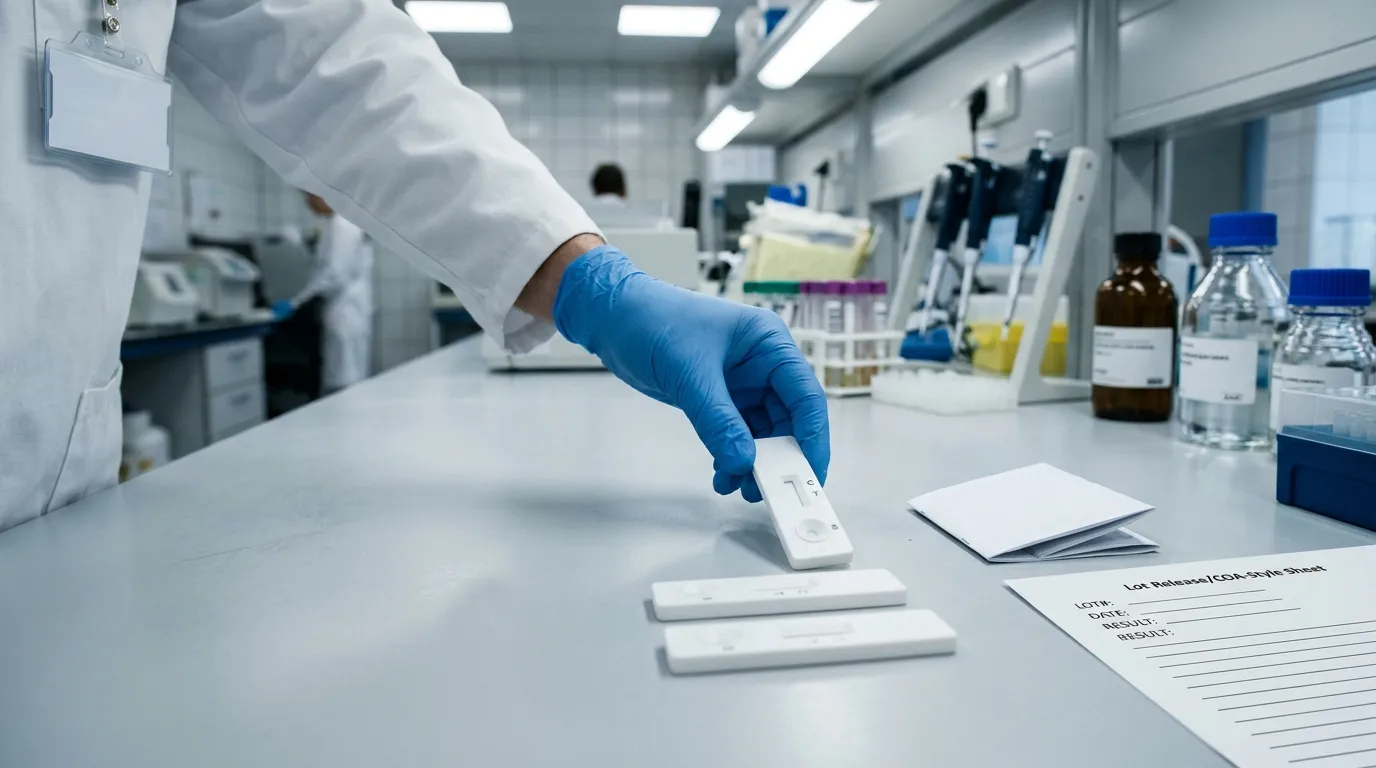
Once your product brief is ready, the ODM project usually moves through a similar sequence:
- Submit the product brief. Include the target market and regulatory requirements from the start so the supplier can flag feasibility issues early.
- Receive a feasibility assessment and quotation. The supplier reviews the technical request, confirms that it can produce the format, and indicates what is needed for the initial samples.
- Review a sample plan. Ask how many samples will be produced, which lots they will come from, and what documentation will accompany them.
- Evaluate samples. Test the samples in your own setting where possible, or send them to an independent laboratory. Check packaging, labeling, lot numbers and the IFU against your brief.
- Lock the specification and artwork. Before bulk production, both parties should agree in writing to the final product specification, packaging artwork, IFU and acceptance criteria.
- Produce the bulk order. The supplier manufactures the lot according to the locked specification.
- Review the quality documentation. Each production lot should have its own certificate of analysis and lot-release documentation.
- Arrange export and shipment. Confirm labeling, export documents, freight terms and any destination-country import requirements.
The MOQ for ODM rapid tests is not a fixed number: it depends on the test format, the packaging, the target market and whether an existing product is being relabeled or a new product is being adapted. If you are not yet familiar with MOQ and export process, the moq and export guide explains those mechanics separately.
The sample stage is not the end of your quality assessment. A single batch can look good while later batches vary. A study published in PLOS ONE describes the challenges of monitoring the manufacturing consistency of HIV rapid diagnostic tests, noting that RDTs have not always had specific sampling and testing standards to support ongoing lot production. For a buyer, this reinforces a practical rule: ask for multiple lots before committing to a long-term supply relationship, and check whether the manufacturer has a consistent lot-release process.
Documents and Evidence to Request from an RDT Supplier
The table below separates the documents that sound similar but are not interchangeable.
| Document | What It Shows | What It Does Not Show |
|---|---|---|
| ISO 9001 certificate | A quality management system for the company or site | Product performance or product approval |
| ISO 13485 certificate | A quality management system for medical devices | CE marking, FDA clearance/approval, or WHO prequalification |
| CE marking documentation | Conformity with the EU legislation that applied when the device was placed on the market | Approval for every market or automatic WHO/FDA listing |
| FDA clearance, approval or EUA | A defined regulatory status for a specific product from the U.S. FDA | A general quality certificate covering every product in the catalogue |
| WHO prequalification or EUL listing | Eligibility for procurement decisions that require WHO listing | Proof that a similar test from the same supplier is also listed |
| Instructions for use | Intended use, specimen type, test procedure, interpretation and storage conditions | The result of independent batch testing |
| Certificate of analysis (COA) | The results for a particular production lot | A guarantee about future lots |
| Technical data sheet (TDS) | Physical or technical characteristics of the product | Regulatory approval |
| Safety data sheet (SDS) | Chemical safety and handling information | Clinical performance data |
Two documents are often confused:
ISO 13485 does not mean the product is CE-marked. ISO 13485 certifies the manufacturer's quality management system. A company can hold ISO 13485 and still need to go through product-specific conformity assessment for each device.
A CE mark is not a global licence. A product intended for the EU may need one route. The same product intended for the United States may need a different route. RDT buyers should ask for documentation that names the product and the market.
Your supplier should be able to explain which documents apply to your target market. If you are buying for a national or public-health program, check whether the program requires WHO prequalification, a special performance evaluation or another national registration. The World Health Organization's manual on selecting molecular WHO-recommended rapid diagnostic tests is one example of how procurement decisions are organized around product-specific WHO guidance rather than broad marketing claims.
The certificate of analysis deserves more attention than most buyers give it. A COA should identify the product name, lot number, manufacturing date and release test results. If a supplier cannot produce a COA for the lot you are about to buy, that is a serious gap in quality documentation.
How to Qualify an ODM Rapid Test Supplier

Supplier qualification is the step where buyers move from reading website promises to reviewing actual evidence. Use the document list above as the first filter. Then add the following checks:
Ask for the product-specific IFU, not only the brochure. The IFU defines the product's intended use, specimen types, procedure, interpretation, storage conditions and limitations. If the IFU does not match your product brief, the ODM process is not complete.
Ask how many lots have been produced. A supplier that has produced dozens of commercial lots will normally have more process data than one still at sample stage.
Ask for lot-release data from several batches. Look at the certificate of analysis from previous lots whenever possible. This helps you identify whether the product is consistent or whether performance changes from batch to batch.
Ask which regulatory documents already exist. If a supplier claims CE, FDA or WHO status, ask for the document that names the exact product and the issuing body. If the supplier cannot provide it, the claim is a claim, not evidence.
Ask who holds the regulatory files. For some buyers, owning the registration file matters because it gives the buyer control when moving to another contract manufacturer. For other buyers, using a supplier's existing approval is faster. Decide before you place the order.
Ask whether third-party testing is acceptable. If your local regulations or your own quality policy require independent evaluation, confirm that the supplier will provide samples and technical documents for that exercise.
Red flags include:
- Vague claims such as "CE approved" without a product-specific document;
- A refusal to share the IFU before ordering;
- A certificate of analysis that lists only the product name and no lot release criteria;
- An insistence that "quality" or "accuracy" is proven by ISO 13485;
- No clear answer about who owns the design and the design changes;
- A request to finalize branding before the product has been technically evaluated.
The supplier qualification process does not have to assume bad faith. It simply has to recognize that a rapid diagnostic test is not a generic commodity. Each product's intended use, specimen matrix, regulatory status and lot history matter. The PLOS ONE paper already cited shows that even well-known test types can face manufacturing-consistency questions. Buyers who ask for evidence are not creating unnecessary friction; they are protecting the reliability of their own supply chain.
From This Guide to Your ODM Project
ODM rapid diagnostic test sourcing works best when the buyer brings a clear product brief and a clear documentation checklist. The product brief defines what you want. The documentation checklist prevents you from accepting marketing language in place of evidence.
If you are evaluating Trustlab as an ODM RDT supplier, start the conversation with the specific product brief you want to develop. Ask Trustlab which test formats, specimen types and target markets are supported for your product; ask for the current IFU and certificate of analysis for any existing product you are considering, and ask which regulatory documents are available for the exact product, rather than assuming that a general company certificate covers your project.
A well-prepared buyer will make the supplier conversation shorter and more useful for both sides. Send your product brief. Ask the documentation questions from this guide. Then compare the supplier's technical response with the evidence requirements of your target market. That process is the most reliable way to move from a written specification to a batch of rapid diagnostic tests that arrives ready for your market.