


Updated 1 week ago
Optical PCR Plate Manufacturer for qPCR and Fluorescence Reading
trustlabofficial

Researcher loading an optical PCR plate into a real-time PCR instrument
An optical PCR plate is a plastic consumable engineered for fluorescence-based qPCR readout. Well color, surface finish, geometry, and contamination controls all sit in the optical path between the reaction and the instrument's detector. A manufacturer that cannot document those details is asking you to trust an assay to unverified plastic.
In qPCR language, "optical" means fluorescence detection — not microscope optics. A real-time PCR instrument excites a fluorescent dye in each well and measures the emitted signal while amplification is still happening. Because the plate sits between the sample and the detector, the plastic itself becomes part of the measurement.
This guide gives you the evaluation criteria to use before choosing an optical PCR plate supplier: well-color options, the documentation you should receive, the format questions that determine instrument fit, and a practical way to compare vendors. For a complete overview of PCR plate families and their formats, see our pcr plates manufacturer guide.
Why "Optical" Matters in a PCR Plate
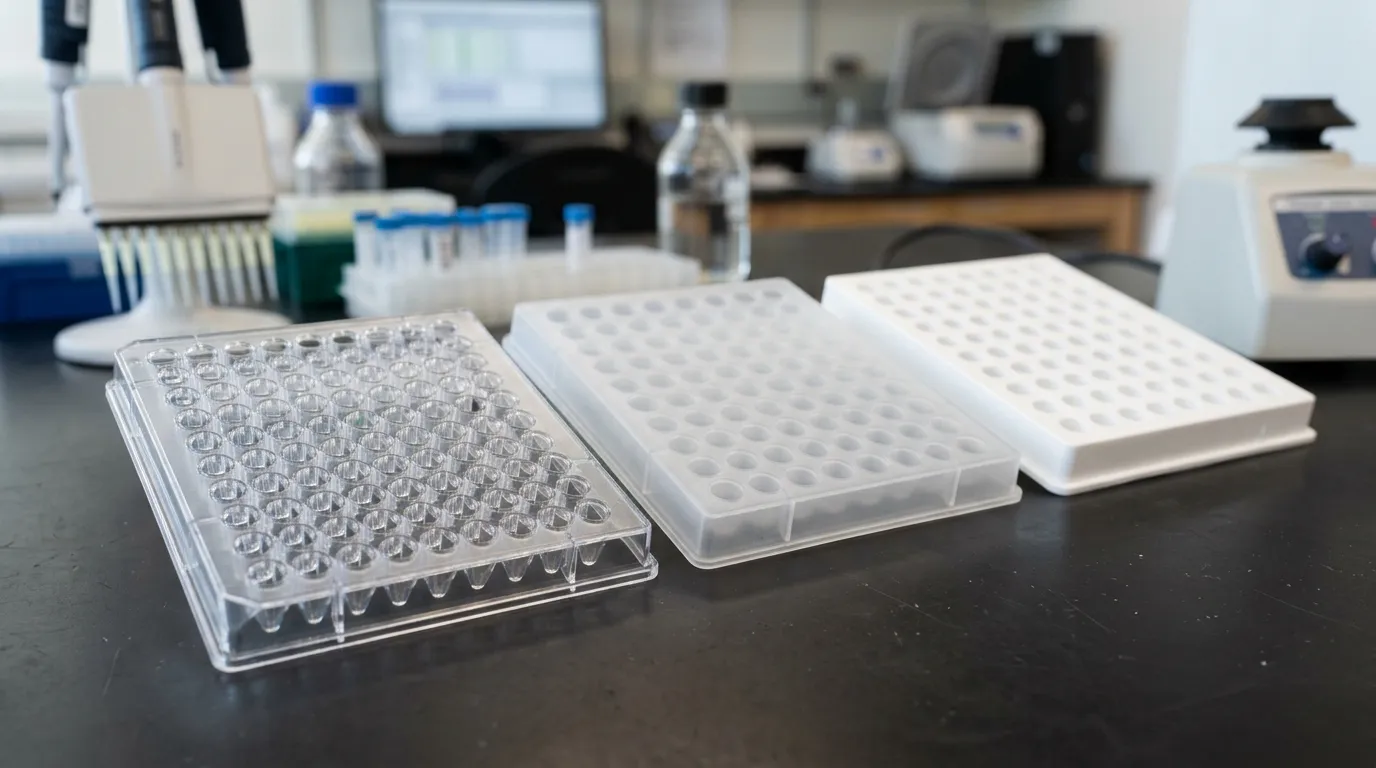
Real-time qPCR reads fluorescence through the plastic of the plate. The optical behaviour of a plate is created by two design elements: the polymer material and the finish of the well wall.
Three mechanisms matter:
- Autofluorescence — the plastic itself can emit background signal when excited. A plate designed for fluorescence work should be manufactured from polymer stock that keeps this background low.
- Crosstalk — light from one well can travel laterally and reach a neighbouring well. In dense 96-well or 384-well layouts, crosstalk raises the apparent signal of negative or low-signal wells.
- Surface reflection and scattering — clear surfaces transmit light, pigmented surfaces reflect it, and frosted surfaces diffuse it. Each choice trades signal recovery against isolation.
A plate marketed as "optical" should have controlled all three factors. The well colour tells you which compromise the manufacturer chose.
Well-Color Options for Fluorescence Detection
| Well color | Effect on excitation and emission | Common application | Trade-off to check |
|---|---|---|---|
| Clear | Light passes through the wall with little obstruction | Standard singleplex or moderate-sensitivity qPCR on instruments designed for clear plates | Transmission increases the risk of crosstalk in tightly spaced wells |
| Frosted | Diffuses light and reduces directional background | Optical qPCR plates for real-time instruments; the Applied Biosystems MicroAmp optical plate, for example, is frosted and screened for auto-fluorescent wells | Scattering can attenuate signal if the instrument optics expect a clear window |
| White (pigmented) | Reflects fluorescence upward toward the detector | Low-concentration targets, weak fluorophores, and assays that need a stronger signal | Reflected light can amplify differences caused by uneven pipetting |
| Black | Absorbs stray light and blocks lateral transmission | Fluorescence plate-reading protocols that need strong well-to-well isolation | Absorption lowers signal recovery and is less common for routine qPCR |
Frosted and white options are the two designs most often described as "optical." Frosted wells are a recognised way to reduce fluorescence interference; white wells are common when the assay needs maximum signal. In both cases, confirm that the instrument's optical calibration and the manufacturer's stated compatibility support the plate design you select.
What to Verify Before Choosing a Manufacturer
A supplier can describe plates as "high quality," "optical grade," or "DNA-free" on a website. Those phrases only become meaningful when you can verify what they stand for. Add the following items to your request list, and treat any manufacturer that hesitates to provide them as a risk.
| Verification item | What to request | Why it matters |
|---|---|---|
| Per-lot purity evidence | Certificate of analysis (COA) for the lot you intend to buy | "DNA-free" and "RNase-free" are claims that should be supported for the actual lot, not only for an ideal product description |
| Dimensional compliance | Dimensional drawing or footprint statement | A plate that is not flat or is out of footprint tolerance will seat poorly in a block or an automated gripper |
| Instrument fit | A list of specific qPCR instrument models and block types | "Fits most instruments" is not engineering data; correct fit depends on block geometry, heated-lid clearance, and optical alignment |
| Scope of certification | The certificate itself, including its scope statement | ISO 13485 covers the manufacturer's quality-management system; it is not a product certificate for one specific plate |
| Auto-fluorescence screening | A description of the QC step used to identify fluorescent wells | An optical plate is useful only when every well keeps background signal low |
| Sterility status | Clear wording: sterile or non-sterile | Sterility is a defined claim with its own evidence; "clean" or "contamination-free" language does not prove sterility |
| Customization terms | OEM, barcode, and packaging minimums in writing | Custom ordering is common in this category, but the terms are supplier-specific and must be confirmed before quoting |
Purity Claims and Certification Documents
Purity language is easy to print and harder to prove. Large manufacturers describe their reaction plates as free of DNA, RNases, and PCR inhibitors, and state that the plates are produced under an ISO 13485-certified quality system. Those statements are meaningful, but only when the supplier can show you the documentation behind them.
The working document for plate purity is the certificate of analysis. Ask for the COA for the specific lot you will receive, and check that it names what was tested, the method, and the result. If a manufacturer cannot provide a COA, treat its purity wording as unsupported.
ISO 13485:2016 is a quality-management-system standard for the design and manufacture of medical devices. When a supplier says it is ISO 13485-certified, ask about the scope of the certificate: which manufacturing site, which product groups, and which certificate number. The certificate signals that the facility runs a controlled process; it is not the same as product-level validation for qPCR.
The same logic applies to sterility. Most qPCR workflows do not require sterile plates, but if your protocol does, the supplier must state the sterile status explicitly and supply the associated evidence. Do not assume that "DNA-free," "clean," or "contamination-free" wording means sterile.
Selecting the Right Optical Plate Format
Optical performance gets the most attention, but three mechanical decisions determine whether the plate works in your workflow: profile, skirt type, and format. Material construction matters too, especially when plates will run on automated systems.
| Plate attribute | What to check | Why it matters for qPCR |
|---|---|---|
| Profile | Low-profile vs. standard profile | An incorrect profile can prevent the heated lid from sealing evenly, which leads to evaporation and inconsistent results |
| Skirt type | Non-skirted, semi-skirted, or full-skirted | Skirt design affects rigidity, robotic gripping, and the space available for barcode labelling |
| Well format and volume | 96-well or 384-well; working volume range | Throughput, pipetting precision, and evaporation behaviour all change with well geometry |
| Material construction | Polypropylene wells only, or polypropylene wells with a rigid polycarbonate/ABS frame | Polypropylene conducts heat well and has low chemical interaction; a rigid frame improves dimensional stability for automated handling |
| Part-number cross-check | Manufacturer part number against the instrument's consumables list | This is the most reliable way to confirm block fit before placing an order |
Low-profile plates reduce the distance between the heated lid and the sample, which is why some real-time blocks require them. Skirt choice is more about handling: non-skirted plates are flexible, while full-skirted plates are stiffer and easier for grippers to handle. Both profile and skirt options are available in optical plate designs, so the two decisions are independent.
If the plate will run on a liquid-handling system, ask the manufacturer for a compatibility statement rather than assuming that the plate's ANSI/SLAS footprint guarantees robotic access. The footprint is only part of the design; well position tolerance, frame rigidity, and skirt geometry also affect automation reliability.
How to Compare Optical PCR Plate Suppliers

Comparing suppliers becomes straightforward when you evaluate everyone against the same evidence.
- Send each candidate the same documentation list: COA for the relevant lot, dimensional drawing, certificate scope, model compatibility list, and a description of auto-fluorescence screening.
- Ask for sample plates from the same lot that the COA covers.
- Run one defined control assay — the same master mix, the same dye, and the same instrument — across all samples.
- Score each manufacturer on the documentation and the control results, not on website adjectives.
- If the plates will carry your own label, ask about barcode placement, packaging, minimum order quantity, and lead time before you compare prices.
The supplier decision you can defend with documents is the decision most likely to remain stable over time. Specifications sheets, certificates of analysis, and a scope-limited certificate also help you investigate a problem later if a new batch behaves differently.
Use this same checklist when you evaluate Trustlab. PCR plates and tubes are part of Trustlab's laboratory consumable offering. Contact our team if you would like current product information, and ask for the same evidence described in this guide. Any manufacturer — Trustlab included — should be able to discuss that documentation before you place an order.
Frequently Asked Questions
What is an optical PCR plate?
An optical PCR plate is a plastic consumable designed for real-time PCR. Its well colour, surface finish, and material influence the fluorescence signal, so the plate is produced with fluorescence detection in mind.
Are white plates better than clear for all qPCR?
No. White plates often improve signal for low-abundance targets because they reflect emission toward the detector. Clear plates remain the right choice for instruments optimised for clear wells. The decision depends on the assay, the instrument, and the manufacturer's stated compatibility.
How do I verify a manufacturer's purity claims?
Request a certificate of analysis for the specific lot you plan to use. The COA should identify what was tested and the result. If a manufacturer offers only broad statements such as "DNA-free" without supporting documentation, ask for the data before ordering.
Does ISO 13485 mean the plate is certified for qPCR?
Not by itself. ISO 13485 is a quality-management-system certificate that applies to the facility. It shows that the manufacturer operates a controlled process, but it is not the same as product-level validation for qPCR.
Can I order custom optical PCR plates?
Custom PCR plastics, including barcoding and packaging, are offered by a range of manufacturers. The practical details — minimum order quantity, labelling options, and lead time — must be confirmed directly with each supplier before a purchasing decision.