

Updated 2 weeks ago
Private Label Rapid Test Kits for Distributor Brands
trustlabofficial

Private-label rapid test kit sourcing documents and neutral packaged test kits on a procurement desk
Private-label rapid test kits can help distributors launch branded diagnostic products without developing an assay from the beginning. However, private labeling is more than adding a logo to a box. Before production, the buyer should confirm the exact test SKU, intended use, specimen type, product documentation, packaging scope, minimum order requirements, and regulatory responsibilities for the target market.
The practical starting point is to separate four questions:
- Is the rapid test suitable for the intended application and market?
- Which product and packaging elements can be branded?
- What evidence and documents support the exact SKU?
- Which responsibilities belong to the supplier, brand owner, importer, and distributor?
For broader planning around order quantities and international supply, see the moq and export guide.
What Private-Label Rapid Test Kits Include
A private-label rapid test kit is usually an existing test product supplied under a distributor’s or brand owner’s identity. The arrangement may involve custom packaging, pouch printing, labels, instruction materials, or outer-box artwork.
The precise scope depends on the supplier and product. A distributor should not assume that private labeling includes assay modification, clinical validation, regulatory registration, or exclusive product ownership.
| Arrangement | Typical focus | What must be confirmed |
|---|---|---|
| Private label | Existing product sold under the buyer’s brand | Which packaging and documents can be customized |
| White label | Pre-existing product with limited differentiation | Available formats, branding limits, and market documentation |
| OEM | Supplier arrangement with defined customization or production terms | Whether the supplier is providing packaging, product changes, or both |
| Custom development | New or substantially modified product or assay | Development scope, validation evidence, ownership, timeline, and regulatory responsibilities |
Private Label, White Label, OEM, and Custom Development
These terms are not interchangeable in every supplier contract.
Private labeling generally concerns the commercial presentation of an existing product. OEM may describe a broader manufacturing or customization arrangement, but the term alone does not prove that the assay, performance, packaging, or regulatory status will be changed.
Custom assay development is a separate project. It may involve different technical requirements, validation work, development costs, and evidence than branding an existing rapid test.
Before requesting a quotation, define whether you need:
- Existing rapid test kits with branded outer packaging
- Custom pouches or labels
- A translated or adapted IFU
- A different package quantity
- A new assay or test format
- Exclusive distribution or branding rights
- Destination-market registration support
The written supplier response should identify exactly what is included.
How to Evaluate a Rapid-Test Product Before Branding It
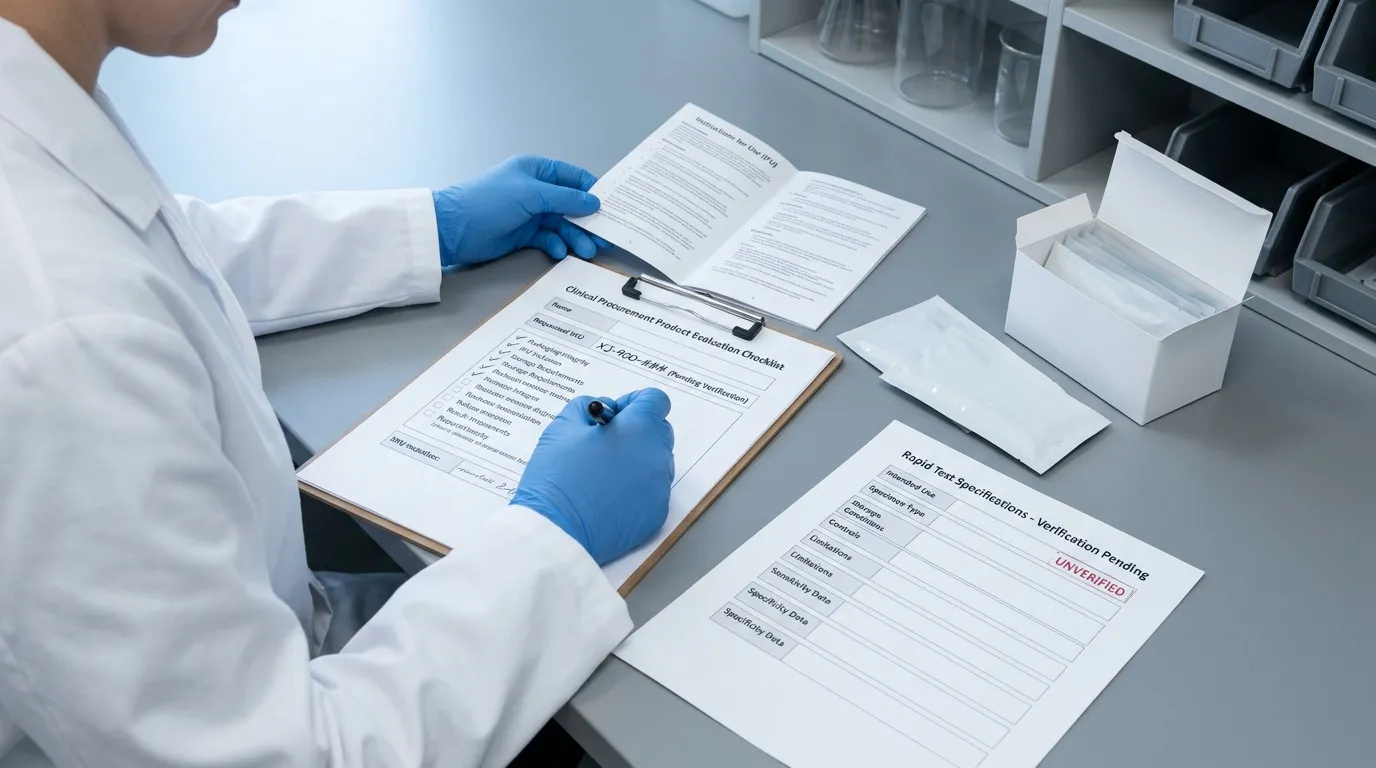
A product should be evaluated before artwork is approved. Branding an unsuitable or poorly documented kit can create problems with procurement, market entry, customer support, and product claims.
Start with the exact SKU or product variant rather than the general product category. Confirm the following points from the applicable product documents:
- Intended use
- Intended user, such as professional or lay user where applicable
- Specimen type
- Test principle or format
- Qualitative or quantitative result
- Result interpretation
- Controls and invalid-result instructions
- Storage conditions
- Shelf-life information
- Product limitations and warnings
- Available performance evidence
- Packaging and package quantity
A product name or category label is not enough to establish these details. For example, a rapid test listed under a disease or analyte name should not automatically be assumed to support every specimen type, user group, or intended-use claim associated with that name.
Product and Intended-Use Questions to Ask
Ask the supplier to identify the exact product and provide the current applicable IFU or technical documentation.
Useful questions include:
- What specimen does the exact test use?
- Is the product intended for professional use, self-testing, research use, or another defined application?
- What result type does the test provide?
- What are the test procedure and result-reading time?
- How are positive, negative, and invalid results described?
- What controls are included?
- What storage conditions apply?
- What limitations or interference information is documented?
- Which languages and markets are covered by the current IFU?
- Does the private-label version use the same documented product configuration?
These questions should be answered for the selected SKU, not inferred from another product in the same category.
How to Review Performance Evidence Without Overclaiming
Performance evidence should be reviewed in context. Sensitivity and specificity describe different characteristics and should not be treated as interchangeable. A detection limit or cut-off is also not the same as clinical diagnostic accuracy.
For the exact product, request the applicable evidence and check:
- The product or model identifier
- The specimen type
- The tested population or sample set
- The comparator method
- The study conditions
- The number and type of samples
- Any stated limitations
- The relationship between the evidence and the current product version
Words such as “accurate,” “reliable,” or “high quality” do not replace product-specific evidence. Do not publish sensitivity, specificity, detection-limit, or diagnostic-accuracy figures unless they are supported by the applicable IFU, validation report, regulatory documentation, or another appropriate authoritative source.
A supplier’s general quality-management certificate also does not establish the performance of a particular rapid test.
What to Confirm About Private-Label Packaging and Documentation
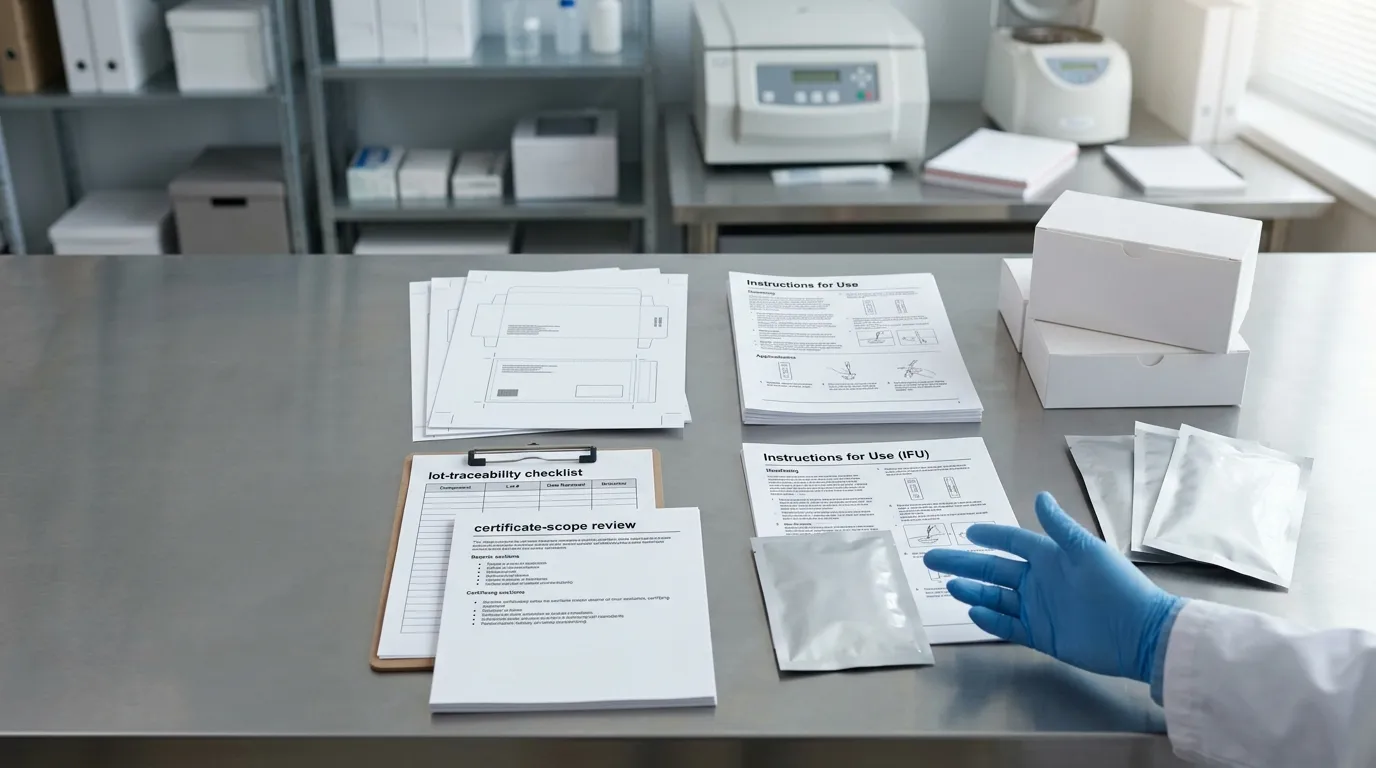
A private-label project normally involves both physical branding and controlled product information. The buyer should establish which components can be customized and who approves the final version.
Potential packaging components include:
- Individual pouch
- Outer box
- Product label
- Instruction leaflet or IFU
- Inserts and accessories
- Package quantity
- Language versions
- Lot and expiry information
- Transport or storage markings
Artwork should be reviewed as a controlled product document, not only as a marketing asset. Changes to intended use, warnings, instructions, storage, result interpretation, or other regulated information may require additional review.
| Document or item | What it helps the buyer verify |
|---|---|
| Current IFU | Intended use, specimen, procedure, interpretation, limitations, warnings, and storage |
| Technical data | Product format, configuration, and applicable technical attributes |
| Performance evidence | Product-specific analytical or clinical performance information where applicable |
| Certificate or conformity document | The product, organization, scope, market, and validity covered by the document |
| CoA, where supplied | Batch- or lot-level release information and stated test results |
| Lot-traceability information | How a batch can be identified and connected to quality records |
| Packaging specification | Pouch, box, insert, label, package quantity, and artwork requirements |
| Change-control information | How product, supplier, packaging, or document changes are communicated |
| SDS, where relevant | Applicable safety and handling information |
A CoA is not the same as a complete technical file. A company certificate is not automatically a product certificate. The buyer should check the scope and identifier on every document.
QMS Certificates Versus Product-Level Regulatory Evidence
ISO 9001 and ISO 13485 concern quality-management-system scopes. They should not automatically be presented as proof that every listed rapid test has product-level regulatory authorization, CE marking, FDA status, clinical validation, or laboratory accreditation.
The same principle applies to broad website wording about CE or ISO compliance. A buyer should request the exact document and check:
- The named organization
- Certificate scope
- Issuing or certification body
- Validity dates
- Covered activities or sites
- Product or management-system identification
- Applicable destination market
For a specific rapid test, product-level conformity or registration evidence must remain attached to that product and jurisdiction. It should not be generalized across an entire catalog.
Private-Label Rapid-Test Launch Workflow
A controlled workflow reduces the risk of approving packaging before the product and documentation have been reviewed.
- Define the product brief.
State the target market, intended application, specimen, user type, test format, language, package quantity, and expected order volume.
- Shortlist exact products.
Request the product name, model or SKU, current configuration, intended use, specimen type, and available documentation.
- Review evidence before artwork.
Check the IFU, technical information, performance evidence, storage requirements, product limitations, and applicable regulatory documents.
- Clarify the private-label scope.
Confirm whether the supplier will customize the pouch, box, label, IFU, inserts, package quantity, or other components. Do not assume assay modification is included.
- Request samples.
Review the physical kit, labeling, packaging, instructions, usability, and configuration. A sample review does not replace product validation or regulatory review.
- Approve artwork and documents.
Establish who owns the artwork, who approves the final version, how translations are checked, and how later changes are controlled.
- Confirm commercial terms.
Obtain the MOQ, price basis, packaging quantity, sample terms, lead time, quotation validity, shipping assumptions, and documentation costs in writing.
- Assign market responsibilities.
Clarify the roles of the supplier, legal manufacturer, brand owner, importer, and distributor for the destination market.
- Confirm batch and post-launch support.
Ask how lot traceability, complaints, changes, replacement requests, and ongoing documentation will be managed.
Responsibilities to Clarify Before Production
The same organization does not necessarily perform every role in a private-label supply chain.
| Party | Responsibilities to clarify |
|---|---|
| Supplier or legal manufacturer | Product supply, manufacturing or sourcing role, technical documents, batch information, and agreed quality support |
| Brand owner | Brand claims, artwork approval, market positioning, and responsibilities accepted under the commercial agreement |
| Importer | Destination-market import and local obligations, where applicable |
| Distributor | Customer channel, purchasing, storage, distribution, and communication responsibilities |
| Regulatory representative or local partner | Registration or conformity activities where required by the market and product type |
The contract and product documents should identify the relevant parties. Do not infer the legal manufacturer from a product listing alone.
How to Compare Private-Label Rapid-Test Suppliers
Compare suppliers against the requirements of the specific project rather than choosing on unit price alone.
| Comparison factor | Questions to ask |
|---|---|
| Product fit | Does the exact SKU match the intended use, specimen, user, and target market? |
| Evidence | Are current IFU, technical, performance, and conformity documents available? |
| Packaging | Can the required pouch, box, label, language, and package quantity be supplied? |
| Artwork control | Who owns, reviews, approves, and updates the artwork? |
| MOQ | Does the minimum quantity apply per SKU, design, pouch, box, or production run? |
| Samples | Can the buyer review product and packaging samples before production? |
| Lead time | What timeline applies to samples, artwork approval, production, and replenishment? |
| Traceability | What batch, lot, and release information is available? |
| Change control | How are product, document, packaging, or supplier changes communicated? |
| Market support | Which party handles registration, importing, labeling, and local obligations? |
| Total landed cost | What additional costs apply for packaging, documentation, freight, taxes, and market requirements? |
A supplier with a broad catalog is not automatically the right supplier for a particular private-label project. The relevant question is whether the supplier can support the exact product, evidence package, packaging configuration, and destination-market requirements.
Questions to Include in the First Supplier Request
A first request should contain enough information to produce a meaningful response:
- Target destination market
- Product category or analyte
- Intended user and application
- Specimen requirement, if already defined
- Preferred test format
- Brand and packaging requirements
- Required languages
- Expected quantity and replenishment plan
- Requested sample configuration
- Required product and quality documents
- Regulatory or conformity documents needed for the target market
- Desired delivery terms
- Questions about MOQ, lead time, artwork, and package quantity
Ask the supplier to identify every quotation line by exact product or SKU. This helps prevent a general category response from being mistaken for confirmation of a particular configuration.
Trustlab-Specific Verification Before You Proceed
Trustlab’s website includes a Rapid Test area and candidate rapid-test product pages, including pages associated with HBsAg, FOB, malaria, dengue, and HCG products in the available research evidence. Those URLs indicate relevant product categories, but they do not by themselves verify private-label availability, manufacturing status, intended use, performance, certification, or regulatory approval for every product.
Before presenting Trustlab as a private-label supplier for a particular project, confirm:
- Whether private-label or OEM service is currently available
- Which exact rapid-test products or SKUs are eligible
- Whether Trustlab is the manufacturer, wholesaler, distributor, or another supply-chain party for the selected product
- Which packaging components can be customized
- Whether the IFU can be supplied or translated for the target market
- What current product-specific performance and technical documents are available
- Which certificates apply to the company, quality system, product, or market
- What MOQ applies to each SKU and packaging configuration
- Whether samples are available and what they represent
- What lead time applies after artwork and sample approval
- Which party handles destination-market registration, importing, labeling, and post-market obligations
Trustlab’s ISO 9001 or ISO 13485 certificate scope, where applicable, should be reviewed separately from product-level regulatory evidence. Broad website language about CE or ISO compliance should not be used as proof that every rapid test has the same status.
Likewise, a listed rapid-test product should not automatically be described as manufactured in-house, sterile, clinically validated, or suitable for self-testing. Those claims require the applicable product-specific evidence.
Request a Quote, Sample, and Documentation Package
Once the product brief is prepared, request a response that identifies the exact SKU and separates product, packaging, documentation, and logistics terms.
The request should ask for:
- Exact product and model or SKU
- Current IFU and technical information
- Intended use and specimen details
- Available performance evidence
- Applicable certificates or conformity documents and their scope
- Storage and shelf-life information
- Packaging and artwork specifications
- Package quantity and MOQ
- Sample availability and sample configuration
- Lead time for samples and production
- Batch or lot documentation
- Shipping and export assumptions
- Destination-market responsibility allocation
A private-label rapid-test project is ready for commercial approval only when the product, evidence, packaging, and responsibilities are sufficiently clear. For Trustlab, the next practical step is to submit a defined product brief and request written confirmation of the eligible SKU, documentation package, branding scope, and commercial terms.