


Updated 1 month ago
Centrifuge for Chemical Industry: Explosion-Proof Design and ATEX Safety Requirements
Arafatshuvo

Centrifuge for Chemical Industry
For chemical processing, centrifuge selection is not simply a question of speed and capacity. A Centrifuge for Chemical Industry may handle flammable solvents, volatile intermediates, corrosive liquids, fine powders, or solvent-containing slurries. Under these conditions, separation performance and explosion protection must be engineered together.
From Trustlab's perspective, the correct starting point is not the centrifuge catalogue. It is the process risk.
When Does a Centrifuge for Chemical Industry Require Explosion Protection?
A chemical centrifuge should be evaluated for explosion protection whenever the process can generate a flammable vapor, mist, gas, or combustible dust atmosphere.
Typical risk points include:
•Solvent charging and feeding;
•High-speed separation;
•Cake washing;
•Discharge and opening;
•Solvent evaporation during cleaning;
•Leakage through seals or connections;
•Fine-powder handling around the machine.
The hazardous atmosphere may exist inside the centrifuge, around the centrifuge, or in both locations.
For European installations, this normally leads to hazardous-area classification such as Zone 0, Zone 1, or Zone 2 for gases and vapors, and Zone 20, 21, or 22 for combustible dust.
This classification becomes the basis for selecting the appropriate Centrifuge for Chemical Industry, electrical equipment, instrumentation, and protection concept.
Explosion-Proof Motor Does Not Mean Explosion-Proof Centrifuge
This is one of the most important distinctions in chemical centrifuge engineering.
An Ex-rated motor controls only one potential ignition source. A rotating centrifuge also contains mechanical and electrostatic hazards.
Potential ignition sources include:
•Bearing overheating;
•Rotor-to-housing contact;
•Friction caused by mechanical failure;
•Braking heat;
•Static discharge;
•Loose or damaged rotating parts;
•Electrical sensors and switches;
•Abnormal vibration caused by imbalance.
Therefore, a Centrifuge for Chemical Industry must be assessed as a complete mechanical-electrical system.
ISO 80079-36 is particularly relevant because non-electrical equipment can generate ignition sources through hot surfaces, mechanically generated sparks, or static electricity.
Separation Performance and Explosion Risk Are Connected
Chemical centrifuge parameters should never be evaluated independently.
The basic relationship is:
Higher RPM → Higher RCF → Stronger separation force
But because centrifugal force rises approximately with the square of rotational speed, increasing RPM also raises mechanical stress on the rotor, shaft, bearings, and supporting structure.
For a Centrifuge for Chemical Industry, engineers should evaluate the following parameters together:
| Process Parameter | Separation Impact | Safety Impact |
| RPM / RCF | Controls centrifugal force | Higher mechanical stress and heat |
| Viscosity | Higher viscosity slows settling | Often temperature-dependent |
| Temperature | Lower viscosity may improve separation | Higher vapor pressure may increase flammable vapor |
| Solids concentration | Affects throughput and cake formation | Can increase imbalance risk |
| Particle size | Determines settling difficulty | Influences required RCF |
| Solvent flash point | Limited effect on separation | Critical for fire/explosion assessment |
| Rotor balance | Maintains stable operation | Excess vibration may become an ignition risk |
A common example is process heating. Raising temperature may reduce viscosity and improve separation, but it can simultaneously increase solvent evaporation.
This is why a chemical process should not be optimized for throughput without reviewing its explosion-risk conditions.
Gas-Tight, Ex-Protected, and Nitrogen-Inerted Designs Are Different
These terms are often used interchangeably in purchasing specifications, but they solve different engineering problems.
Ex-Protected Components
These are intended to prevent electrical equipment from becoming an ignition source. Depending on the installation, they may include:
•Motors;
•Proximity sensors;
•Temperature sensors;
•Switches;
•Valves;
•Junction boxes.
Gas-Tight Construction
Gas-tight design aims to control solvent leakage and vapor release through:
•Enclosed housings;
•Suitable seals;
•Controlled feed and discharge connections;
•Vapor recovery connections.
Nitrogen Inerting
An inerted Centrifuge for Chemical Industry uses nitrogen to reduce oxygen concentration inside the process space.
A reliable inerting system may require:
•Nitrogen flow monitoring;
•Internal pressure monitoring;
•Oxygen measurement;
•Pre-purge logic;
•Start permissives;
•Automatic shutdown if inerting conditions are los
Simply connecting nitrogen to a centrifuge does not create a validated inerting system.
How Should an ATEX Centrifuge Be Matched to the Process?
Equipment should be selected from the actual process outward.
A practical specification sequence is:
Chemical properties → Hazardous-area classification → Protection level → Gas/dust group → Temperature requirement → Centrifuge configuration
The buyer should provide the centrifuge manufacturer with:
•Chemical composition and SDS;
•Solvent concentration;
•Flash point and relevant ignition data;
•Solids concentration;
•Particle-size distribution;
•Liquid and solid density;
•Viscosity;
•Operating temperature;
•Required throughput;
•Required cake moisture or clarification quality;
•Zone classification;
•Cleaning method;
•Available nitrogen and ventilation.
•Material compatibility must be checked separately.
For example, selecting SS316L, duplex stainless steel, Hastelloy, titanium, or another wetted material depends on chemical concentration, temperature, chloride content, corrosion mechanism, and contamination requirements.
ATEX compliance does not automatically mean chemical compatibility.
Installation and Maintenance Are Part of the Safety Concept
Even a properly specified Centrifuge for Chemical Industry can become unsafe if the surrounding installation is poorly designed.
Engineers should review the entire system, including:
•Motor and VFD configuration;
•Ex-rated sensors;
•Electrical cabinet location;
•Grounding and static control;
•Vapor extraction;
•Nitrogen supply;
•Process interlocks;
•Emergency shutdown logic.
Maintenance also has a direct safety function.
Bearing temperature, seal condition, rotor integrity, and vibration should be monitored because deterioration can create both reliability and ignition hazards.
A useful protection philosophy is:
| Abnormal Condition | Detection | Typical Response |
| Excess vibration | Vibration sensor | Alarm / controlled shutdown |
| Bearing overheating | Temperature sensor | Alarm / shutdown |
| Nitrogen pressure loss | Pressure monitoring | Prevent start / stop process |
| Excess oxygen | O₂ monitoring | Interlock according to validated logic |
| Seal deterioration | Inspection / leak detection | Maintenance or safe shutdown |
Specific alarm values must always come from the actual process design and risk assessment.
What Trustlab's High-Speed Centrifuge Demonstrates About Centrifuge Engineering
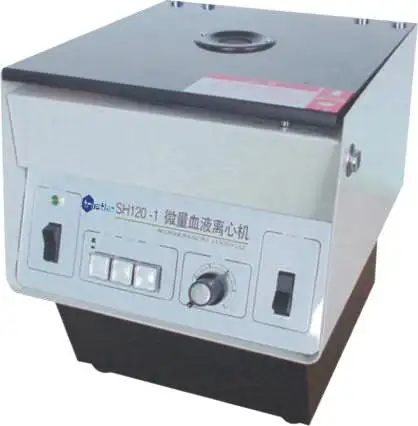
Trustlab's GT211-SH120-1 High Speed Centrifuge is designed for laboratory and capillary-blood applications rather than hazardous chemical production, but its specifications illustrate several fundamental centrifuge design principles.
Specifications include:
•Maximum speed: 12,000 r/min
•Maximum RCF: 15,300 × g
•Rotor capacity: 24 × Φ1.5 mm capillaries
•Speed settings: 11,000 / 12,000 r/min
•Starting time: less than 1 minute
•Braking time: less than 2 minutes
•Timer: 0–10 minutes
•Power supply: AC 220 V ±10%, 50 Hz
•Input power: 230 VA
•Output power: 100 W
•Dimensions: 270 × 310 × 280 mm
•Weight: 11.5 kg
The design also incorporates a swing-out rotor, transparent lid, safety lid mechanism, compact construction, rapid acceleration and braking, and stable high-speed operation.
These characteristics reflect the same engineering fundamentals that matter when evaluating a Centrifuge for Chemical Industry: rotor stability, controlled acceleration, braking performance, centrifugal force, mechanical integrity, and operational safety.
However, the GT211-SH120-1 product information does not state ATEX or IECEx certification. It should therefore be treated as a laboratory high-speed centrifuge rather than represented as an explosion-protected industrial chemical centrifuge.
A Better Way to Specify a Centrifuge for Chemical Industry
For chemical applications, the correct purchasing question is not:
"How fast can the centrifuge run?"
It is:
"Can the centrifuge deliver the required separation performance while remaining compatible with the chemical, hazardous-area classification, operating temperature, containment strategy, and maintenance requirements?"
That approach produces a technically defensible specification and reduces the risk of purchasing equipment that is fast enough to separate the product but unsuitable for the process environment.
For laboratories requiring compact, controlled high-speed separation, the published performance of the Trustlab GT211-SH120-1 provides a practical reference for evaluating RPM, RCF, rotor configuration, acceleration, braking, and laboratory safety design.
FAQs
Q1. What are the electrical requirements of the Trustlab GT211-SH120-1?
The electrical specification is AC 220 V ±10%, 50 Hz, with 230 VA input power and 100 W output power.
Q2. What are the dimensions and weight of the Trustlab high-speed centrifuge?
The GT211-SH120-1 measures approximately 270 × 310 × 280 mm and weighs 11.5 kg, making it suitable for compact laboratory installations.
Q3. What rotor capacity does the Trustlab GT211-SH120-1 offer?
It uses a 24 × Φ1.5 mm capillary configuration with a swing-out rotor, designed primarily for capillary blood separation and related laboratory work.
Q4. How quickly does the Trustlab centrifuge accelerate and stop?
According to the published specifications, the starting time is less than one minute, while the braking time is less than two minutes.
Q5. What timer range is available on the GT211-SH120-1?
The centrifuge provides a 0–10 minute timer, suitable for controlled short-duration high-speed centrifugation.