


Updated 1 month ago
How a High Speed Refrigerated Centrifuge with Rotor Maintains Sample Stability at High RPM
Arafatshuvo

High Speed Refrigerated Centrifuge with Rotor
For sensitive laboratory samples, high rotational speed is useful only when centrifugal force, rotor geometry, temperature, balance, and deceleration are controlled together.
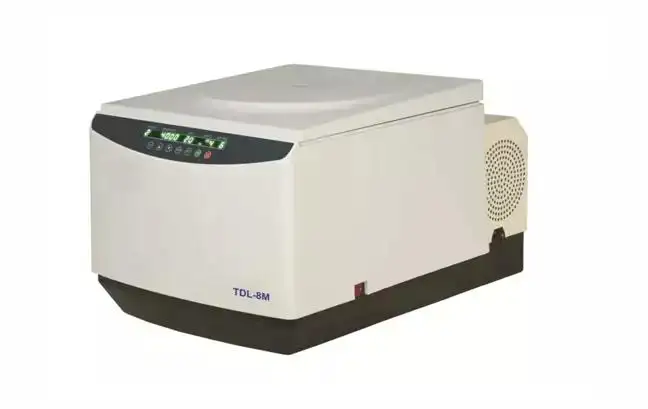
At Trustlab, we consider a High Speed Refrigerated Centrifuge with Rotor as a complete separation system rather than simply a high-speed motor combined with a refrigerated chamber.
The practical question is not only "How fast can the centrifuge spin?" It is:
Can the system deliver the required RCF while maintaining suitable temperature, mechanical stability, and repeatable separation conditions?
Why Sample Stability Becomes More Critical at High RPM
As rotor speed increases, the following three effects occur:
Relatively high RCF is created. Since centrifugal force is directly proportional to the speed of rotation and therefore RPM, increases in RCF with increases in rotor speed occur rapidly.
The thermal load on the refrigeration system increases. The rotation of the rotor creates a partial vacuum along the tubes. The partial vacuum creates an air bearing which results in mechanical and air frictional losses.
Increasing imbalance causes tube-to-tube variations, defects in the rotor and increasing the vibration of the centrifuge. This reduces the repeatability of the process.
When selecting a refrigerated centrifuge with a rotor, you must consider the required rotational speed (RCF), the radius of the rotor, the volume of the sample, and the temperature at which you need to refrigerate the sample. Additional considerations such as the maximum rotor speed can be ignored.
The equation to calculate RCF is:
RCF = 1.118 x 10⁻⁵ x r x RPM²
Where, r is the radius of rotation in centimeters and RPM is the rotational speed in revolutions per minute.
Because RPM is squared, increasing speed by 10% produces approximately 21% more RCF when rotor radius remains unchanged.
Rotor radius is equally important. Two rotors operating at 8,000 rpm can generate different RCF values if their effective radii differ.
For practical protocol development, we recommend the following sequence:
Required RCF → suitable rotor → operating RPM → run time
This approach is more reliable than converting an existing protocol by RPM alone.
Rotor Design Changes How the Sample Separates
Selecting the correct rotor is one of the most important decisions when configuring a High Speed Refrigerated Centrifuge with Rotor.
| Configuration | Separation Effect | Main Consideration |
| Fixed-angle rotor | Short sedimentation path; pellet forms toward tube wall/bottom | Efficient pelleting |
| Swing-out rotor | Tubes move toward horizontal during rotation | Useful for layers and many clinical tubes |
| Smaller high-speed rotor | Can support higher speed/RCF | Lower batch capacity |
| High-capacity rotor | Processes more sample per cycle | Greater rotating mass; speed may be lower |
| Fast braking | Shorter total cycle | May disturb soft pellets or gradients |
| Soft/no braking | Reduces disturbance during deceleration | Longer cycle time |
The correct system-matching sequence is therefore:
RCF → Rotor geometry → Tube format → Sample volume → Temperature → Acceleration/deceleration
Maximum speed is only one part of this decision.
Refrigeration Performance Is More Than the Lowest Set Temperature
For a High Speed Refrigerated Centrifuge with Rotor, the displayed chamber temperature should not automatically be interpreted as the exact sample temperature.
The thermal path is approximately:
Refrigerated chamber → Rotor body → Tube wall → Sample
Actual sample temperature may therefore be influenced by:
• Starting temperature of the rotor and sample;
• Rotor mass and geometry;
• Operating RPM;
• Centrifugation time;
• Sample volume and tube material;
• Ambient laboratory temperature;
• Airflow around the refrigeration system.
For temperature-sensitive proteins, nucleic acids, cells, or other biological materials, rotor pre-cooling may reduce initial thermal transition. Critical protocols should also verify temperature under the actual rotor, speed, load, and run duration used in the laboratory.
Trustlab High Speed Refrigerated Centrifuge with Rotor: Specifications in Context
Trustlab's TLTDL-8M and TLTDL-5M tabletop refrigerated centrifuges use microprocessor control for speed, time, and temperature. The design also incorporates an LCD interface, French Tecumseh R134a compressor unit, lid interlock, imbalance detection, and compatibility with multiple rotor configurations.
| Specification | TLTDL-8M | TLTDL-5M |
| Maximum speed | 8,000 rpm | 5,000 rpm |
| Maximum RCF | 9,100 ×g | 4,390 ×g |
| Maximum capacity | 4 × 250 mL | 72 × 7 mL |
| Speed accuracy | ±30 rpm | ±30 rpm |
| Temperature range | -5°C to +35°C | -5°C to +35°C |
| Temperature accuracy | ±1°C | ±1°C |
| Timer | 1–99 min | 1–99 min |
| Noise | <65 dB(A) | <65 dB(A) |
| Power consumption | 1.2 kW | 1.2 kW |
These specifications illustrate an important selection principle: speed, RCF, capacity, and refrigeration must be evaluated as one operating envelope, not as independent headline numbers.
For example, the TLTDL-8M combines an 8,000 rpm maximum speed with 9,100 ×g maximum RCF and 4 × 250 mL maximum capacity. The TLTDL-5M provides a different operating profile with up to 72 × 7 mL capacity.
Importantly, a published ±1°C temperature accuracy should not be interpreted as proof that every sample remains within ±1°C under every rotor, RPM, and load condition. Critical applications should be validated using the actual protocol.
Installation and Rotor Maintenance Affect Reproducibility
A High Speed Refrigerated Centrifuge with Rotor cannot maintain stable operation if mechanical installation and rotor condition are ignored.
Before use:
• Always place the centrifuge on a rigid, level surface.
• Provide adequate clearance around the refrigeration system.
• Load the rotor with samples as required and balance samples as required.
• Use the correct accessories as required.
• Make sure the rotor is seat correctly.
• Check the tool is functioning correctly.
During routine maintenance, laboratories should inspect the rotor for corrosion, deformation, surface damage, or abnormal wear and periodically verify speed and temperature according to internal quality procedures.
Selecting a High Speed Refrigerated Centrifuge with Rotor as a Complete System
A technically sound selection should follow this path:
Sample requirement → Required RCF → Rotor → Capacity → Temperature control → Braking behavior → Installation → Validation → Supplier support
At Trustlab, our objective is to match centrifugation equipment to the actual laboratory workflow rather than focus on a single maximum-speed specification. Trustlab has supplied laboratory and medical products internationally since 2015, with products exported to more than 100 countries.
If you are evaluating a High Speed Refrigerated Centrifuge with Rotor, share your required RCF, tube type, sample volume, temperature range, and throughput with Trustlab. Our team can help identify a configuration that better matches the operating conditions of your laboratory.
FAQs
Q1. What High Speed Refrigerated Centrifuge with Rotor models does Trustlab offer?
Trustlab currently offers the TLTDL-8M and TLTDL-5M tabletop refrigerated centrifuges, designed for biological, clinical, research, and industrial laboratory applications.
Q2. What is the maximum speed of the Trustlab refrigerated centrifuge?
The TLTDL-8M reaches up to 8,000 rpm, while the TLTDL-5M reaches up to 5,000 rpm.
Q3. What RCF can Trustlab centrifuges generate up to?
The TLTDL-8M provides a RCF up tp 9,100 ×g, while the TLTDL-5M provides up to 4,390 ×g. Buyers should compare RCF as well as RPM when matching a centrifuge to a separation protocol.
Q4. What sample capacity is available?
The TLTDL-8M supports a maximum capacity of 4 × 250 mL, while the TLTDL-5M supports up to 72 × 7 mL, allowing laboratories to select different throughput configurations.
Q5. What temperature range does the Trustlab High Speed Refrigerated Centrifuge with Rotor support?
Both models specify a temperature setting range of -5°C to +35°C with published temperature accuracy of ±1°C. Critical applications should still validate actual sample temperature under their specific rotor, speed, load, and run conditions.