



Updated 2 weeks ago
Custom Microscope Manufacturer: Optical Design, Illumination and Imaging Selection Guide

Trustlab
The author is a specialist at Ningbo Trustlab Instruments Co., Ltd., a leading provider of laboratory and medical consumables since 2015. With extensive experience in global healthcare and laboratory markets, they focus on delivering high-quality, innovative solutions and professional support to laboratories, hospitals, and distributors worldwide. Trustlab’s products are trusted in over 100 countries, reflecting the company’s commitment to reliability, excellence, and customer satisfaction.

Custom Microscope Manufacturer
Selecting a Custom Microscope Manufacturer should start with the specimen, required detail, observation method, and workflow—not with magnification alone. A microscope is an integrated optical-mechanical system. Objective quality, numerical aperture, illumination, focusing stability, working distance, stage movement, and imaging configuration all affect whether the instrument delivers useful and repeatable results.
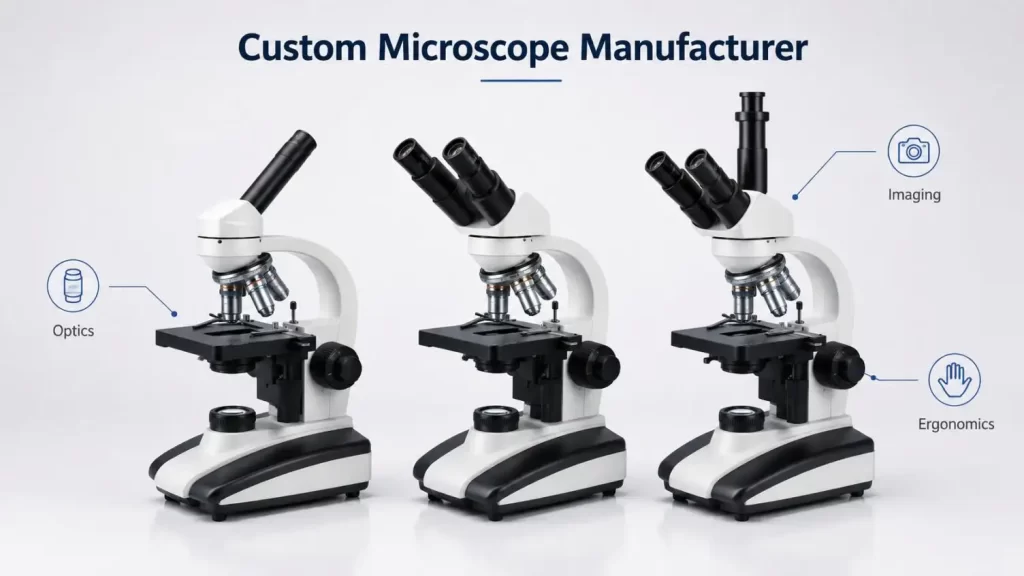
At Trustlab, we approach microscope configuration from the application backward. Our microscope portfolio supports biological, binocular, trinocular, and digital observation requirements, with adjustable focusing, illumination, ergonomic operation, and laboratory-oriented construction.
What Does a Custom Microscope Manufacturer Actually Customize?
A Custom Microscope Manufacturer does more than change external appearance or add accessories. Practical customization may involve:
•Objective and eyepiece combinations
•Magnification and numerical aperture
•Binocular, trinocular, or digital heads
•Transmitted or reflected illumination
•Camera and imaging interfaces
•Mechanical stage configuration
•Coarse and fine focusing
•Working distance
•Sample clearance
•Ergonomic viewing position
•Packaging, labeling, and OEM requirements
The correct configuration is the one that matches the specimen and workflow without adding unnecessary optical or mechanical complexity.
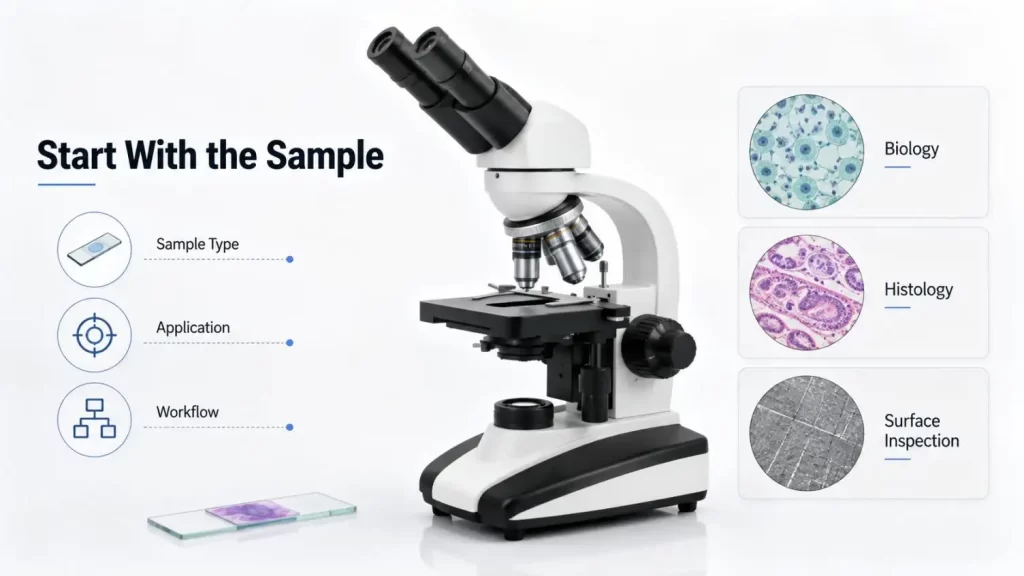
Start With the Sample and Required Detail
The specimen determines the microscope architecture.
| Application | Main Requirement | Design Priority |
| Biological samples | Cell and tissue observation | Resolution, transmitted illumination |
| Histology | Stained sections | Color fidelity, field flatness |
| Microbiology | Fine structures | NA, focusing precision |
| Education | Repeated observation | Simplicity, durability |
| Research | Imaging and documentation | Optical flexibility, camera path |
| Material inspection | Surface features | Working distance, reflected light |
For a Custom Microscope Manufacturer, the first questions should therefore be:
•What sample will be observed?
•What is the smallest feature that must be distinguished?
•Is observation visual, digital, or both?
•Does the operator need free space around the sample?
•Will images be stored, measured, or shared?
These inputs are more useful than simply requesting "higher magnification."
Magnification, Resolution, and Numerical Aperture
Total magnification is commonly calculated as:
Objective magnification × eyepiece magnification
However, higher magnification does not automatically improve image detail.
Useful resolution is strongly influenced by:
•Numerical aperture (NA)
•Illumination wavelength
•Objective correction
•Optical alignment
•Contrast
•Sample preparation
Increasing magnification after the optical system has reached its resolving limit only enlarges existing information. This is often described as empty magnification.
For this reason, Trustlab emphasizes clear imaging and practical magnification ranges rather than treating a high magnification number as the sole performance indicator.
Importance of Numerical Aperture
Generally speaking, a higher NA allows objectives to resolve finer detail and collect more light. But, the following aspects of the microscope can also be impacted.
•Depth of field
•Working distance
•Focusing sensitivity
•Illumination requirements
Therefore, a Custom Microscope Manufacturer has to find the best compromise between resolution and microscope usability, as opposed to maximizing the NA in isolation.
Binocular, Trinocular, or Digital?
The observation head should be aligned with how the microscope is most likely going to be utilized.
| Configuration | Best For | Main Benefit | Key Limitation |
| Binocular | Routine visual work | Comfortable two-eye observation | Limited dedicated camera path |
| Trinocular | Visual + imaging | Separate camera connection | More complex configuration |
| Digital | Documentation and teaching | Easy display and sharing | Sensor quality becomes critical |
Trustlab supports multiple observation configurations, allowing laboratories, distributors, and educational users to select a platform aligned with their workflow.
When Trinocular Design Adds Value
A trinocular microscope is particularly useful when the operator needs to:
•Observe through eyepieces while recording images
•Connect a camera permanently
•Build a documentation workflow
•Support teaching or remote review
For routine visual inspection, however, binocular design may remain the more economical choice.
Illumination Is Part of Image Formation
Lighting should be regarded as a core component of an optical system, not a supplementary attachment.
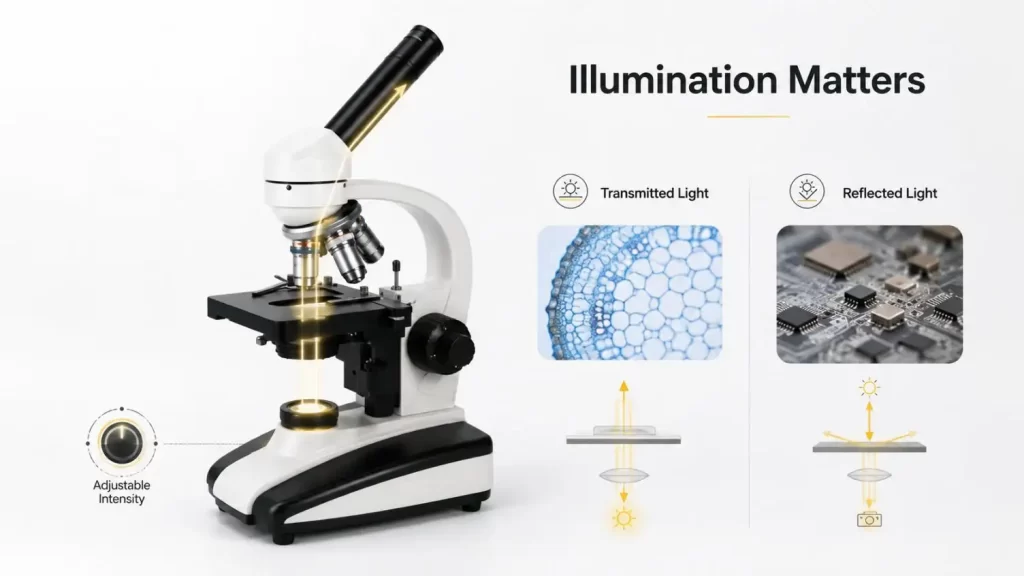
Important criteria for design include:
•Intensity of light
•Evenness across the viewing area
•Harmony of color
•Heat generation
•Adjustment of contrast
•Compliance with the power of objective lenses
Transmitted Versus Reflected Illumination
Transmitted illumination often works with specimens that are thin, transparent, or semi-transparent.
In cases when the sample is opaque or otherwise entirely impenetrable, reflected illumination is usually more appropriate.
Trustlab microscopes feature adjustable illumination. This means the user can change the brightness to best fit the type of specimen and the objective lens used. This also minimizes the risk of overexposing the specimen.
Digital Imaging Requires Optical Matching
Adding a camera does not automatically improve microscope performance.
A digital configuration should consider:
•Sensor size
•Pixel size
•Camera resolution
•Frame rate
•Field coverage
•Optical adapter ratio
•Computer or display interface
•Image capture software
If the camera resolution greatly exceeds the information delivered by the optical system, additional pixels may add file size without adding useful detail.
A technically capable Custom Microscope Manufacturer should therefore treat imaging as a combined optics + sensor + workflow problem.
Mechanical Stability Affects Repeatability
Mechanical performance must be taken into account in addition to optical quality. It impacts focus retention and positioning accuracy.
This is particularly true for:
The Focusing System
•Easy coarse adjustment
•High sensitivity and fine adjustment
•Low backlash and high stability of focus
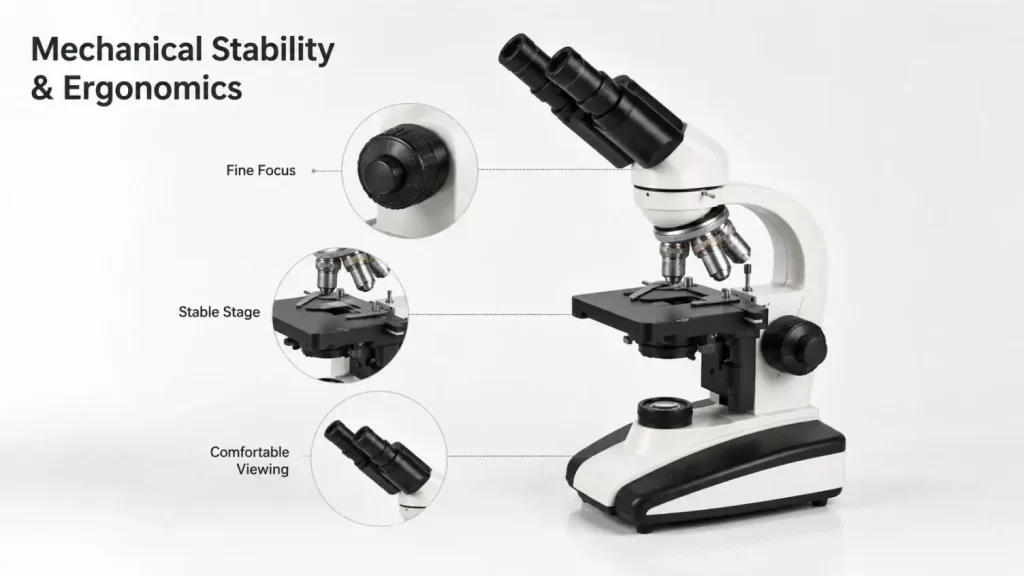
Mechanical Stage
•Controlled X-Y movement
•Secure specimen holding
•Smooth positioning
•Low mechanical play
In most laboratory applications, comfort and positioning of the user have a significant impact on productivity.
Trustlab designs microscopes considering these aspects for frequent use in the lab and classroom for general, medical, and research applications.
Standard vs. Custom Microscope
Customization should solve a real application problem.
| Requirement | Standard Microscope | Custom Configuration |
| Routine teaching | Usually sufficient | Often unnecessary |
| General biology | Usually suitable | Useful for special workflows |
| Camera integration | Option dependent | Can be planned from start |
| Special sample geometry | Limited | Greater flexibility |
| Specific working distance | Fixed choices | Better matching |
| OEM distribution | Standard specification | Market-specific configuration |
A good Custom Microscope Manufacturer should help customers avoid both under-specification and unnecessary customization.
About Trustlab
Founded in 2015, Ningbo Trustlab Instruments Co., Ltd. has developed into a supplier of laboratory and medical products serving healthcare institutions, laboratories, and distributors worldwide.
Trustlab products have been exported to more than 100 countries, including the USA, UK, UAE, South Africa, Poland, Greece, Portugal, France, and other international markets.
This global supply experience is relevant when selecting a Custom Microscope Manufacturer, because long-term projects often require more than an initial sample. Buyers also need:
•Stable repeat-order specifications
•Consistent product quality
•Export-ready packaging
•Reliable communication
•Support for distributor and laboratory requirements
•Long-term supply continuity
Trustlab continues to invest in product development, quality control, and international service capability while expanding its laboratory and medical solution portfolio.
Define Your Requirements Before Requesting a Quote
Before contacting a Custom Microscope Manufacturer, prepare:
•Sample type
•Smallest feature to observe
•Magnification range
•Required resolution
•Observation method
•Binocular, trinocular, or digital preference
•Camera requirement
•Illumination method
•Working distance
•Quantity
•Destination market
• Certification requirements
The more clearly these parameters are defined, the easier it is to select a microscope that delivers useful optical performance without unnecessary cost or complexity.
If you are sourcing microscopes for a laboratory, university, healthcare facility, research project, or distribution program, Trustlab can review your specimen type, imaging requirements, optical configuration, expected quantity, and market needs to help identify a practical microscope solution for your application.
FAQs
Q1. What sorts of microscopes does Trustlab offer?
Trustlab offers a range of microscopes: bio-observation microscopes, teaching microscopes, research microscopes, and medical microscopes, complete with binocular, trinocular, and digital configurations.
Q2. Can Trustlab produce a customized microscope?
Absolutely. As a Custom Microscope Manufacturer, Trustlab evaluates parameters like the required range of magnification, observation methods, lighting, imaging, working distance, and surrounding conditions of the application to determine a proper fit.
Q3. Can Trustlab accommodate both binocular and trinocular microscopes?
Of course. Binocular microscopes are adequate for basic observations, while trinocular microscopes are better fit to observation requirements that include imaging.
Q4. Does Trustlab provide digital microscopes?
Certainly. Trustlab provides configurations for use in digital microscopy in case digital images need to be captured, displayed, or shared for teaching or research purposes, or for simplifying or enhancing laboratory operations.
Q5. What do buyers need to include to request a quote for a custom microscope?
Prospective customers are required to provide the sample type, required magnification, minimum feature size, imaging needs, lighting choice, working distance, number of units, and the intended market.
Written by
Trustlab
The author is a specialist at Ningbo Trustlab Instruments Co., Ltd., a leading provider of laboratory and medical consumables since 2015. With extensive experience in global healthcare and laboratory markets, they focus on delivering high-quality, innovative solutions and professional support to laboratories, hospitals, and distributors worldwide. Trustlab’s products are trusted in over 100 countries, reflecting the company’s commitment to reliability, excellence, and customer satisfaction.


