



Updated 2 weeks ago
Laboratory Sample Preparation Equipment for Chemistry Labs Before Analysis

Trustlab
The author is a specialist at Ningbo Trustlab Instruments Co., Ltd., a leading provider of laboratory and medical consumables since 2015. With extensive experience in global healthcare and laboratory markets, they focus on delivering high-quality, innovative solutions and professional support to laboratories, hospitals, and distributors worldwide. Trustlab’s products are trusted in over 100 countries, reflecting the company’s commitment to reliability, excellence, and customer satisfaction.

Laboratory Sample Preparation Equipment
Reliable chemical analysis begins before the sample enters an ICP, AAS, HPLC, GC, UV-Vis system, or titration workflow. Errors introduced during weighing, homogenization, extraction, separation, heating, or dilution can directly affect recovery, repeatability, and analytical uncertainty.
For this reason, selecting Laboratory Sample Preparation Equipment should start with three questions:
•What is the physical and chemical nature of the sample?
•What condition must the sample reach before analysis?
•Which preparation steps can change, contaminate, or lose the target analyte?
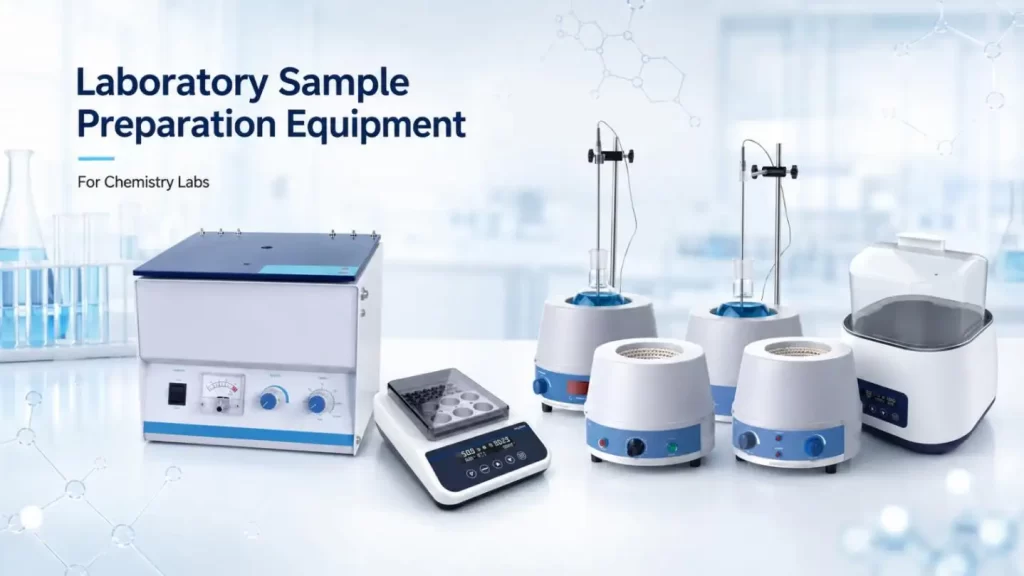
At Trustlab, we view Laboratory Sample Preparation Equipment as a connected preparation workflow rather than a group of isolated instruments. Depending on the method, this may combine electronic balances, mixers and shakers, centrifuges, water baths, dry baths, heating mantles, pipetting products, and laboratory glassware.
Match Laboratory Sample Preparation Equipment to the Sample Matrix
Not every sample requires the same preparation sequence. Adding unnecessary steps can increase processing time, contamination risk, and sample loss.
| Sample Condition | Main Preparation Requirement | Typical Equipment |
| Powder / fine solid | Weighing, mixing, homogenization | Balance, mixer, stirrer |
| Coarse heterogeneous solid | Particle-size reduction | Crusher, mill, grinder |
| Suspension | Solid-liquid separation | Centrifuge, filtration system |
| Liquid solution | Mixing, dilution, transfer | Shaker, stirrer, pipette |
| Heat-assisted sample | Dissolution, extraction, incubation | Water bath, dry bath, heating mantle |
| Complex matrix | Extraction or digestion | Heating/digestion and separation equipment |
A practical workflow should therefore be built backward from the analytical instrument rather than forward from an equipment catalogue.
Particle Size and Homogeneity Are Different Control Targets
Grinding, mixing, and homogenization are often grouped together, but they solve different analytical problems.
Particle-Size Reduction
Grinding increases effective surface area and can improve subsequent dissolution or extraction. However, excessive grinding may introduce:
•Heat that affects temperature-sensitive compounds;
•Contamination from grinding tools or vessels;
•Loss of very fine particles during transfer;
•Longer preparation and cleaning cycles.
Thus, the right target particle size should depend on the sample matrix and analytical method, not on the smallest particle size a machine can handle.
Homogenization and Mixing
Homogenization looks to make the aliquot stand in for the original sample. Mixing parameters should consider:
•Sample volume;
•Viscosity;
•Solids content;
•Vessel geometry;
•Mixing speed or oscillation frequency;
•Processing time.
Trustlab shaker, mixer, and stirring equipment can be integrated into routine chemistry workflows where controlled agitation is required before aliquoting, extraction, dilution, or separation.
Centrifugation vs. Filtration: Select by Separation Mechanism
A major decision when configuring Laboratory Sample Preparation Equipment is whether suspended material should be removed by centrifugal sedimentation or physical filtration.
| Selection Factor | Centrifugation | Filtration |
| Separation principle | Density / particle sedimentation | Pore-based retention |
| High solids loading | Often suitable | Can cause clogging |
| Consumable requirement | Mainly tubes | Filter media required |
| Analyte adsorption | Mainly tube-material dependent | Membrane-dependent |
| Separation control | RCF, time, rotor | Pore size, membrane, pressure |
Do Not Compare Centrifuges by RPM Alone
Relative centrifugal force depends on both rotational speed and rotor radius. Therefore, two centrifuges operating at the same RPM may produce different separation performance.
Important procurement parameters include:
•Maximum and operating RCF;
•Rotor type and radius;
•Tube size and number of positions;
•Working sample volume;
•Run-time control;
•Temperature range for heat-sensitive samples.
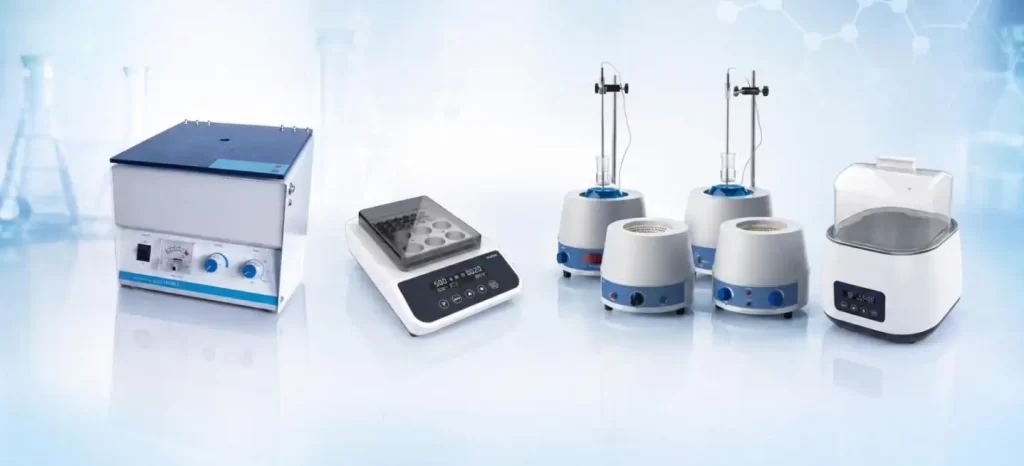
Trustlab offers standard, compact, and refrigerated centrifuge configurations, allowing Laboratory Sample Preparation Equipment to be selected according to sample throughput and temperature-control requirements rather than maximum speed alone.
When Is Controlled Heating Required?
Heating may be required for dissolution, extraction, incubation, reaction acceleration, or temperature conditioning. However, different heating technologies should not be treated as interchangeable.
Water Bath
Suitable where indirect, relatively uniform temperature control is needed around tubes, bottles, or vessels.
Dry Bath
Useful where samples are heated in blocks without water, reducing water handling and allowing controlled tube-based incubation.
Heating Mantle
Designed for direct heating of compatible laboratory flasks and is useful in chemical workflows where vessel geometry and controlled heating are important.
Trustlab supplies these temperature-control categories as part of its Laboratory Sample Preparation Equipment portfolio. The choice should depend on required temperature range, vessel type, sample chemistry, temperature uniformity, and batch size.
For aggressive acid digestion or closed-vessel microwave digestion, pressure capability, vessel chemistry, method validation, and safety requirements must be evaluated separately.
Build the Sample Preparation Workflow Backward From Analysis
The downstream analytical technique defines what "prepared" actually means.
ICP / AAS Workflows
A typical sequence may be:
Weigh → Homogenize → Digest/Dissolve → Separate → Dilute → Analyze
Control priorities include contamination, complete dissolution, dilution accuracy, and recovery.
HPLC / GC Workflows
A common logic is:
Homogenize → Extract → Centrifuge/Filter → Transfer → Dilute → Analyze
Here, solvent compatibility, filter adsorption, extraction recovery, and particulate removal become more important.
Wet Chemistry and Titration
Typical operations may include:
Weigh → Dissolve → Mix → Transfer → Adjust Volume → Analyze
For these workflows, balances, stirrers, pipettes, volumetric glassware, and temperature-control equipment may be more important than high-speed separation equipment.
These sequences are not universal SOPs. The correct Laboratory Sample Preparation Equipment configuration must follow the validated analytical method.
Control Throughput Without Sacrificing Sample Integrity
A high-specification instrument does not automatically create a high-throughput workflow. Bottlenecks often occur during preparation.
Before selecting equipment, calculate:
•Samples per shift;
•Samples per batch;
•Preparation time per stage;
•Centrifuge or heating capacity;
•Cooling time;
•Cleaning/changeover time;
•Consumable usage;
•Number of manual transfers.
Increasing batch capacity is useful only if each sample can still receive equivalent mixing, heating, separation, and handling conditions.
Prevent Carryover at Every Sample-Contact Surface
Cross-contamination is especially important for trace analysis and low-concentration samples.
Review all contact surfaces, including:
•Tubes and centrifuge vessels;
•Pipette tips;
•Glassware;
•Stirrer components;
•Heating vessels;
•Filters and membranes.
Material compatibility should be evaluated against acids, alkalis, organic solvents, and the target analyte. "Chemically resistant" does not automatically mean "analytically inert."
Cleaning procedures should also define when rinsing is sufficient and when blanks or cleaning verification are required.
A Practical Laboratory Sample Preparation Equipment Selection Checklist
Before final configuration, define:
- Sample matrix — solid, liquid, suspension, powder, or complex matrix
- Analytical method — ICP, AAS, HPLC, GC, spectroscopy, or wet chemistry
- Preparation objective — homogenize, dissolve, extract, separate, heat, or dilute
- Critical parameters — particle size, RCF, temperature, volume, or mixing speed
- Throughput — samples per batch and per day
- Contamination limits — contact materials, cleaning, carryover, and blanks
- Verification needs — calibration, safety, documentation, and method compatibility
The best Laboratory Sample Preparation Equipment system is not the one with the largest number of instruments. It is the shortest controlled workflow that consistently converts the original sample into a representative, stable, and method-compatible analytical sample.
Trustlab's range of balances, mixers, centrifuges, heating equipment, pipetting products, and laboratory glassware can be combined around different chemistry-laboratory workflows. For a new laboratory or workflow upgrade, providing Trustlab with the sample type, sample volume, daily throughput, preparation procedure, and downstream analytical method is a practical way to identify a suitable configuration without unnecessary equipment or process complexity.
FAQs
Q1. What Laboratory Sample Preparation Equipment does Trustlab offer?
Electronic balances, centrifuges, shakers, mixers, heaters, stirrers, baths, pipettes, lab glassware - you name it, and we have it. Trustlab has the lab equipment for any preparation stage.
Q2. How does Trustlab assist in choosing Laboratory Sample Preparation Equipment for a chemistry lab?
The selection process begins with considering the sample matrix, the purpose behind the sample preparation, the volume of samples, the daily throughput, and the analytical method downstream. Based on these principles, we can assist you in determining the necessary equipment for sample weighing, mixing, heating, separation, and liquid handling.
Q3. Does Trustlab have centrifuges for sample prep?
Yes. We have lab centrifuges that can be used for sample prep. When buying a centrifuge, consider the rotor configuration, tube capacity, sample size, temperature, and run time, rather than focusing on the maximum speed (RPM) the centrifuge can achieve.
Q4. Which Trustlab equipment can be used for mixing and homogenizing samples?
Shakers, mixers, and stirrers are available to assist in mixing solutions, preps of suspension and extraction, and reagent mixing and homogenizing samples.
Q5. What heating equipment does Trustlab offer for sample prep?
Heating mantles, dry baths and water baths are available in our Lab Equipment Sample Preparation line. The choice would depend on what sample chemistry you have, what the batch size is, and which type of heating is required.
Written by
Trustlab
The author is a specialist at Ningbo Trustlab Instruments Co., Ltd., a leading provider of laboratory and medical consumables since 2015. With extensive experience in global healthcare and laboratory markets, they focus on delivering high-quality, innovative solutions and professional support to laboratories, hospitals, and distributors worldwide. Trustlab’s products are trusted in over 100 countries, reflecting the company’s commitment to reliability, excellence, and customer satisfaction.


