



Updated 2 weeks ago
Digital Microscope with Camera for Inspection: Camera, Optics and Imaging Selection Guide

Trustlab
The author is a specialist at Ningbo Trustlab Instruments Co., Ltd., a leading provider of laboratory and medical consumables since 2015. With extensive experience in global healthcare and laboratory markets, they focus on delivering high-quality, innovative solutions and professional support to laboratories, hospitals, and distributors worldwide. Trustlab’s products are trusted in over 100 countries, reflecting the company’s commitment to reliability, excellence, and customer satisfaction.

OEM Microscope Manufacturer
A Digital Microscope with Camera for Inspection is more than a conventional microscope fitted with a camera. For laboratory inspection, biological observation, education, and sample documentation, its practical performance depends on how well the optical system, image sensor, illumination, display, storage, and data interface work together.

At Trustlab, we design digital microscopy around this complete imaging chain. Instead of evaluating a microscope only by magnification or camera megapixels, users should first define what needs to be observed, how much detail must be resolved, and whether the result needs to be captured, transferred, compared, or archived.
How Does a Digital Microscope with Camera for Inspection Work?
The basic imaging path can be summarized as:
Sample → Objective Lens → Optical Image → CMOS Sensor → Digital Processing → LCD Display → Image Storage
Each stage affects final image quality.
The objective determines how much specimen detail reaches the imaging plane. The CMOS sensor converts that optical information into digital pixels, while the display and storage system determine how efficiently operators can review and document the result.
A properly configured Digital Microscope with Camera for Inspection can support:
•Real-time sample observation
•Digital image capture
•Reference-image creation
•Sample-to-sample comparison
•Training and teaching
•Inspection documentation
•Image transfer for laboratory records
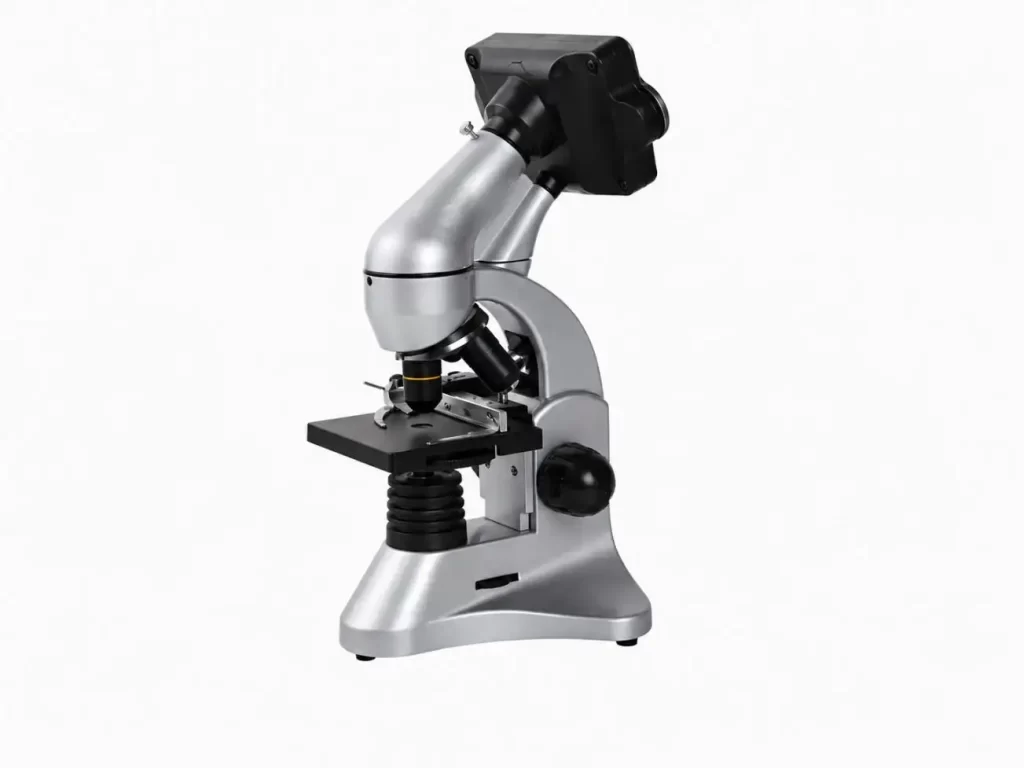
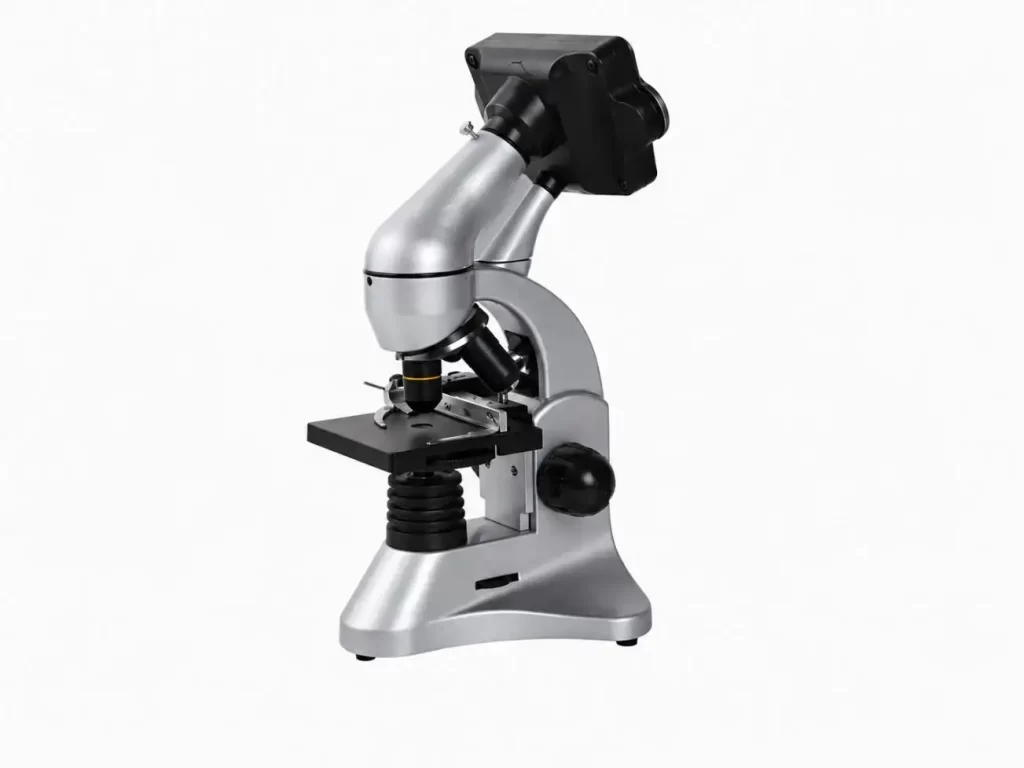
Trustlab integrates the CMOS camera and TFT LCD into the microscope platform so routine observation and digital documentation can be completed without requiring a separate imaging workstation.
Camera Megapixels Are Only Part of Image Quality
Camera resolution is frequently overemphasized when microscopes are compared.
A 2 MP, 5 MP, or higher-resolution sensor defines the number of pixels available for image capture, but it does not independently determine the smallest detail that can be resolved.
For a Digital Microscope with Camera for Inspection, image quality depends on the entire optical-digital chain:
| Technical Factor | Effect on Inspection |
| Objective resolution | Determines resolvable specimen detail |
| Numerical aperture | Influences resolution and light collection |
| Camera pixel count | Determines digital image dimensions |
| Sensor performance | Influences noise and image consistency |
| Focus accuracy | Controls edge and feature sharpness |
| Illumination | Controls contrast and visibility |
| Display resolution | Affects on-screen interpretation |
Trustlab combines a 2.0 MP CMOS sensor with up to 1600 × 1200 image capture and conventional microscope optics. This approach is intended for routine digital observation where optical information and documentation capability must remain balanced.
Optical Resolution Comes First
More pixels cannot recover information that the objective lens has failed to resolve.
Key evaluation points include:
•The minimum feature size that must remain visible
•The optical characteristics of transparent, biological, or surface-oriented samples
•The distinction between qualitative observation and measurement-based inspection
•The required image quality for documentation, comparison, or further analysis
These factors are more useful than comparing megapixel numbers alone.
Optical Magnification vs. Digital Zoom
Another specification that requires careful interpretation is magnification.
Optical Magnification
Optical magnification is produced by the microscope optics and enlarges the actual optical image reaching the eye or camera.
Trustlab's digital microscope platform provides a 40X–400X optical magnification range, suitable for common biological and laboratory observation tasks.
Digital Zoom
Digital zoom enlarges pixels from an already captured image. Trustlab's system provides additional digital enlargement of up to 8X for screen-based review.
Digital zoom can help operators:
•Examine a selected image region
•Present details on the LCD
•Compare visible structures
•Improve teaching demonstrations
However, digital zoom should not be interpreted as additional optical resolving power.
For a Digital Microscope with Camera for Inspection, useful optical resolution is generally more important than the highest combined magnification figure.
Why Illumination Direction Matters
Inspection quality depends heavily on how light interacts with the sample.
Trustlab's microscopes use LED light systems that are customizable for both the top and bottom lighting. This feature allows the microscope to be used with varying sample characteristics.
| Sample | Preferred Lighting Approach |
| Biological Slides | Bottom Transmitted Light |
| Cells and Tissue Sections | Bottom Illumination |
| Transparent Specimens | Bottom Illumination |
| Surface Structures | Top Illumination |
| Mixed Sample Processing | Top and Bottom Illumination Combined |
Light systems must balance contrast with a minimum of glare and oversaturation. Increasing brightness does not equate to revelation of more information.
When reproducibility is essential, operators need to maintain consistency for the following:
•Light Intensity
•Sample Orientation
•Objective Selection
•Focus Position
•Camera Exposure
These elements can affect image comparisons stored in the system.
Integrated Camera or External Camera?
Camera systems should be designed based on workflow as opposed to specification.
Integrated Digital Microscope
An integrated Digital Microscope with Camera for Inspection is practical when users prioritize:
•Fast installation and setup
•Compact bench-space requirements
•Routine image capture
•Simple operator training
•Direct LCD observation
•Reduced dependence on a PC
External Camera System
A modular external camera is more suitable for applications involving:
•Specialized scientific cameras
•Advanced imaging software
•Calibrated dimensional measurement
•Frequent sensor upgrades
•Specialized fluorescence or research imaging
Trustlab's integrated architecture is primarily designed for efficient routine microscopy rather than replacing highly specialized research imaging platforms.
Image Storage Is Part of the Inspection Process
Digital inspection should not stop at viewing the image.
A practical workflow is:
Observe → Focus → Capture → Store → Transfer → Compare → Archive
Trustlab integrates SD card storage, internal memory, and USB 2.0 connectivity, helping users move from observation to documentation without adding multiple external devices.
Important workflow considerations include:
•Independent image capture without continuous PC connection
•Local image storage for routine inspection records
•Efficient file transfer to laboratory documentation systems
•Consistent creation of reference images
•Simple operating procedures for daily laboratory use
These factors often have a greater operational impact than a small difference in camera specifications.
Digital Microscope with Camera for Inspection: Selection Checklist
Before specifying a system, the application requirements should be clearly defined.
•Sample type: Biological, transparent, surface-oriented, or mixed
•Required detail: Minimum feature size that must be resolved
•Optical magnification: Appropriate working magnification range
•Camera: Image capture and documentation requirements
•Illumination: Top, bottom, or dual illumination
•Display: Integrated LCD or external screen
•Storage: Local image-recording requirements
•Connectivity: USB transfer or PC integration
•Ergonomics: Operator position and shared-use requirements
•Analysis level: Visual inspection or calibrated measurement
Trustlab also uses a 45° inclined viewing head with 360° rotation, supporting more flexible workstation positioning and shared laboratory observation.
Where Is a Digital Inspection Microscope Most Suitable?
A Digital Microscope with Camera for Inspection is particularly practical for:
•Routine biological sample observation
•Prepared-slide inspection
•Laboratory teaching
•Microscope training
•Sample documentation
•Reference-image libraries
•Basic comparative inspection
•Research workflows requiring straightforward digital capture
For applications requiring micron-level calibrated dimensional measurement, advanced fluorescence imaging, automated image analysis, or research-grade sensors, a more specialized microscopy platform should be evaluated.
Building a Better Digital Inspection Workflow
Choosing a Digital Microscope with Camera for Inspection should begin with the sample and inspection objective—not the largest magnification or megapixel number on a specification sheet.
Optical resolution, CMOS imaging, illumination direction, image capture, storage, connectivity, and operator ergonomics should be treated as one system.
At Trustlab, we integrate 40X–400X optical microscopy, CMOS digital imaging, TFT LCD viewing, dual LED illumination, digital zoom, image storage, and USB connectivity into a practical platform for laboratory observation and documentation.
For laboratories, distributors, and educational suppliers evaluating a Digital Microscope with Camera for Inspection, Trustlab can support configuration discussions based on sample type, optical range, imaging workflow, illumination method, and documentation requirements.
FAQs
Q1. What kind of Digital Microscope with Camera for Inspection does Trustlab offer?
Trustlab offers integrated digital microscope solutions that integrate optical microscopy, CMOS imaging, LCD viewing, image capturing, storage, and data transfer all on a single research platform.
Q2. For what purposes can Trustlab digital microscopes be used?
Trustlab digital microscopes can be used for biological observation, slide inspections, laboratory instruction, training, sample recording, and general comparative inspection that is not very difficult.
Q3. Is a Trustlab digital microscope connected to a PC for image viewing?
A Trustlab digital microscope does not require a PC; a microscope is equipped with a TFT LCD and therefore requires no connection to a PC for image observation.
Q4. What range of optical magnifications is available?
Trustlab's digital microscope has a 40X to 400X optical magnification range that satisfies most laboratory and biological observation requirements.
Q5. Does Trustlab's digital microscope offer digital zoom?
Yes; digital zoom of 8X is available; however, Trustlab's digital microscope does not replace optical magnification with digital zoom.
Written by
Trustlab
The author is a specialist at Ningbo Trustlab Instruments Co., Ltd., a leading provider of laboratory and medical consumables since 2015. With extensive experience in global healthcare and laboratory markets, they focus on delivering high-quality, innovative solutions and professional support to laboratories, hospitals, and distributors worldwide. Trustlab’s products are trusted in over 100 countries, reflecting the company’s commitment to reliability, excellence, and customer satisfaction.


