


Updated 3 weeks ago
DNase/RNase-Free PCR Tubes for Contamination-Sensitive Workflows
trustlabofficial

Clear 0.2 mL polypropylene PCR tube strip with domed caps held in a gloved hand
PCR tubes certified free of DNase and RNase are a basic but essential safeguard for workflows where enzyme contamination can destroy experimental results. These 0.2 mL polypropylene tubes are manufactured and packaged to prevent nuclease enzymes from contacting your samples, making them the standard choice for PCR, qPCR, and reverse-transcription workflows. This page explains what DNase/RNase-free certification really means, how to verify supplier claims, and which tube format and cap style fits your application.
Note that the term "DNase/RNase-free tubes" is sometimes used loosely for 1.5 mL microcentrifuge tubes. This article is specifically about 0.2 mL PCR tubes and strips. Trustlab produces these through its pcr tubes manufacturer program, where contamination control is built into the production process.
Why DNase/RNase-Free PCR Tubes Matter
DNase and RNase are enzymes that degrade DNA and RNA, respectively. If either is present on the inner surface of a PCR tube, it can destroy the molecules you are trying to amplify or measure.
RNase contamination is especially problematic. RNases are highly stable — they resist heat, pH changes, and many chemical treatments — and they are abundant on human skin and in the environment. Even trace RNase activity on a tube wall can degrade RNA templates before reverse transcription, leading to failed cDNA synthesis, high Cq values, or no amplification in RT-qPCR.
DNase contamination is equally damaging for DNA-based workflows. DNase can digest template DNA or freshly amplified PCR product, producing false negatives or irreproducible results.
The workflows that depend most on nuclease-free consumables include:
- RNA extraction and storage
- Reverse transcription and RT-qPCR
- Sensitive diagnostic PCR assays
- Low-copy-number or long-range amplification
For these applications, choosing PCR tubes that are certified DNase/RNase-free removes one avoidable variable from the experiment.
What "DNase/RNase-Free" Certification Actually Means
"DNase-free" means the product has been tested and found free of detectable deoxyribonuclease activity. "RNase-free" means the same for ribonuclease activity. "Nuclease-free" is an umbrella term that usually means both.
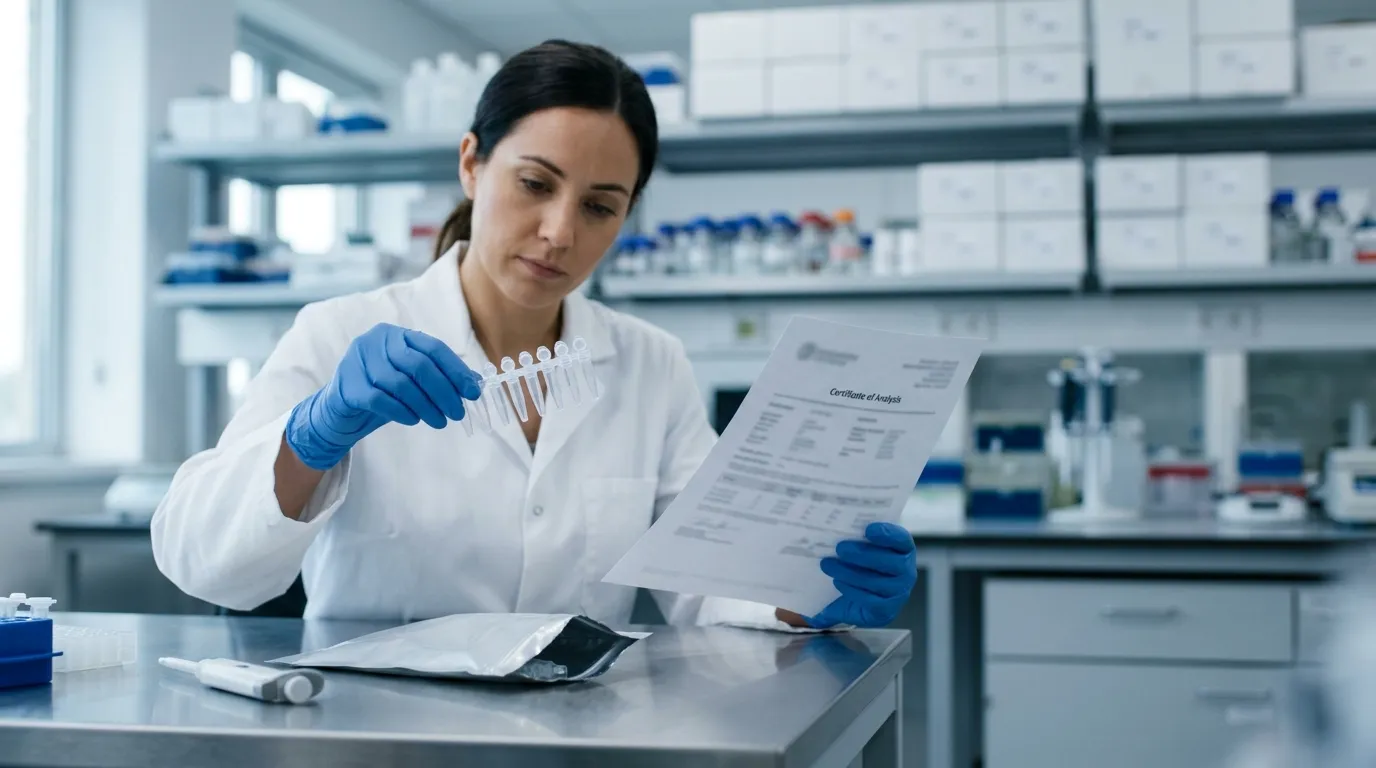
The critical distinction buyers should understand is the difference between a "guaranteed" claim and a "lot-tested" claim. A supplier that merely guarantees nuclease-free status on a specification sheet may not have tested every production lot. A lot-tested claim means each batch has been assayed for nuclease activity before release, with results documented in a Certificate of Analysis (CoA).
A CoA is the document that lets you verify a supplier's claim. It should state the lot number, the tests performed, the assay method, and the result. This documentation standard is used by manufacturers such as Teknova, which provides lot-specific CoAs showing RNase, DNase, and PCR-inhibitor testing for its products.
DNase/RNase-Free vs. Sterile vs. PCR-Inhibitor-Free
These three terms are frequently confused, and confusing them can lead to incorrect purchasing decisions.
| Term | What It Means | What It Prevents | How It Is Verified |
|---|---|---|---|
| Sterile | No viable microorganisms | Microbial contamination | Autoclaving, gamma irradiation, or ethylene oxide treatment; verified by sterility testing |
| DNase/RNase-free | No detectable DNase or RNase enzyme activity | Enzymatic degradation of DNA or RNA | Nuclease activity testing per lot, documented in a CoA |
| PCR-inhibitor-free | No substances that inhibit polymerase | Failed or inhibited amplification | PCR inhibition testing with a defined assay |
A tube can be sterile yet still contain nucleases. Sterilization kills microorganisms; it does not necessarily inactivate all enzymes. Likewise, a DNase/RNase-free tube is not inherently sterile unless the manufacturer also performs and documents sterilization. When a protocol calls for nuclease-free consumables, verify the nuclease-free claim separately from any sterility claim.
USA Scientific, for example, certifies its TempAssure PCR tubes as free of RNase, DNase, DNA, and PCR inhibitors. This illustrates the difference between minimal nuclease testing and a more comprehensive contamination-control panel.
DNase/RNase-Free PCR Tube Specifications and Options
PCR tubes are available in several configurations, and the right choice depends on the workflow.
| Specification | Typical Options | Notes |
|---|---|---|
| Volume | 0.2 mL | Standard for most thermal cyclers |
| Material | Polypropylene | Autoclavable, chemically resistant, low nucleic-acid binding |
| Format | Individual tubes or 8-strips | Strips suit high-throughput workflows and multichannel pipettes |
| Cap type | Domed or flat | Affects sealing mechanism and labeling convenience |
| Packaging | Racks, bags, or refill packs | Affects storage and contamination risk |
Polypropylene is the standard PCR tube material because it withstands thermal cycling temperatures without melting or warping. It also resists binding of nucleic acids and proteins, helping to maintain accurate reaction conditions. For fluorescence-based qPCR, virgin polypropylene with low autofluorescence is preferred.
Autoclavability is a practical consideration if your lab sterilizes consumables before use. Polypropylene PCR tubes generally withstand 121°C autoclave cycles. Autoclaving, however, does not substitute for certified nuclease-free status — it only addresses microbial contamination.
Trustlab states that its lab consumables range includes DNase/RNase-free certification, autoclaving or gamma irradiation options, a usable temperature range of -80°C to +121°C, and leak-proof sealing design. Because these claims are made at the product-line level, buyers should request the product-specific datasheet and certificate for the exact PCR tube configuration they intend to purchase.
Choosing the Right PCR Tube Format and Cap Style
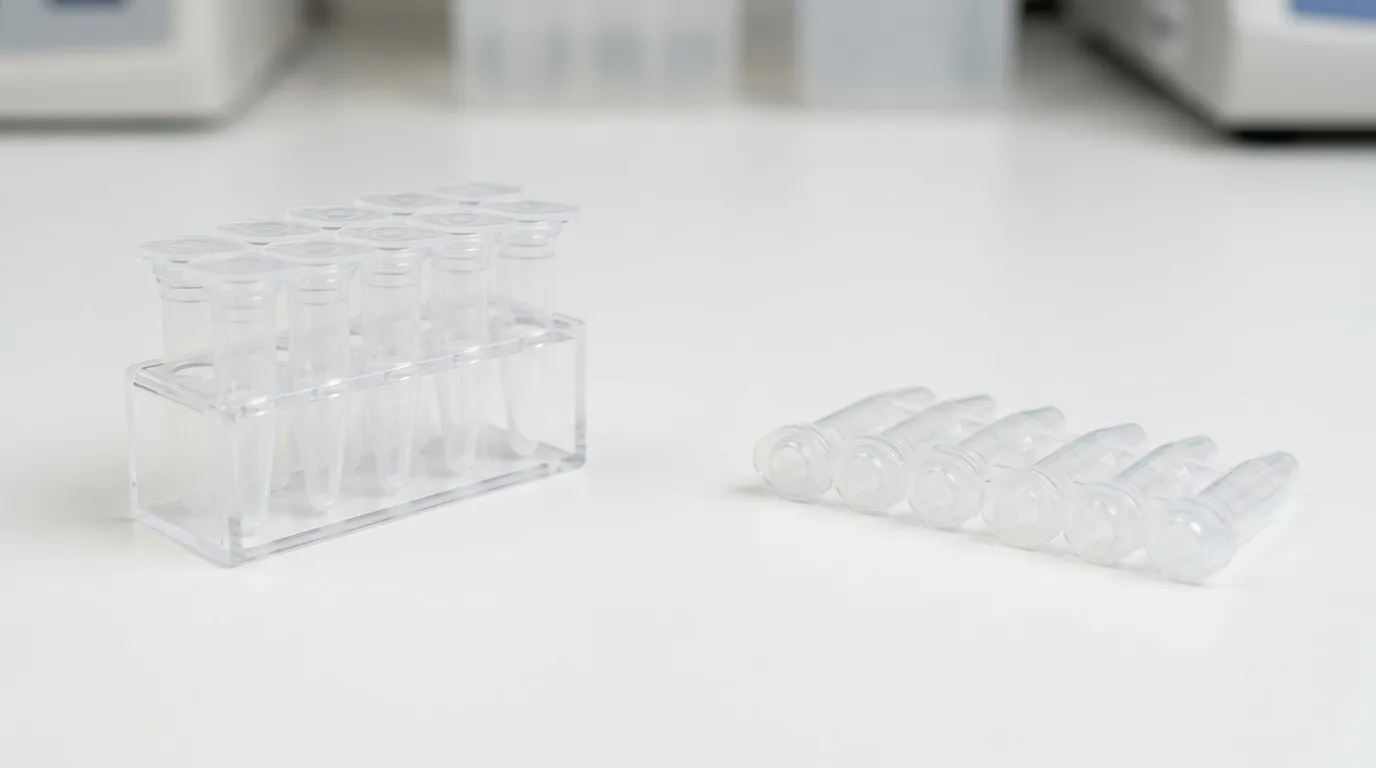
Two decisions come up with every PCR tube purchase: individual tubes versus strips, and domed caps versus flat caps.
Individual tubes vs. 8-strips
Individual tubes offer flexibility. You can open one tube at a time, label it individually, and store reactions as single samples. This is convenient for low-throughput labs or when only a few reactions are needed.
8-strip tubes connect eight tubes in a single strip. They reduce tube handling, speed up setup, and work naturally with multichannel pipettes. For replicate reactions, standard curves, or screening workflows, strips are the more efficient choice.
| Consideration | Individual tubes | 8-strip tubes |
|---|---|---|
| Throughput | Low to medium | Medium to high |
| Multichannel pipette use | Not applicable | Yes |
| Per-reaction handling | Higher | Lower |
| Flexibility | High — open one at a time | Moderate — strip remains connected |
Domed caps vs. flat caps
Domed caps seal through pressure from the thermal cycler lid. The lid presses the dome down over the tube rim, creating a tight seal during cycling. Domed caps are the most common choice and work well with most cyclers.
Flat caps seal directly onto the tube without relying as heavily on lid pressure. They also provide a flat surface for labeling, which is useful when tracking many samples. Some researchers prefer flat caps for certain optical detection systems, though this depends on the instrument design and should be confirmed with the cycler manufacturer's recommendations.
| Cap type | Sealing method | Best for |
|---|---|---|
| Domed | Thermal cycler lid pressure | Standard PCR and qPCR on most instruments |
| Flat | Direct seal onto tube | Labeling needs; certain optical detection systems |
Trustlab Quality Documentation and Product Assurance
Trustlab manufactures laboratory consumables and states that its product range meets DNase/RNase-free certification standards. The company's stated quality specifications for its consumables line include autoclaving or gamma irradiation options, a usable temperature range of -80°C to +121°C, and leak-proof sealing design. For procurement teams, the key step is requesting the documentation that backs these claims.
When requesting a quote or samples, ask Trustlab to confirm the following for the specific PCR tube product:
- Which nuclease tests are performed (DNase, RNase, or both)
- Whether testing is performed per lot
- Whether a Certificate of Analysis is available for each lot
- Whether the product is sterile or non-sterile
- Whether the product is tested for PCR inhibitors
How to Verify Any Supplier's "DNase/RNase-Free" Claim
The verification framework below applies to any PCR tube supplier, including Trustlab. It helps procurement teams separate documented quality from marketing claims.
Documents to request
| Document | What it should show |
|---|---|
| Certificate of Analysis (CoA) | Lot number, test methods, measured results, acceptance criteria |
| Lot-test report | Confirmation that the specific lot you received was tested |
| Product datasheet | Material, volume, packaging, and handling specifications |
| Sterility certificate | If sterility is claimed, the method and validation evidence |
Questions to ask any supplier
- What assay method is used for nuclease testing?
- What is the detection limit of the assay?
- Are all lots tested, or only samples?
- Is the claim "guaranteed" or "lot-tested"?
- Is sterility claimed separately from nuclease-free status?
- Is PCR-inhibitor testing performed, or only nuclease testing?
- Can you provide a CoA for the lot being shipped?
Red flags to watch for
- A supplier that only says "guaranteed" without offering test data
- Refusal to provide a CoA or lot-test documentation
- No defined test method for nuclease detection
- Use of the term "nuclease-free" when the documentation only covers sterility
- Confusion between sterile and nuclease-free in the supplier's own product literature
For sensitive workflows — RNA work, RT-qPCR, diagnostic PCR — the cost difference between documented and undocumented nuclease-free claims is small compared with the cost of failed experiments. A supplier that cannot produce a CoA for its PCR tubes should not be your first choice.