


Updated 2 weeks ago
Gel Clot Activator Tube Manufacturer for Serum Preparation
trustlabofficial

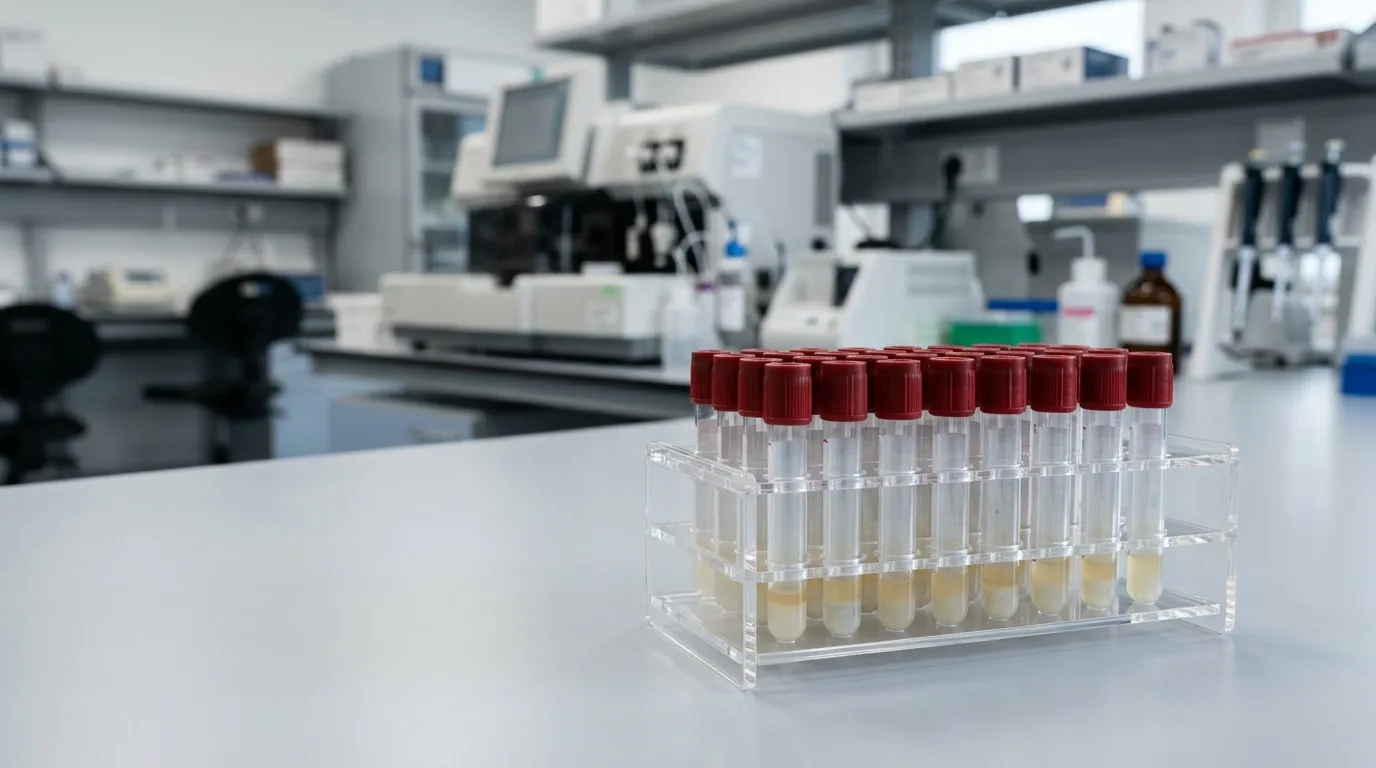
Gel clot activator blood collection tubes in a laboratory rack
Trustlab’s website presents Ningbo Trustlab Instruments Co., Ltd. as a manufacturer and wholesaler of laboratory and medical consumables, and lists gel plus clot activator tube formats for serum preparation. The listed range includes 1–4 mL through 7–10 mL formats and tube dimensions of 13×75 mm, 13×100 mm, and 16×100 mm, according to Trustlab’s medical consumable supplies OEM guide.
For distributors, laboratories, and OEM buyers, selecting a gel clot activator tube manufacturer requires more than comparing volume and tube size. The tube design, additive, separator gel, processing instructions, documentation, quality-system scope, and product-specific regulatory evidence should all be reviewed before bulk purchasing.
What Is a Gel Clot Activator Tube?
A gel clot activator tube is a serum tube that combines a clot activator with a separation gel. The clot activator helps the collected blood coagulate, while the gel forms a barrier between the serum and the clot after centrifugation.
These tubes are commonly described as serum separator tubes, or SST tubes, when they contain both a clot activator and a gel separator. The typical workflow is:
- Blood is collected into the evacuated tube.
- The tube is gently inverted according to the applicable manufacturer instructions.
- The clot activator promotes clot formation.
- After clotting, the tube is centrifuged.
- The separation gel moves between the serum and cellular components.
- The separated serum is transferred or analyzed.
Clot activator tubes without gel can also produce serum, but they do not provide the same physical barrier between serum and the clot. For a broader explanation of tube categories, see different types of vacuum blood collection tubes.
The exact clot activator chemistry should be confirmed in the product’s technical documentation. Many products use silica particles applied to the tube wall, while other designs may use different activating treatments. A manufacturer’s product page or IFU should be used to confirm the additive or coating for a specific product.
Trustlab Gel Clot Activator Tube Specifications
Trustlab’s available website information identifies gel plus clot activator tube formats by volume range and tube dimensions. The published information does not provide a verified SKU-by-SKU mapping between every volume and dimension, so buyers should request the current technical datasheet or catalog before placing an order.
| Specification | Trustlab information currently listed | Buyer verification point |
|---|---|---|
| Product type | Gel plus clot activator tube | Confirm the exact additive and gel configuration |
| Application | Serum preparation | Confirm suitability for the intended laboratory workflow |
| Listed volume formats | 1–4 mL through 7–10 mL | Confirm the nominal draw volume for each variant |
| Listed tube dimensions | 13×75 mm, 13×100 mm, and 16×100 mm | Confirm which dimensions correspond to each volume |
| Tube material | Not verified for the specific Trustlab gel clot activator variants | Request confirmation of PET, glass, or another material |
| Cap or closure configuration | Not verified for each Trustlab variant | Confirm cap color, stopper type, and closure design |
| Packaging and package quantity | Not verified | Request the current packaging specification |
| Sterility status | Not verified for the specific variants | Do not assume sterile status without product documentation |
Nominal draw volume and physical dimensions are different specifications. A 5 mL or 10 mL designation should not be treated as a tube dimension, and a 13×100 mm dimension does not by itself establish the tube’s nominal draw volume.
The same principle applies to product codes. Model numbers, catalog codes, package quantities, and variants should remain separate. If a supplier’s product page or catalog contains duplicate or conflicting codes, request written confirmation rather than relying on an assumed mapping.
For the wider Trustlab range, see vacuum blood collection tubes.
How a Gel Clot Activator Tube Works

The performance of a gel clot activator tube depends on the interaction between the tube coating, the blood sample, the clotting period, and the centrifugation process.
Collection and mixing
After collection, the tube must be mixed according to its applicable instructions. Gentle inversion helps distribute the blood across the clot activator coating. Excessive shaking can contribute to hemolysis, while inadequate mixing may leave the sample insufficiently exposed to the activator.
Competitor technical pages commonly specify several gentle inversions, but the correct number is product-specific. Trustlab’s exact inversion instruction should come from its IFU or technical datasheet rather than being inferred from another manufacturer’s tube.
Clot formation
The sample normally needs time to clot before centrifugation. Published manufacturer examples describe clotting periods of approximately 20–30 minutes, although the required time varies by product design and laboratory conditions. Improve Medical lists a 30-minute clotting period for one gel and clot activator product, while Hinotek lists a 20–25-minute range for its product.
These figures are general manufacturer examples, not verified Trustlab specifications. Buyers should request the clotting-time instruction for the exact Trustlab variant.
Centrifugation and gel migration
Centrifugation separates the serum from the clot and cellular components. The gel moves under centrifugal force and forms a barrier between the layers.
Centrifugation should be specified using relative centrifugal force, or RCF, expressed as ×g, when the instruction requires a force value. RPM is rotational speed and cannot be substituted for RCF without considering the centrifuge rotor radius.
Published competitor instructions include ranges such as 1,500–2,000 ×g for 10 minutes and 1,800–2,200 ×g for 10 minutes. These values should not be presented as Trustlab’s instructions. The current Trustlab IFU should control the centrifugation time and RCF for each product variant.
Applications of Gel Clot Activator Tubes
Gel clot activator tubes are intended for workflows that require serum rather than anticoagulated whole blood or plasma. Common laboratory applications include:
- Serum biochemistry
- Routine clinical chemistry
- Immunology
- Serology
- Some therapeutic drug monitoring workflows
Laboratory specimen references such as Labcorp identify gel-barrier serum tubes as tubes containing a clot activator and gel for serum preparation. However, suitability for a specific analyte or analyzer should be confirmed through the applicable laboratory procedure, test method, and tube manufacturer documentation.
A general serum application does not prove compatibility with every assay. Tube materials, clot activators, separator gels, stopper components, and sample-processing conditions can affect certain analytical methods. A manufacturer should therefore provide product-specific information when a buyer needs validation for a defined panel, instrument, or application.
Quality Assurance and Regulatory Context for Manufacturers
A qualified gel clot activator tube manufacturer should be able to explain its quality system, product documentation, manufacturing controls, and regulatory scope. These are related but separate areas.
Quality-management-system certification
ISO 9001 and ISO 13485 are quality-management-system standards. They should not automatically be interpreted as product approvals.
- ISO 9001 generally concerns a quality-management system applicable to the certified organization and scope.
- ISO 13485 is specific to quality management for medical devices and related organizations.
- Neither certificate, by itself, proves that a particular gel clot activator tube is sterile, FDA-cleared, CE-marked, clinically validated, or suitable for every assay.
Trustlab’s website states ISO 9001 compliance and references ISO 13485 certificates on its certificate-related materials. The exact certificate scope, validity, issuing body, and applicability to gel clot activator tubes should be confirmed directly before those claims are used in procurement or regulatory documentation.
Sterilization and sterility evidence
A supplier should identify whether the exact product is sterile or non-sterile and provide supporting documentation where sterility is claimed.
Two sterilization methods that appear in industry product documentation are:
- Ethylene oxide, or EO, sterilization, for which residual EO considerations are relevant to ISO 10993-7.
- Gamma or other radiation sterilization, for which validation is associated with ISO 11137.
Improve Medical describes radiation sterilization, a 10⁻⁶ sterility assurance level, and ISO 11137 for one of its products. Nasmed describes EO-related documentation for its own products. These competitor claims provide market context only; they do not establish Trustlab’s sterilization method or sterility status.
Do not treat “clean,” “safe,” “hygienic,” or “contamination-free” wording as a sterility claim. Request the exact product sterilization record, certificate, or applicable technical document for the Trustlab variant under consideration.
Product-level regulatory evidence
Regulatory status is product- and jurisdiction-specific. For example, the US FDA 510(k) review document for Improve Medical’s IMPROVACUTER gel and clot activator tube identifies a specific product and clearance record. That document demonstrates the product-specific nature of FDA clearance; it does not establish FDA clearance for other manufacturers.
Similarly, CE marking depends on the product, conformity route, applicable legislation, economic operator information, and market jurisdiction. Broad website wording about CE or ISO compliance is not sufficient evidence for a specific Trustlab tube.
Before procurement, request:
- Current technical datasheet
- Product IFU
- Product and packaging specifications
- Applicable certificate or declaration of conformity
- Sterilization documentation, if the product is sold as sterile
- Batch or lot documentation
- Shelf-life and storage information
- Traceability information
- Relevant regulatory registration or clearance documents for the destination market
For additional supplier-assessment guidance, read how to evaluate blood collection system supplier quality.
Choosing a Gel Clot Activator Tube Manufacturer: What to Check

A procurement team can use the following checklist when evaluating Trustlab or another gel clot activator tube supplier.
1. Confirm the exact product configuration
Ask the manufacturer to identify the exact product family, variant, model, or SKU. Confirm:
- Nominal draw volume
- Tube dimensions
- Tube material
- Clot activator type
- Separator gel presence
- Closure and cap configuration
- Sterility status
- Package quantity
Do not accept a general category description as a substitute for variant-level information.
2. Match the tube to the workflow
Confirm that the tube is intended for the serum workflow required by the laboratory. Review the collection volume, clotting period, inversion instructions, centrifugation RCF, and storage conditions.
If the buyer needs validation for specific analytes or analyzers, request supporting data rather than relying on a general statement that the tubes are suitable for serum testing.
3. Review the documentation package
A manufacturer should be able to identify which documents are available for the product and which apply only to the company’s quality system. The documentation request should distinguish:
- Company QMS certificate
- Product technical datasheet
- Product IFU
- Sterilization certificate
- Batch or lot certificate
- Regulatory documentation
- Packaging and labeling specification
- Storage and shelf-life documentation
A QMS certificate supports evaluation of the management system’s certified scope. It does not replace product-level regulatory or performance evidence.
4. Check quality and traceability controls
For bulk procurement, ask how the manufacturer identifies production lots, manages product release, handles nonconformities, and maintains traceability. The buyer may also need a sample batch certificate or a defined quality agreement.
The specific quality controls available from Trustlab should be confirmed through its current product documentation and commercial team.
5. Discuss OEM or private-label requirements separately
Trustlab’s medical consumables page is positioned as an OEM-related resource and lists gel plus clot activator tube formats. Buyers considering private labeling, packaging changes, or other customization should confirm the exact available service, minimum order quantity, artwork requirements, lead time, and documentation implications directly.
Do not assume that a listed product automatically proves a particular OEM configuration or in-house manufacturing arrangement.
Comparison: Gel Clot Activator and Other Blood Collection Tubes
| Tube type | Specimen produced | Main component or additive | Typical workflow purpose |
|---|---|---|---|
| Gel clot activator tube | Serum | Clot activator plus separator gel | Serum preparation with a physical barrier after centrifugation |
| Plain clot activator tube | Serum | Clot activator without separator gel | Serum preparation where a gel barrier is not required |
| EDTA tube | Anticoagulated whole blood or plasma, depending on procedure | EDTA anticoagulant | Hematology and other applications requiring anticoagulated blood |
| Heparin tube | Plasma | Heparin anticoagulant | Selected plasma chemistry workflows |
| Sodium citrate tube | Citrated plasma | Sodium citrate anticoagulant | Coagulation testing and related procedures |
The correct tube depends on the required specimen, additive, test method, and laboratory procedure. This page focuses on gel clot activator tubes rather than providing a complete tube-selection guide.
Common Issues and Buyer Considerations
Incomplete clotting and fibrin strands
If a sample is not adequately mixed or is centrifuged before clot formation is complete, fibrin strands may remain in the serum. The laboratory should follow the exact product instructions for mixing and clotting time.
Tube-component interference
Research has documented that components of blood collection tubes can affect some clinical chemistry measurements. A peer-reviewed review by Bowen and colleagues discusses possible interference from clot activators, separator gels, stopper materials, and other tube components in clinical chemistry workflows: Interferences from blood collection tube components on clinical chemistry assays.
This is a general laboratory consideration, not evidence that Trustlab tubes cause a specific interference. If a buyer needs analyte-level validation, the relevant product documentation and laboratory verification should be reviewed.
Incorrect centrifugation
Using the wrong RCF, time, or centrifuge setup can affect gel migration and serum quality. Do not convert a published RPM value into RCF without the rotor radius and operating conditions. Use the product IFU wherever available.
Unresolved product data
A supplier page should be checked for consistency between its narrative, specification table, product code, and current catalog. If a volume, dimension, package quantity, or code conflicts across documents, request confirmation before creating a purchase specification.
Procurement: Getting Started with Trustlab
For a quotation or technical discussion, provide Trustlab with the information needed to identify the correct tube configuration:
- Required nominal draw volume
- Preferred tube dimensions
- Tube material, if specified
- Clot activator and gel requirements
- Sterile or non-sterile requirement, if applicable
- Packaging and labeling needs
- Destination market
- Required documentation
- Estimated purchasing volume
- OEM or private-label requirements, if applicable
You can review Trustlab’s medical consumable supplies OEM guide and contact Trustlab to request current product specifications, documentation, samples, or a quotation. Ask the commercial team to confirm any MOQ, customization, lead-time, regulatory, or sterility detail for the exact gel clot activator tube variant rather than relying on a general category statement.
Frequently Asked Questions
Does Trustlab’s gel clot activator tube have FDA clearance or CE marking?
The available research does not verify FDA clearance or CE marking for a specific Trustlab gel clot activator tube. Request the applicable product-level regulatory documentation for the destination market and exact variant.
Can Trustlab customize gel clot activator tubes?
Trustlab presents its medical consumables range in an OEM-related context, but the available evidence does not verify specific customization options, minimum order quantities, or labeling terms for gel clot activator tubes. Confirm these details directly.
What is the MOQ for Trustlab gel clot activator tubes?
A verified MOQ was not available in the reviewed evidence. Ask Trustlab to confirm the MOQ for the required volume, dimensions, packaging, and any OEM configuration.
Does Trustlab provide samples?
Sample availability was not verified in the reviewed evidence. Request confirmation when contacting Trustlab, especially if the tubes must be evaluated against a defined laboratory workflow or analyzer.