


Updated 1 month ago
Glassware for Laboratories in Automated Labs: Challenges and New Requirements
Arafatshuvo

Glassware for Laboratories
Automation changes what laboratories should expect from glassware. In manual work, an operator can compensate for a slightly different vessel diameter, neck position, liquid level, or label orientation. A robotic system cannot. Once Glassware for Laboratories becomes part of an automated workflow, the vessel also becomes a mechanical and process interface.
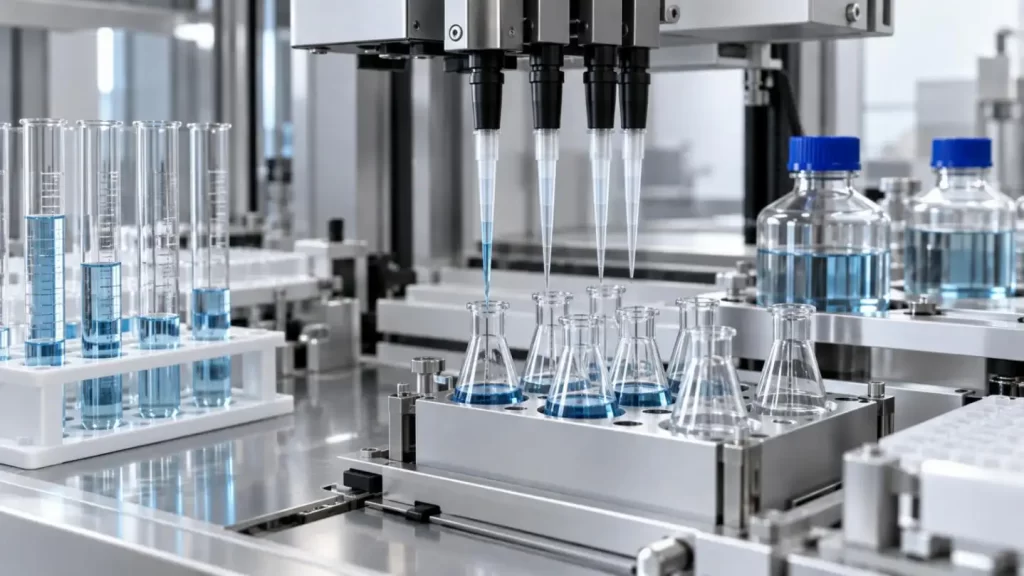
At Trustlab, we therefore view glassware selection for automation as more than choosing the right capacity or glass type. Material, geometry, dimensional consistency, liquid-access conditions, closure design, identification, and system qualification all need to be considered together.
Why Conventional Glassware Can Become an Automation Variable
A vessel may perform perfectly during manual use and still create intermittent problems in a robot cell.
Typical failure modes include:
• Gripper slip caused by changes in body diameter or contact geometry;
• Inaccurate placement caused by vessel height or base variation;
• Aspiration errors when bottom geometry changes liquid height;
• Decapping failures caused by neck or closure variation;
• Barcode read failures due to curvature, reflection, or inconsistent label position;
• Higher breakage after repeated gripping, washing, heating, and cooling.
The important specification is therefore not simply the nominal size of Glassware for Laboratories, but the range of physical variation that the automation system must tolerate.
Geometry Matters as Much as Glass Composition
Borosilicate 3.3 is widely selected for laboratory applications because of its low thermal expansion and chemical resistance. ISO 3585 defines the properties of borosilicate glass 3.3.
For automation, however, material selection is only one layer.
Critical Parameters for Robotic Handling
| Parameter | Automation Impact |
| Body OD | Defines gripper opening and contact position |
| Overall height | Affects Z-axis clearance and placement |
| Roundness | Influences grip-force distribution |
| Neck ID/OD | Affects pipetting and automated decapping |
| Bottom geometry | Changes liquid height and dead volume |
| Wall thickness | Influences ID, mass and thermal behavior |
| Base flatness | Affects stability in racks or nests |
| Total mass | Must remain within robotic payload limits |
These parameters are connected. A change in wall thickness can alter internal volume, weight and center of gravity. A different bottom profile can change aspiration depth even when two vessels have the same nominal capacity.
For this reason, Glassware for Laboratories intended for automation should be evaluated as part of a complete tolerance stack: vessel variation + carrier variation + robot positioning + gripper repeatability.
Direct Gripping or a Rack? Choose the Mechanical Interface First
There is no universal automation solution.
| Strategy | Best Fit | Engineering Trade-Off |
| Direct robot gripping | Stable, repeatable vessel geometry | More sensitive to OD and roundness |
| Rack or nest | Multiple vessel types | Improves positioning but adds hardware |
| Standard glassware + software compensation | Flexible laboratories | Requires broader robot tolerance |
| Custom glassware | Repetitive high-volume processes | Requires qualification and controlled specifications |
In many projects, a well-designed rack or nest can be more practical than forcing unusually tight dimensional tolerances onto every vessel.
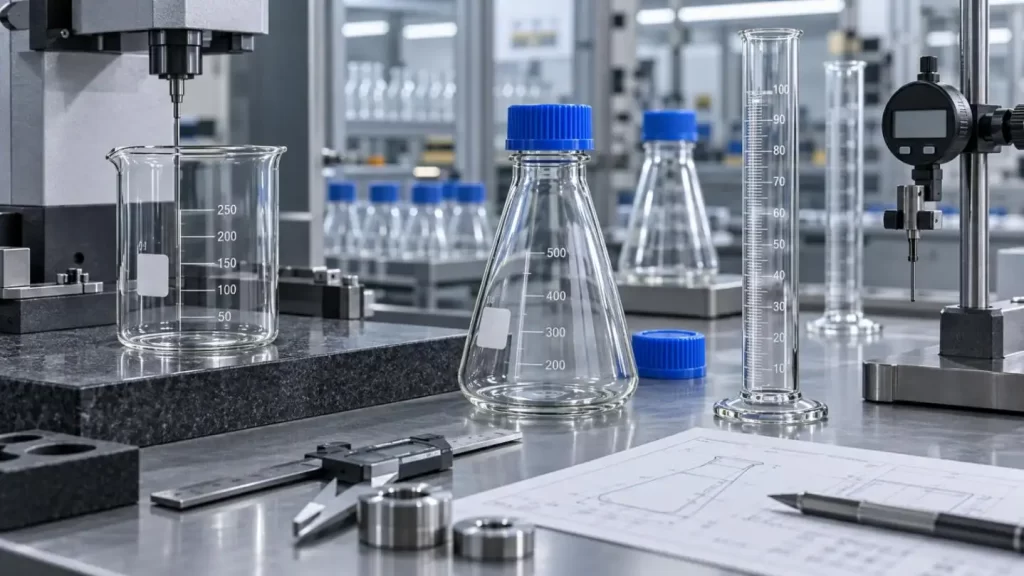
Dimensions Are the Starting Point for System Matching
Trustlab manufactures a broad range of Glassware for Laboratories, including beakers, conical flasks, reagent bottles, graduated cylinders, volumetric flasks and related formats. Trustlab states that its glassware uses borosilicate materials and undergoes quality control for laboratory applications.
Specific product dimensions can be used during initial automation feasibility studies.
Trustlab Glassware Examples
| Product | Capacity | Dimensions |
| Borosilicate Beaker 1102 | 250 mL | Ø60 × 120 mm |
| Borosilicate Beaker 1102 | 1000 mL | Ø95 × 180 mm |
| GL45 Erlenmeyer Flask | 250 mL | Ø85 × 143 mm |
| GL45 Erlenmeyer Flask | 500 mL | Ø105 × 183 mm |
| GL45 Erlenmeyer Flask | 1000 mL | Ø131 × 230 mm |
Trustlab's Beaker 1102 range extends from 50 to 3000 mL and uses low-expansion Type 1 borosilicate glass. The product page also lists OEM availability.
The Trustlab GL45 Erlenmeyer Flask is manufactured from 3.3 borosilicate glass and uses a DIN GL45 thread with a pouring ring and PP screw cap. This defined closure format can be important where storage, automated opening, or repeatable liquid access must be considered.
These dimensions support preliminary engineering. Final robot compatibility should still be verified against production samples and actual grippers, racks and deck layouts.
Liquid Handling Requires Its Own Validation
For automated dispensing, vessel capacity alone is not enough. Engineers should evaluate:
• Usable working volume;
• Minimum aspiration volume;
• Dead volume;
• Liquid height at low fill levels;
• Pipette-tip clearance;
• Meniscus detection conditions.
Trustlab's Glass Graduated Cylinder 1611, for example, uses borosilicate 3.3 and is available from 5 to 1000 mL. Published graduation tolerances range from 0.3 mL at 5 mL capacity to 10 mL at 1000 mL capacity.
However, manual volumetric performance and automated liquid-handler performance are separate questions. ISO 23783 covers automated liquid handling systems, including general requirements and volumetric performance measurement and reporting.
Qualification Should Use Production-Representative Glassware
Before approving Glassware for Laboratories for automated operation, we recommend checking more than one ideal sample.
Qualification should include:
• Minimum and maximum expected dimensional samples;
• Repeated pick-and-place cycles;
• Gripping at different fill levels;
• Aspiration near minimum working volume;
• Cap opening and closing where applicable;
• Barcode or marking readability;
• Washing, sterilization and thermal cycling;
• Inspection criteria for scratches, chips and damaged markings.
This helps determine whether the workflow is robust across realistic production variation.
What Should Be Included in a Glassware RFQ?
For automation projects, buyers should specify more than material and nominal volume. Critical purchasing information may include body and neck dimensions, tolerances, drawings, closure configuration, glass type, marking requirements, batch consistency and sample qualification requirements.
ISO 4796-1, for example, specifies screw-neck laboratory bottles from 25 mL to 20,000 mL, but conformity with a product standard does not automatically establish robotic compatibility.
The final acceptance test must always consider the actual robot, liquid handler, carrier, scanner and process.
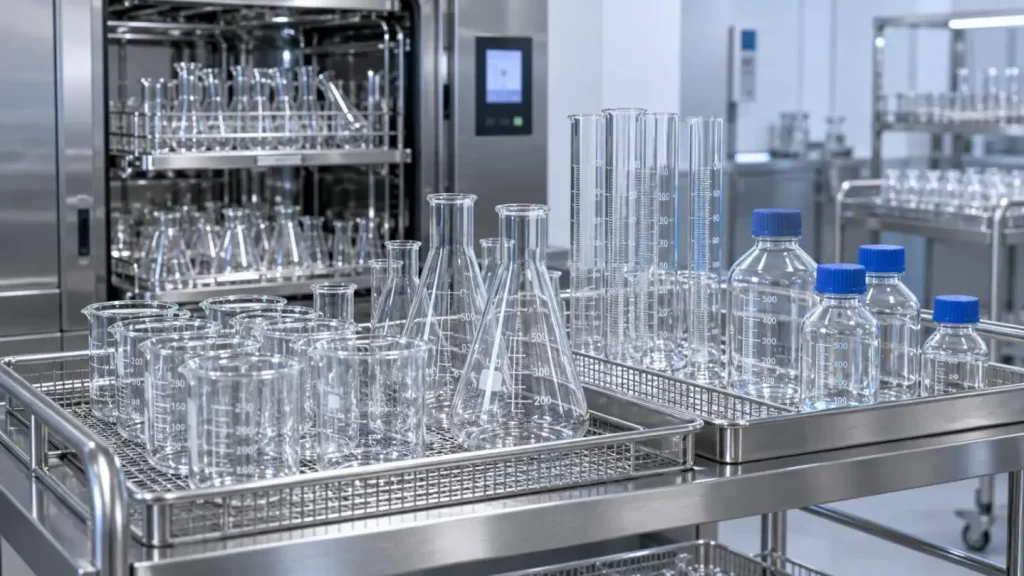
Engineering Glassware Into the Automation Workflow
As laboratories become more automated, Glassware for Laboratories should no longer be treated as a passive consumable. Its geometry, material, closure, dimensional consistency and interaction with automated equipment can directly affect process reliability.
Borosilicate lab glassware is available in multiple sizes from Trustlab. A variety of products can also be manufactured to order. Automating laboratory processes can lead to improved productivity and efficiency. Evaluating the dimensions of the components in an automated system and verifying that samples representative of the system can be an initial step in developing an automated system.
Explore the Trustlab Glassware for Laboratories range or discuss your required capacity, dimensions and application with the Trustlab team before moving into system qualification.
FAQs
Q1. What types of Glassware for Laboratories does Trustlab supply?
Trustlab offers laboratory glassware including borosilicate beakers, Erlenmeyer flasks, graduated cylinders, reagent bottles, volumetric glassware and other common laboratory formats for research, testing and industrial laboratory applications.
Q2. Does Trustlab offer borosilicate Glassware for Laboratories?
Yes. Trustlab supplies products manufactured from borosilicate glass, including borosilicate 3.3 products designed for applications where chemical resistance and low thermal expansion are important.
Q3. What capacities are available for Trustlab borosilicate beakers?
Trustlab Borosilicate Beaker 1102 is available in capacities from 50 mL to 3000 mL, giving laboratories multiple size options for preparation, mixing, heating and general handling.
Q4. What are the dimensions of Trustlab beakers for automation planning?
For example, the Trustlab 250 mL Borosilicate Beaker 1102 is approximately 60 mm OD × 120 mm high, while the 1000 mL version is approximately 95 mm OD × 180 mm high. Published dimensions can support preliminary equipment and rack design.
Q5. Does Trustlab supply GL45 laboratory flasks?
Yes. Trustlab offers GL45 Erlenmeyer flasks made from borosilicate 3.3 glass with a DIN GL45 thread, pouring ring and PP screw cap. Available examples include 250 mL, 500 mL and 1000 mL sizes.