



Updated 2 months ago
Stable Rotation in Laboratory Centrifuges for Consistent and Reliable Separation Results

Admin

Laboratory Centrifuges
Laboratory centrifugal separation techniques can be applied to both the biological and chemical sciences. As in these other techniques, reliable separation is critical, and it all begins with the laboratory centrifuge. If the speeds of rotation are not controlled, the separation results will be inconsistent at best and unreliable at worst. Pelleting will not be reproducible, and the supernatants will not be clear.
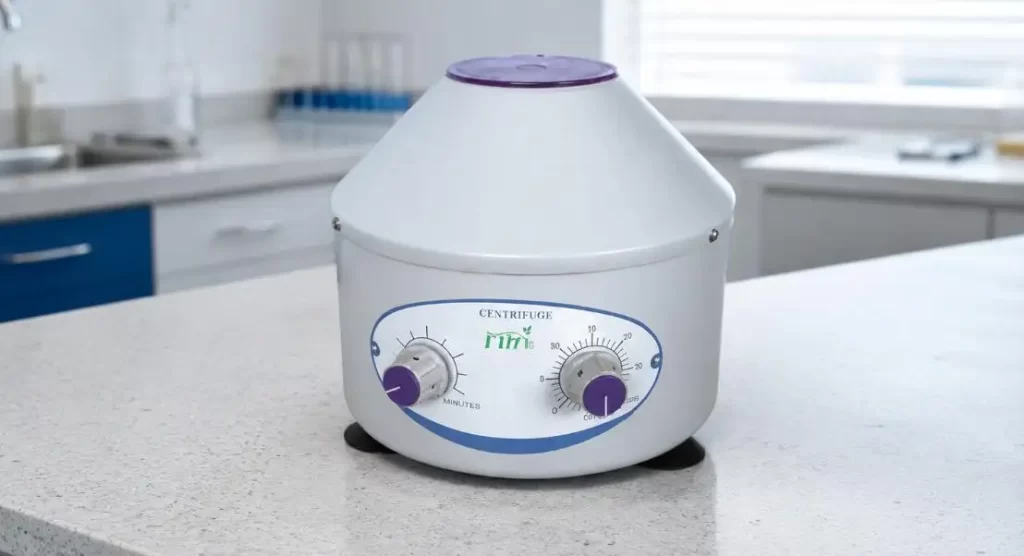
The Trustlab Laboratory Centrifuge has been engineered for stability of rotation in periodic applications. The robust and compact design focuses on reliability and excellent separation for multiple runs. The Trustlab Laboratory Centrifuge achieves this through an innovative design of the motor and simple user interface, paired with a balanced rotor and active vibration control.
Why Rotation Stability is Important in a Laboratory Centrifuge?
In a mixture, suspended particles are separated through sedimentation under the action of relative centrifugal forces. Rotor radius and rotational speed are the two dependent variables of the relative centrifugal forces for a given mixture. If there are fluctuations in speed, sedimentation patterns will change, leading to a compact pellet with varying clarity of supernatant.
A Laboratory Centrifuge with stable rotation allows for:
•Consistent Pellets: At the same rotational speeds, sedimentation patterns are the same.
•Clearer Supernatants: Controlled deceleration and the removal of vibrations disrupt the boundary pellet.
•Consistent Process Times: Stable speed allows for repeated protocols.
•Fewer cycles: Separation may be adequate on the first cycle, meaning no re-centrifugation is necessary.
•Greater reliability in the laboratory: Less variation in speed and time settings means anyone is capable of operating the unit.
These benefits are particularly important in shared laboratories, where Laboratory Centrifuges may process different sample types throughout the working day.
Motor Control and Speed Regulation
The motor is one of the main factors affecting rotational consistency. Trustlab designs its benchtop Laboratory Centrifuges with controlled speed regulation for routine separation rather than unnecessary high-speed performance.
Important motor-related considerations include:
•Steady acceleration toward the selected speed
•Controlled operation during the timed cycle
•Consistent output under properly balanced sample loads
•Predictable deceleration after the cycle
•Suitable power management for repeated laboratory use
A maximum speed of approximately 4,000 r/min and a maximum relative centrifugal force of around 1,790 × g provide a practical operating range for many routine biological, educational, and chemical applications.
Rotor Design and Sample Positioning
The geometry of a rotor affects the trajectory of particles in a sample tube. Fixed-angle rotors allow the sample tubes to be positioned at the same angle, causing the particles to fall to the outer wall and accumulate at the bottom of the tube.
When designing rotors, Trustlab incorporates principles that enable stable performance of the rotor, such as:
•Fixed sample tube orientation: During the entire separation cycle, each sample tube is fixed in a certain position.
•Balanced rotor assembly: A balanced assembly and controlled manufacturing eliminate the natural imbalance of rotors.
•Equal sample tube distribution: Sample tubes can be placed in various positions spaced evenly around the rotor.
•Compatible sample tubes: The design of the rotor allows the use of various standard sample tubes in laboratories, which reduces the effort of sample preparation.
•Robust rotor design: Robust materials allow the rotor to sustain multiple operations under standard laboratory use.
It is also important to maintain proper sample placement. Sample tubes placed directly opposite to each other should have the same volume and should be of the same type.
Vibration and Noise Control
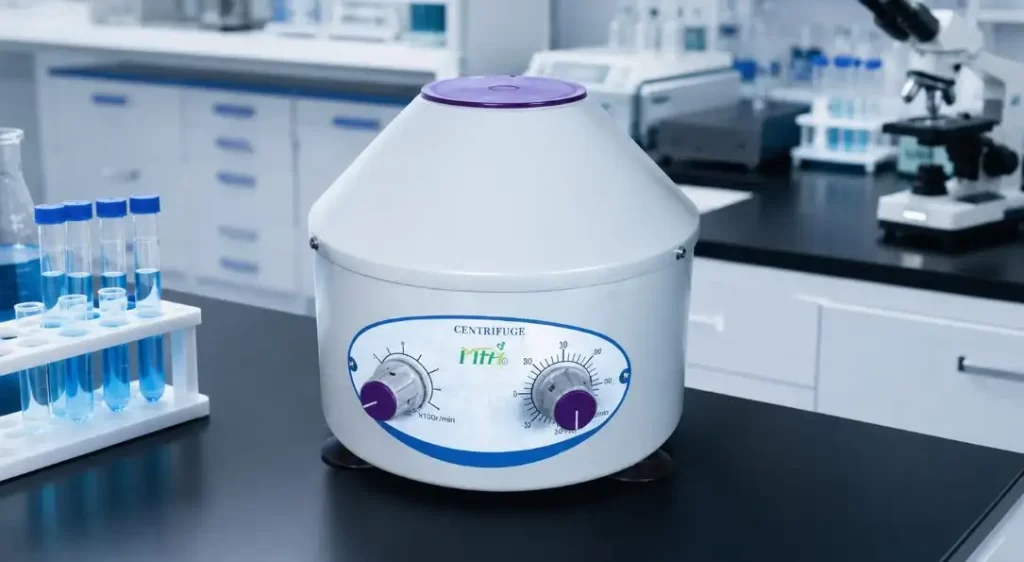
High levels of vibration can lead to poor separation and high wear of the equipment and can also cause an uncomfortable work environment. Trustlab addresses vibration through the combined design of the rotor, motor assembly, housing, and supporting structure.
Key measures include:
•A compact, low-profile benchtop structure
•Stable contact with the laboratory work surface
•Housing materials that help control minor mechanical vibration
•Balanced internal rotating components
•Operating noise maintained at approximately 55 dB or lower under standard conditions
Low-noise Laboratory Centrifuges are especially useful in teaching laboratories, sample preparation rooms, and shared research facilities where several instruments may operate simultaneously.
Practical Features for Consistent Daily Operation
Separation reliability depends not only on rotational performance but also on how consistently operators follow the same procedure. Practical controls can therefore contribute to repeatable results.
Timed Operation
A timer range of up to approximately 30 minutes allows operators to repeat established processing durations. Simple controls also reduce unnecessary setting errors during routine work.
Lid Safety Mechanism
A secure lid helps prevent access to the rotor while it is spinning. This enhances the operational safety and further reduces the risk of a run being interrupted.
Space Efficient Benchtop Design
The Compact Laboratory Centrifuge is designed to save space on the laboratory benchtop and can be positioned conveniently next to related sample preparation equipment. Movement and vibration of the apparatus is reduced by the compact design.
Easier to Clean
The addition of smooth surfaces to the chamber and outer housings allows for quick cleaning. Cleaning the rotor chamber prevents buildup of residue, which can interfere with tube seating and rotor balance.
Operational Factors Summary
| Design Area | Operational Function | Laboratory Benefit |
| Speed regulation | Maintains controlled rotational speed | Supports repeatable centrifugal force |
| Fixed-angle rotor | Holds tubes in a consistent orientation | Encourages predictable pellet formation |
| Balanced assembly | Reduces uneven rotational forces | Limits vibration and mechanical stress |
| Timer control | Standardizes processing duration | Improves protocol repeatability |
| Lid protection | Restricts access during operation | Supports safer laboratory procedures |
| Compact housing | Stabilizes the instrument on the bench | Saves workspace and reduces movement |
| Low-noise operation | Limits disruption in shared spaces | Improves the working environment |
| Common tube capacity | Supports routine sample formats | Simplifies daily sample preparation |
Common Uses for Laboratory Centrifuges
Trustlab's benchtop Laboratory Centrifuges are designed for a variety of common laboratory functions, such as:
•Removing suspended cells from culture media
•Harvesting biological or chemical precipitates
•Clarifying liquid samples
•Sedimentizing fine particulates
•Recovering supernatants: for analysis
•Collecting droplets from the inner surfaces of tubes
•Pre-processing samples for analysis
•Teaching the fundamentals of centrifugation
Choose the appropriate instructions for speed, time, tube type, sample volume, etc., for each individual use case.
Providing Reliable, Long-Term Separation
Reliability and constancy for long-term use is impacted not only by design and construction but also by maintenance and correct use of the equipment, including loading inspected tubes, carefully balancing samples, cleaning the rotor chamber, and checking the rotor for visible damage or contamination.
Trustlab has designed practical Laboratory Centrifuges with:
•Controlled rotational performance
•User-friendly interface
•Balanced rotors
•Benchtop space efficiency
•Low operating noise
•Easy to clean
•Reliable performance for repetitive workflows

Final Thoughts
In Laboratory Centrifuges, the most important design consideration is stable rotation because it directly impacts sedimentation, clarity of supernatant, consistency of pelleted sediment, and the repeatability of protocols.
Trustlab offers separate sample systems for routine laboratory use and practical daily Laboratory Centrifuges. Well-designed Laboratory Centrifuges for daily routines should emphasize controlled, repeatable operation rather than top speed.
FAQs
Q1. What is the significance of stable rotation in Laboratory Centrifuges?
Stable rotation permits the generation of uniform centrifugal forces, which leads to consistent results in separations.
Q2. What are the reasons for vibration during centrifugation?
The most common reasons are: rotor contamination, in unbalanced tubes, unequal sample volumes, or improper tube positions.
Q3. What is the correct method to balance samples?
Samples should be placed in tubes of equal type and volume directly opposite in the rotor.
Q4. Is it possible for Laboratory Centrifuges to work with more than one tube size?
Use only the pre approved tube size and adapters for that specific rotor.
Q5. What is the correct method for selecting speed?
Speed should be selected in combination with RCF, the type of sample, the type of tube, and the lab protocol.