


Updated 2 months ago
Professional Compound Microscope for Biology Lab: Optical Performance

Admin
Professional Compound Microscope for Biology Lab
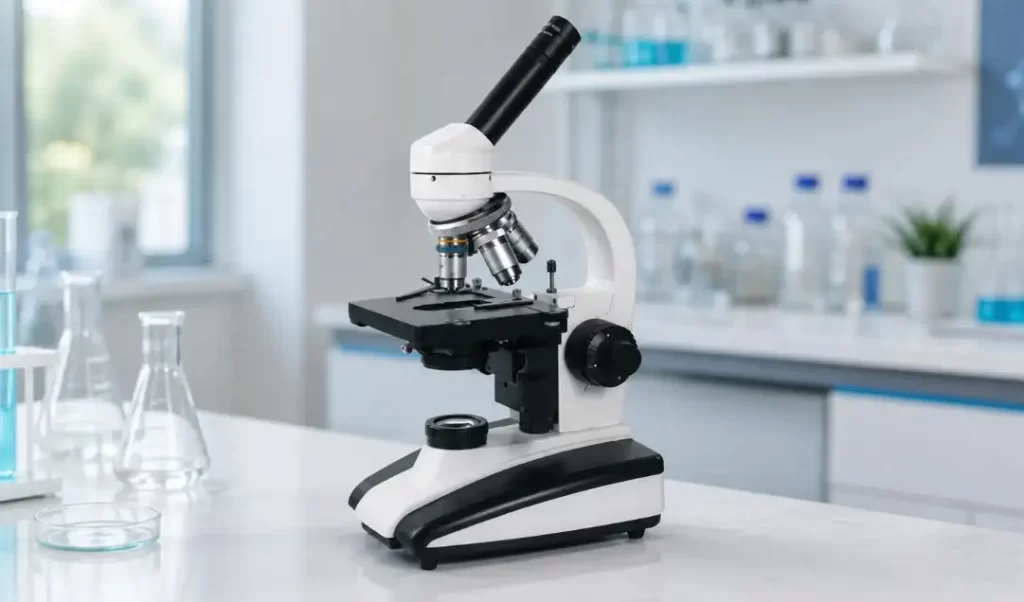
The Professional Compound Microscope for Biological Lab Students includes everything necessary for optical magnification of samples, including cells and microorganisms. This microscope features different objective lenses and eyepieces, lights, a focusing mechanism, and has a stage suitable for daily use in the laboratory.
In laboratory applications, performance is not just dependent on the level of magnification.
For Trustlab, a practical Professional Compound Microscope for biology labs is a balance of optical performance and mechanical and user control and allows for repeatable and consistent use.
What Is a Professional Compound Microscope for Biology Lab?
A compound microscope has two primary optical systems. The first is the objective lens, and the second is the eyepiece. The lens forms a first magnified image, and the eyepiece further enlarges this for the user to see.
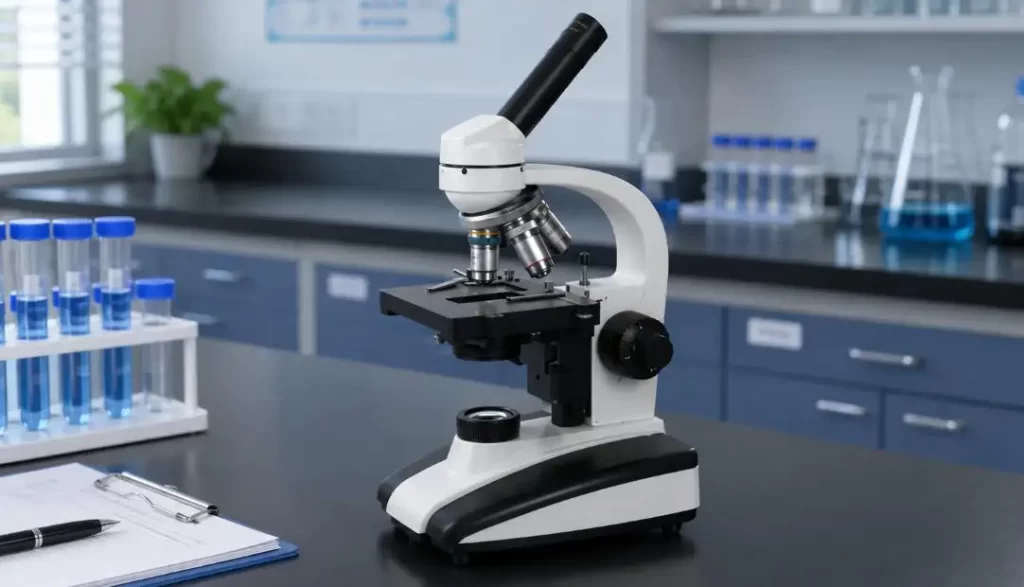
This is what a Professional Compound Microscope for Biology Lab looks like:
•Wide-field eyepiece: Comes with a 10x eyepiece comfortable for standard biological lab work.
•Objectives: Allow the user to customize the power for different observations.
•Binocular viewing head: A viewing head that consists of a pair of eyepiece tubes to enhance the comfort of the user during long laboratory sessions.
•Mechanical stage: Allows both fine and coarse positioning of the stage in the X and Y directions.
•Built in light source: Gives constant and even illumination.
Selection of Objectives and Magnification
Typically, the Professional Compound Microscope for Biology Lab allows a range of 40X to 1000X magnification through the combination of the 4X, 10X, 40X, 100X objectives and a 10X eyepiece.
| Objective | Total Magnification with 10X Eyepiece | Typical Use |
| 4X | 40X | Locating specimens and scanning slides |
| 10X | 100X | Observing tissue organization and larger structures |
| 40X | 400X | Examining cells and selected microorganisms |
| 100X oil | 1000X | Detailed observation of small biological structures |
Users typically start with the lowest power objective and work their way to higher magnifications in order to focus on the specimen. This is done to avoid damaging the slide by a contact between the objective and the slide.
It should be noted that the higher the magnification, the more important the resolution is. Without the proper optical system, illumination, sample preparation, or focus, higher magnification would be useless.
Stable Illumination and Image Contrast
Biological samples that are transparent or lightly stained need specific lighting. In a Professional Compound Microscope for Biology Lab, the lamp, condenser, diaphragm, and objectives create a complete visible image.
Halogen lamps produce a bright and stable lighting system designed for standard observation.
•Stable brightness: A stable lamp output eliminates the sudden jumps that can occur in a visible image.
•Natural looking: Halogen lamps produce a color balance that is natural for many biological specimens.
•Brightness control: Light intensity can be controlled, and therefore glare for the observation of transparent specimens can be reduced.
•Stable illumination: Stable illumination allows different slides or different portions of the same specimen to be compared.
Abbe Condenser and Iris Diaphragm
An NA 1.25 Abbe condenser collects and focuses light from the illuminator onto the specimen. The integrated iris diaphragm controls the width of the illumination cone.
| Adjustment | Effect on Observation |
| Diaphragm opened wider | More light and potentially higher resolution |
| Diaphragm partly closed | Increased contrast and greater depth of field |
| Condenser raised | More concentrated illumination |
| Condenser lowered | Softer illumination and reduced intensity |
Proper condenser adjustment is particularly relevant at medium and high magnification. Excessive light may reduce contrast, while insufficient light may obscure fine specimen structures.
Mechanical Stage and Specimen Control
At high magnification, the visible field becomes smaller. The double-layer mechanical stage allows for the manipulation of the slide in the x-axis and y-axis directions, all without hand control.
•Ultimate control: Mechanically controlled centering allows for the user to center the structure in the viewing field.
•Systematic inspection: The control of the stage movement allows the user to view large, but still systematic, parts of the specimen.
•Improved control: The user is able to control movement and return to locations of the specimen which has been observed, due to the graduated movement of the stage.
•Minimized movement: The movement of the specimen during observation is minimized with the specimen holder.
These features make the Professional Compound Microscope for Biology Lab well-suited for planned laboratory processes and the analysis of repeatedly collected samples.
Coarse and Fine Adjustments
This system allows for the varying distance of the objective lens to the specimen. Different adjustments of the system allow for the varying degrees of focus.
•Coarse adjustments: Focus is achieved by the movement of the stage at low magnification.
•Fine adjustments: Focus is achieved by the movement of the stage at medium and high magnification.
•Gradual movements: Ease of focus is enhanced by the absence of movements of the stage.
•Sufficient Focusing Range: The range of the focus system is sufficient for the varying positions of different slides and specimens.
Focusing at higher magnifications of 40X and 100X necessitates particularly fine focusing because of the extremely shallow depth of field.
Binocular Design and Viewing Comfort
A 45-degree inclined binocular head supports a more natural observation posture. A 360-degree rotating head also allows several users to share the microscope without moving the complete instrument.
| Ergonomic Feature | Laboratory Benefit |
| Binocular head | Allows viewing from both eyes |
| 45-degree inclination | Minimizes awkward bending of the neck |
| Rotating head | Enables teaching and observation sharin |
| Wide-field eyepieces | Offers larger visible field |
| Stable microscope base | Minimizes movement during focusing |
These design features are applicable in teaching labs, research labs, clinical testing labs, and any other environments that require frequent use of microscopes.
Applications in Biology Laboratories
A Professional Compound Microscope for Biology Lab can assist with different observation tasks for the following:
•Cell observation: It enables viewing the shape and arrangement of cells, cell nuclei, and some internal cell structures.
•Tissue observation: It enables viewing the different structural and organizational types of tissue in prepared tissue sections.
•Observation in microbiology: Depending on the preparation, it may enable viewing some types of bacteria, fungi, algae, and protozoa.
•Instructing: Learners are trained in switching on the microscope and the selection of appropriate objective lenses and focus and light intensity adjustment.
•Routine Testing: Multiple tests of specified procedures can be performed by using the microscope for routine testing.
•Research: Researchers can view and analyze different specimens and take notes on their observations.
Trustlab's Technical and Manufacturing Expertise
Trustlab's vision of the Professional Compound Microscope for Biology Lab is to combine the optical and mechanical systems/subsystems.
•Optical Design: Based on normal biological observations, it is made up of eyepieces, objectives, condensers, and sources of illumination.
•Mechanical Design: This consists of focus and stage systems/subsystems designed to allow easy and stable movement.
•Manufacturing Control: Checks can be performed during the manufacturing process to ensure the alignment of optics and illumination, as well as the response of light and focusing and the movement of the stage.
•Experience with Applications: Trustlab is focused on laboratories, educational institutions, distributors, and research projects.
•OEM Services: We offer changes in product labels, instructions, and packaging, along with modifications in product design, to satisfy the requirements of individual projects.
Final Thoughts
A Professional Compound Microscope for Biology Lab enhances biological study by providing integrated control of the different variables of observation: magnification, light, focus, and specimen control. The integrated system of the optical design (Abbe condenser), mechanical (stage and binoculars), and focusing system (micro focus) is the basis of this system.
With emphasis on a harmonious optical design, stable mechanical operation, quality inspections during manufacturing, and OEM adaptability, Trustlab offers complete microscope solutions for the teaching, testing, and biological research markets.
FAQs
Q1. What is the advantage of a mechanical stage?
A mechanical stage allows controllable and methodical scanning of the specimen through precise movement of the slide in the X and Y axes.
Q2. What is a suitable range of magnification for biology lab work?
A range of 40X to 1000X accommodates scanning of biology specimens and viewing of cells in detail.
Q3. What is the benefit of a binocular head?
A binocular head accommodates viewing through both eyes which may enhance related comfort for long observation sessions.
Q4. What does an Abbe condenser do?
An Abbe condenser aids in the control of both contrast and definition of an image by assisting in the focusing of the light on the specimen.
Q5. When would you use a 100X oil objective?
This lens is generally employed in viewing fine details of small structures including some of the stained cells and selected microorganisms.