



Updated 5 days ago
Sodium Heparin Tube Supplier for Plasma-Based Testing
trustlabofficial

Sodium heparin blood collection tubes arranged on a laboratory bench
When sourcing a sodium heparin tube supplier, confirm more than the additive and tube color. The required tube format, material, nominal draw volume, dimensions, closure, packaging, intended workflow, and supporting documentation should match the laboratory’s testing method.
Sodium heparin tubes are used to collect anticoagulated blood for plasma preparation in applications such as certain chemistry and biochemistry workflows. However, a general statement that a tube is suitable for plasma testing does not prove compatibility with every assay. The final selection should be checked against the laboratory method, product documentation, and applicable specimen requirements.
What to Confirm When Sourcing Sodium Heparin Tubes for Plasma Testing
A supplier inquiry should identify the exact tube configuration required. Ask the supplier to confirm each of the following:
- Additive: Sodium heparin, clearly distinguished from lithium heparin or another anticoagulant.
- Tube format: Vacuum or non-vacuum.
- Material: For example, PET or glass, if the material is relevant to the workflow.
- Nominal draw volume: The intended blood-collection volume, kept separate from tube dimensions.
- Tube dimensions: Diameter and length, using the supplier’s stated units.
- Closure: Cap or stopper configuration and color, where applicable.
- Packaging: Units per pack or carton, with package quantity kept separate from the tube’s nominal volume.
- Intended application: The laboratory, research, or testing workflow in which the tube will be used.
- Documentation: Current technical data, IFU, packaging information, and any applicable conformity or quality documents.
- Commercial terms: Quantity required, destination market, samples, MOQ, lead time, labeling, and shipping requirements.
Do not use tube color alone to identify the additive. The product label, catalog code, technical document, or IFU should confirm the exact configuration.
Product Configuration Fields
A useful quotation request should describe the product using measurable fields rather than general terms such as “high quality” or “suitable for all tests.” Ask the supplier to confirm:
| Field | Why it matters |
|---|---|
| Additive | Determines the anticoagulant specified for the workflow |
| Tube format | Establishes whether an evacuated or non-evacuated tube is required |
| Material | May affect handling, transport, chemical exposure, and workflow fit |
| Nominal draw volume | Helps match the collection tube to the required specimen amount |
| Dimensions | Supports rack, holder, instrument, and handling compatibility |
| Closure | Identifies the physical tube configuration |
| Package quantity | Supports purchasing and inventory planning |
| Product code or SKU | Keeps the quotation tied to the correct variant |
For broader context on tube formats and category distinctions, buyers can review different types of vacuum blood collection tubes. Trustlab’s available heparin-related pages should still be checked against a current product document before any exact specification is published or ordered. Information from one heparin product or variant should not automatically be applied to another.
Documentation and Commercial Fields
Before placing a bulk order, request the documents and commercial details relevant to the exact product:
- Current technical datasheet or specification sheet
- Instructions for use, where applicable
- Additive and tube-configuration information
- Material, dimensions, nominal volume, and packaging details
- Sterility status, if sterility is required
- SDS or related safety documentation, where applicable
- Lot traceability or certificate of analysis, if offered
- Destination-market regulatory or conformity documentation, where required
- MOQ, lead time, sample availability, and labeling terms
A quality-management-system certificate such as ISO 9001 or ISO 13485 should not be treated as automatic proof that every listed product is sterile, CE-marked, FDA-authorized, clinically validated, or registered in a particular market. A QMS certificate applies to its stated organizational scope; product-level claims require product-specific evidence.
For broader supplier-review criteria, see how to evaluate blood collection system supplier quality.
Why Sodium Heparin Tubes Are Considered for Plasma-Based Testing
Sodium heparin is an anticoagulant additive used in blood collection tubes. The anticoagulant helps maintain a specimen in an anticoagulated state so plasma can be prepared for appropriate laboratory procedures. Manufacturer product information commonly associates sodium heparin tubes with plasma determinations and chemistry-related applications, but those descriptions should be read together with the applicable method and IFU.
The tube is not automatically appropriate for every plasma-based test. Tube selection can affect preanalytical conditions, and blood collection devices may influence laboratory results through their materials, additives, or handling requirements. Research on blood collection tube components has documented the importance of evaluating possible effects on clinical chemistry assays, while laboratory guidance recommends selecting collection tubes according to the test, analytical method, and preanalytical requirements.
For that reason, “for plasma-based testing” should be treated as an application context, not as universal validation for every assay. Buyers comparing vacuum blood collection tubes should also confirm whether the selected tube format and additive match the laboratory’s documented workflow.
Sodium Heparin vs Lithium Heparin: What Should Buyers Compare?
Sodium heparin and lithium heparin are different additives. A buyer should not substitute one for the other simply because both may be described as heparin tubes or may use a similar color convention.
Compare the following points:
| Comparison point | What to verify |
|---|---|
| Additive identity | Confirm sodium heparin or lithium heparin on the product document |
| Test method | Check which additive the laboratory method or analyzer protocol specifies |
| Specimen requirement | Confirm whether the method requires plasma, whole blood, or another specimen condition |
| Tube configuration | Compare material, size, nominal volume, closure, and packaging |
| Documentation | Request the current IFU or technical specification for the exact product |
| Laboratory validation | Confirm that the selected tube has been accepted for the intended workflow |
The correct choice depends on the testing method and laboratory requirements. Neither sodium heparin nor lithium heparin is a universal replacement for the other.
How to Match the Tube to the Laboratory Workflow

Use the following sequence when evaluating a sodium heparin tube supplier:
- Identify the specimen and testing method. Confirm whether the workflow requires plasma, whole blood, or another specimen type.
- Confirm the additive. Ensure that the product is specifically sodium heparin rather than lithium heparin, EDTA, a serum tube, or another configuration.
- Match the physical configuration. Check vacuum status, material, dimensions, nominal draw volume, closure, and packaging.
- Review handling instructions. Use the exact product IFU or laboratory protocol for collection, mixing, processing, centrifugation, storage, and transport requirements.
- Check method-specific suitability. The laboratory should confirm that the selected tube is appropriate for the intended assay or analytical workflow.
- Request documentation and samples when needed. A sample evaluation may help the buyer review fit, labeling, packaging, and workflow handling before a larger order, but sample availability must be confirmed with the supplier.
- Confirm commercial conditions. Request current pricing, MOQ, lead time, packaging, labeling, and destination-market requirements for the exact SKU.
Do not calculate or assume centrifugation conditions from a general product description. If a workflow specifies RCF, expressed as ×g, it must not be replaced with RPM without the required rotor information and calculation inputs.
What Documentation Should a Sodium Heparin Tube Supplier Provide?
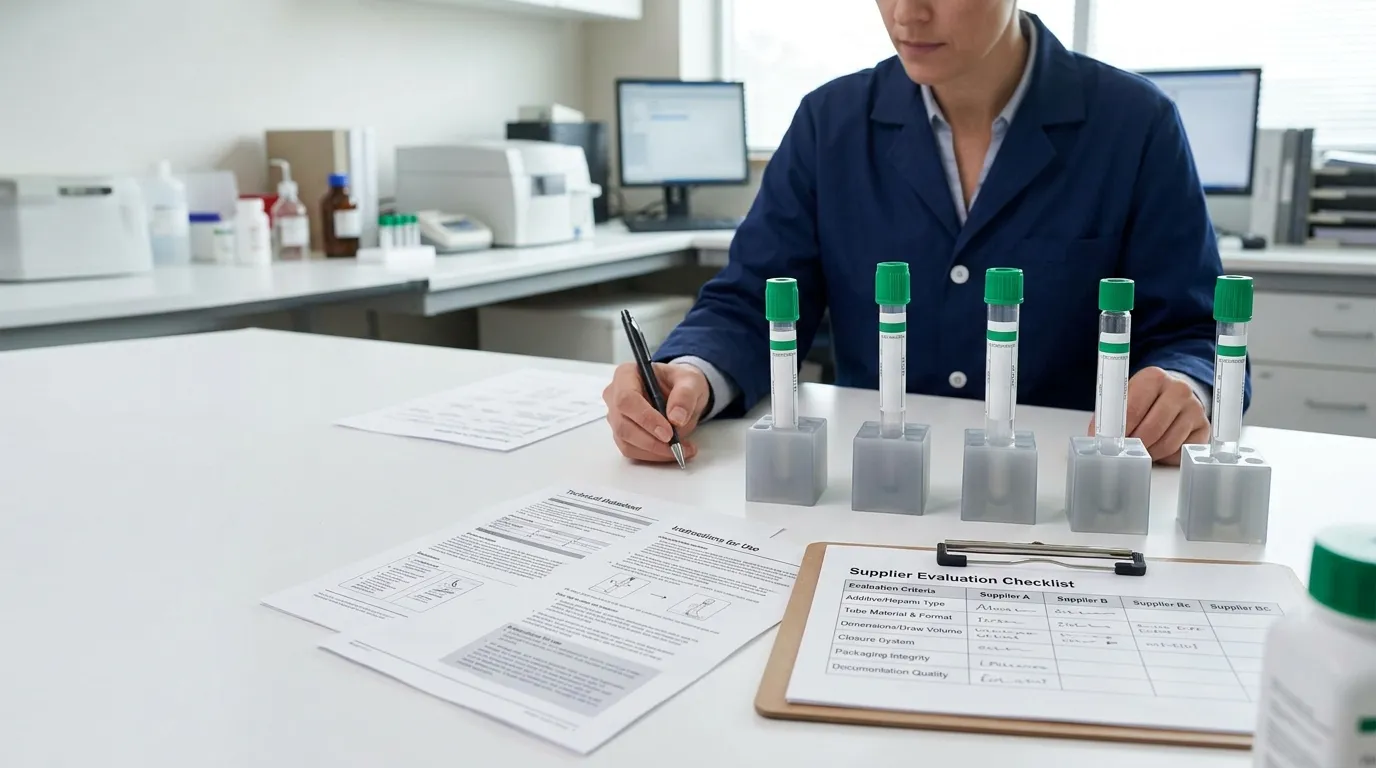
A supplier evaluation should distinguish between documents that describe the product and documents that describe the supplier’s quality system.
| Document or information | What it can help confirm | What it does not automatically prove |
|---|---|---|
| Product datasheet | Configuration, dimensions, material, volume, additive, and packaging | Suitability for every assay |
| IFU | Intended use, handling, processing, warnings, and limitations for the exact product | Regulatory approval in every market |
| SDS or safety document | Relevant safety and handling information | Sterility or clinical performance |
| Certificate of analysis | Lot-specific or batch-specific information, if supplied | Performance of all production lots |
| QMS certificate | Certified management-system scope | Product-level CE, FDA, sterility, or clinical claims |
| Regulatory/conformity document | Product and jurisdictional status within its stated scope | Approval of the supplier’s entire catalog |
| Packaging or label documentation | Product identity, lot, quantity, and labeling details | Validation of the laboratory method |
Trustlab-specific certification and regulatory statements should be checked against the current certificate and the exact product documentation. Broad website language about CE or ISO standards should not be rewritten as a product-level approval or conformity claim.
Request a Sodium Heparin Tube Quote: Information to Include
A complete inquiry helps the supplier identify the correct product and reduces avoidable clarification. Include:
- Required additive: sodium heparin.
- Tube format: vacuum or non-vacuum.
- Preferred or required material.
- Nominal draw volume.
- Required dimensions.
- Closure or labeling requirements.
- Package quantity and estimated order volume.
- Intended plasma-based workflow or laboratory application.
- Destination country or market.
- Required technical, quality, safety, or regulatory documents.
- Sample requirements, if evaluation samples are needed.
- Target delivery timing and any packaging or private-label requirements.
Ask the supplier to confirm the exact product code or SKU in the quotation. If several heparin products are available, the quotation should identify the additive, variant, package quantity, and applicable documentation for each option.
Choosing Trustlab as a Sodium Heparin Tube Supplier
When contacting Trustlab about sodium heparin tubes, ask for confirmation at the exact product or SKU level. The key questions are:
- Which current product or SKU contains sodium heparin?
- Is the tube vacuum or non-vacuum?
- What material, dimensions, and nominal draw volumes are available?
- What closure and packaging configurations are offered?
- Is the product sterile or non-sterile?
- What IFU, technical datasheet, safety document, or certificate is available?
- Which intended applications are documented for the product?
- Can the supplier confirm destination-market documentation?
- What are the current MOQ, lead time, sample, labeling, and quotation terms?
Trustlab’s heparin-related product pages indicate relevant blood-collection coverage, but exact product specifications, product-level certification, sterility, regulatory status, manufacturing status, and commercial terms should be confirmed before they are treated as established facts.
If you are evaluating a sodium heparin tube for a plasma-based workflow, send the supplier the required additive, tube format, volume, dimensions, packaging, intended application, quantity, destination market, and documentation requirements. This gives Trustlab the information needed to review the correct configuration rather than quoting a broader heparin product category.