


Updated 4 days ago
PET vs Glass Blood Collection Tubes: Material and Workflow Trade-Offs
trustlabofficial

Blood collection tubes are made primarily from one of two materials: PET (polyethylene terephthalate) or borosilicate glass. Neither material is universally better. PET tubes are lighter and more resistant to breakage; glass tubes are more chemically inert and provide a stronger barrier to air and moisture. The right choice depends on your assays, transport and workflow demands, storage conditions, and the type of documentation you require from a supplier.
This comparison explains the practical trade-offs between PET and glass tubes so you can make a procurement decision based on evidence rather than habit. If you are evaluating tubes as part of a complete product range, the broader context of blood collection systems may also be useful.
What Are PET and Glass Blood Collection Tubes?
PET and glass tubes may look similar, but they perform differently once you consider the full workflow.
PET is a clear, lightweight polymer. It is inexpensive to produce, shatter-resistant, and easy to ship. Because it weighs less than glass, it also reduces transport costs. Many modern evacuated blood collection tubes use PET because of those practical advantages.
Borosilicate glass is a heat-resistant glass with low chemical reactivity. It is nearly impermeable to gases and moisture, and its surface is less likely to interact with components of blood or additives inside the tube. These properties make glass useful when sample stability and long-term vacuum retention are the highest priorities.
The term “plastic” is often used loosely. In blood collection, PET is not the same as every polymer; the tube material must be evaluated on its actual physical and chemical behavior. Similarly, blood collection glass is typically borosilicate, not ordinary soda-lime glass used in packaging. The material type matters because it changes how the tube interacts with the additives, the sample, and the laboratory workflow.
For a wider look at tube designs, see the guide to different types of vacuum blood collection tubes.
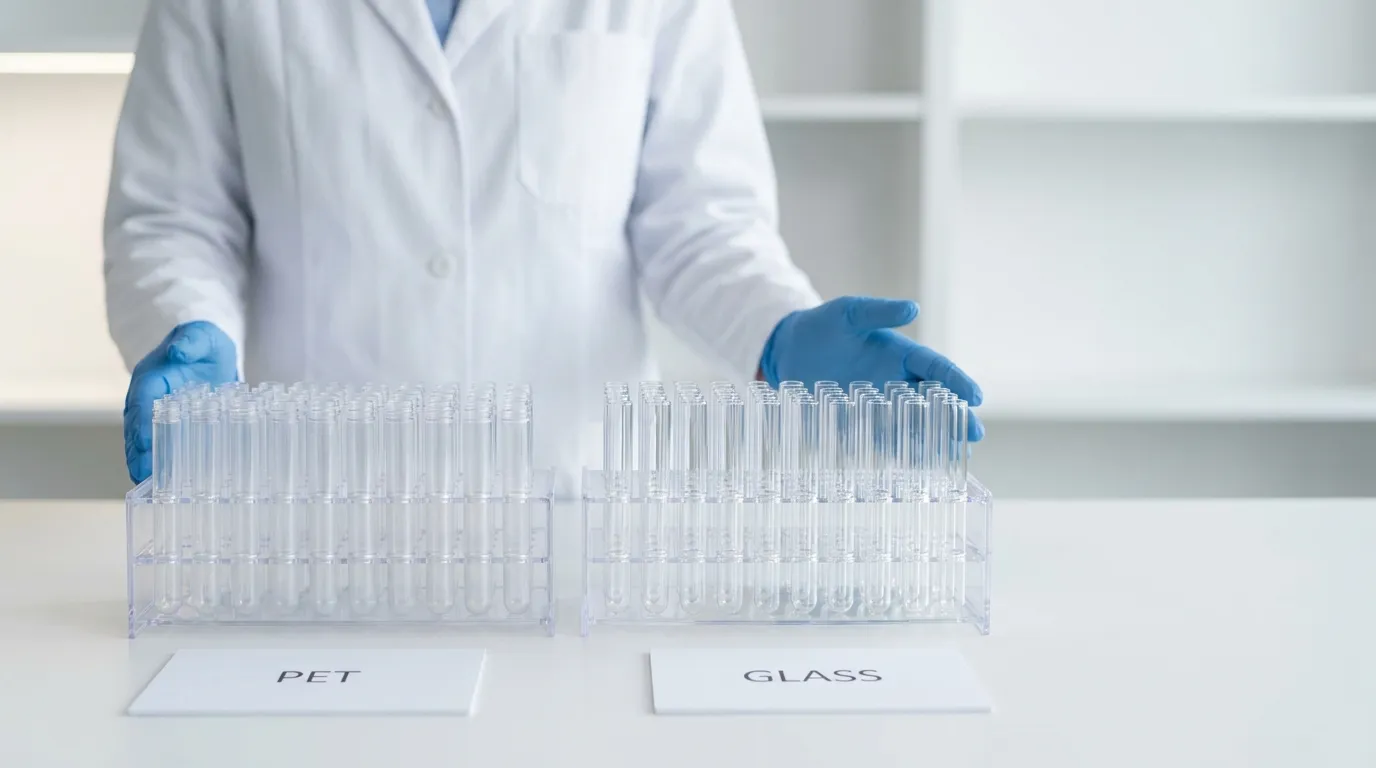
Comparing Material Properties: Safety and Workflow
The material choice affects nearly every stage of tube use, from arrival in the lab to centrifugation and disposal.
| Property | PET tubes | Borosilicate glass tubes |
|---|---|---|
| Breakage resistance | High; less likely to fracture on impact | Lower; can break if dropped or handled roughly |
| Weight | Light | Heavier; adds shipping weight and handling load |
| Chemical inertness | Moderate; surface may interact with some analytes | High; low chemical reactivity |
| Surface adsorption | Can adsorb hydrophobic analytes | Low adsorption for most analytes |
| Moisture and gas barrier | Permeable over time; moisture vapor can pass slowly | Nearly impermeable |
| Vacuum retention | Depends on tube design and stopper; can lose vacuum over longer storage | Generally better because the wall does not let air or moisture pass |
| Main workflow benefit | Reduces breakage risk, easier handling and transport | Predictable inert environment for the sample |
These differences become important in practice when labs compare tube breakage during centrifugation, the stability of additives over time, and whether assay results change with the tube material.
Breakage and Biohazard Risk
Breakage is the most obvious workflow difference. PET tubes are difficult to break under normal laboratory use, and when they fail, they tend to crack rather than shatter into sharp fragments. Glass tubes are more fragile and can fracture into pieces that may contaminate a centrifuge, a work surface, or the operator.
A broken glass tube also creates a biohazard. Splinters can carry blood, and cleanup requires handling the fragments carefully. A review of blood collection tube components notes that plastic tubes minimize the biohazard exposure that can follow breakage during centrifugation and handling. That safety benefit is one reason many laboratories and blood collection device suppliers moved toward PET and other polymers.
Glass is not shatter-proof. Any tube can break if handled incorrectly, especially under centrifugation stress, at low temperatures, or after being dropped. The practical question is whether your workflow can tolerate a higher breakage rate in exchange for glass’s other properties.
Material Chemistry, Inertness, and Interference Risk
Tube material is not just a physical container; it is part of the pre-analytical environment. The tube surface can interact with the blood sample before testing begins.
Borosilicate glass has a relatively inert surface. It is less likely to bind proteins, peptides, or other compounds from the blood sample. This is why glass has historically been treated as the reference material for tubes when sample integrity matters most.
PET is a hydrophobic material. Water-based fluids and certain biomolecules do not spread evenly across its surface, and some hydrophobic analytes can adsorb, or stick, to the tube wall. If that happens, the measured concentration in the sample may be lower than the true value.
PET tube manufacturers often address this problem by applying a surfactant or other coating to the interior surface. The coating makes the surface more wettable and reduces adsorption. But coatings can introduce their own analytical interference. Stanford University’s technology review of PET blood collection tubes highlights this trade-off: while coatings can reduce adsorption, some surfactants can interfere with downstream assays, especially mass spectrometry-based methods.
The clinical impact is assay-dependent. Researchers have documented tube-related changes in hormone assays, coagulation testing, and other laboratory measurements when comparing glass and plastic tubes. A comparative study of glass and plastic tubes for coagulation assays found that plastic tubes can be acceptable for routine coagulation testing, but the laboratory must verify the tube type with its own assay system.
The correct conclusion is not “PET is bad” or “glass is always better.” It is that tube material should be treated as a variable to be validated, especially when a laboratory changes suppliers or changes from glass to PET or vice versa.
Vacuum Retention, Barrier Properties, and Shelf Life
For evacuated blood collection tubes, the vacuum inside the tube determines how accurately blood is drawn into the tube and mixed with additives. The tube wall must keep that vacuum over time.
Glass provides a strong barrier. It does not allow air or water vapor to pass through, so the vacuum is protected by the tube wall itself. The remaining leak points are the stopper and the seal between the stopper and the tube. Because of this, glass tubes have traditionally been viewed as the standard for vacuum retention and long-term stability.
PET is more permeable. Water vapor and gases can pass through the polymer over time, although the rate depends on the resin, wall thickness, and design. Moisture vapor transmission is a particular concern for tubes containing dry additives, because moisture entering the tube can slowly change the additive environment. Research on hybrid tube designs has described PET as having a higher moisture vapor transmission rate than glass, and that is why newer polymer tubes sometimes add a barrier layer or other protection.
This does not mean PET tubes cannot hold a vacuum. Modern PET tubes are designed for practical shelf life, and many perform reliably within their labeled storage period. But when a laboratory stores tubes for long periods, works in high-humidity environments, or needs maximum confidence in draw accuracy, glass can offer a measurable advantage.
One research group that compared glass and plastic tubes reported that glass tubes preserve the vacuum better than plastic tubes over time. The finding supports the general engineering principle: a rigid, impermeable wall protects an internal vacuum more effectively than a permeable polymer.
Choosing the Right Tube Material for Your Laboratory or Product Line
There is no one-size-fits-all answer. The most useful way to choose is to compare your actual workload, assay requirements, and supply chain against the properties of each material.
Start with your intended use:
- Routine chemistry and coagulation: PET tubes can be suitable, but confirm the specific tube type with your assays. Coagulation testing is sensitive to the contact surface, so laboratories should check product-specific data before switching.
- Tests involving hydrophobic analytes: If you measure hormones, peptides, or other compounds that might adsorb to plastic, ask whether the PET tube has a coating and whether that coating interferes with your method.
- Long storage or delayed testing: Glass may be preferable when an inert surface and strong moisture barrier are important.
- High-throughput or off-site transport: PET is often more practical because it is lighter and less likely to break during centrifugation, handling, and shipping.
Also consider the entire blood collection system. The tube is only one part; needles, holders, additives, centrifugation, and laboratory workflows all affect the final result. If your team is changing the tube material, validation is not optional. A laboratory should verify the new tube with its own analytical methods and specimen types.
Selection Questions to Ask a Tube Supplier
Once you have narrowed the material choice, ask the supplier for product-specific evidence. These questions work for any blood collection tube manufacturer or distributor:
- What exact material is used? Is the tube PET, another polymer, or borosilicate glass?
- Is the interior surface treated? If the tube is coated, what is the coating and does it affect common assays?
- Do you provide vacuum retention data? What is the expected shelf life, and what testing supports that claim?
- What sterility status applies to this exact product? A product can be sterile or non-sterile, and the label should say which.
- What regulatory or quality documentation applies to the product? Distinguish between a company-level ISO certificate and product-specific approvals or test reports.
- Can you provide an IFU, technical datasheet, or validation summary for the specific tube model? General claims about a product family are not enough.
If you are evaluating Trustlab as a potential supplier, those same questions apply. Trustlab offers vacuum blood collection tubes as part of its product range, and its published OEM overview lists tube formats in both PET and glass in standard sizes. But the supplier must confirm the exact documentation, sterility status, and regulatory scope for the specific SKU you intend to use.
For a broader framework, the guide on how to evaluate blood collection system supplier quality walks through the documentation and qualification checks that matter before purchasing.
Common Questions About PET and Glass Tube Selection
Are blood collection tubes plastic or glass? Both. PET and borosilicate glass are the two dominant materials. PET is common in routine collection sets, while glass is still used when inertness and barrier performance are priorities.
Which material is safer? PET is safer under normal handling because it is more resistant to breakage and produces lower biohazard risk. Glass tubes can break into sharp fragments, so their use requires more careful handling and disposal practices.
Do PET tubes affect assay results? They can. PET surfaces may adsorb certain hydrophobic analytes, and surfactant coatings used to reduce adsorption can interfere with sensitive techniques such as mass spectrometry. The effect is assay-specific, so new tube types should be validated before routine use.
Does tube material influence shelf life? Yes. Glass is nearly impermeable to air and moisture, so it preserves the vacuum and dry additives more effectively over long periods. PET has a higher moisture vapor transmission rate, which can be relevant in humid environments or when tubes are stored for a long time.
Can a laboratory switch from glass to PET without revalidation? No. Any change in tube material should be checked with the laboratory’s own tests, especially for coagulation, hormone, and other assays where the tube surface can influence results.
Bottom Line for Buyers and Laboratories
PET and glass blood collection tubes are not interchangeable equivalents. PET offers practical safety and logistics advantages: it resists breakage, weighs less, and is well suited to routine workflows. Glass offers a more inert surface and a stronger barrier to moisture and gases, which can be decisive for assay reliability, vacuum retention, and long-term sample stability.
Choose the material only after matching it to your tests, storage conditions, transport needs, and supplier documentation. Ask for the exact material, coating, sterility status, vacuum data, and product-specific regulatory documentation. A supplier that cannot provide those details should not be treated as a low-risk source.
If your next step is comparing actual products, Trustlab’s vacuum blood collection tubes page is a useful place to review the product family. Then verify the material, additive, and documentation for the exact tube you need.