



Blood Culture vs Widal Test for Typhoid Diagnosis
Typhoid fever is still a significant public health problem in many developing countries, particularly in areas with inadequate sanitation and water quality. Typhoid is caused by the bacteria Salmonella Typhi, and can cause serious complications if not diagnosed and treated early. The selection of optimal diagnostic test for typhoid management is one of the most difficult aspects of treating typhoid.
The blood culture test and the Widal test are some of the most commonly employed tests. Both are commonly employed to diagnose typhoid, but there are marked differences in their accuracy, speed, cost and clinical utility. Knowing these differences can inform the patient, healthcare provider, and/or the laboratory when making decisions.
What Is Typhoid Fever?
Typhoid fever is a disease caused by bacteria that can be passed on through contaminated food and water. It is particularly prevalent in places where clean drinking water and sanitation are not available.
Some of the common symptoms of typhoid are:
- Persistent high fever
- Weakness and fatigue
- Abdominal pain
- Headache
- Loss of appetite
- Diarrhea or constipation
- Nausea and vomiting
These symptoms are also common to malaria, dengue, viral fever and gastrointestinal infections, so it is very important to use laboratory confirmation to get treatment right.
Why Accurate Typhoid Diagnosis Matters
If the diagnosis is wrong, the treatment may be delayed, antibiotics may be used unnecessarily and the patient can develop antibiotic resistance. Prompt and correct diagnosis is helpful:
- Start appropriate antibiotic therapy
- Prevent severe complications
- Reduce disease transmission
- Improve recovery outcomes
- Avoid misuse of antibiotics
The blood culture and Widal test are the two most common tests used for diagnosis. Both have pros and cons depending on the stage of infection and the resources available in the medical care.
What Is a Blood Culture Test?
Blood culture is regarded as the ‘gold standard' test for typhoid fever. This test is used to actually detect the bacteria Salmonella Typhi in the blood.
How Does a Blood Culture Work?
During the procedure:
- A blood sample is collected from the patient.
- The sample is placed in a special culture medium.
- If bacteria are present, they multiply in the laboratory.
- The bacteria are identified and tested for antibiotic sensitivity.
This method confirms an active infection rather than simply detecting antibodies.
Advantages of Blood Culture
High Accuracy
Blood culture offers high specificity and is highly reliable during the first week of illness when bacterial levels are highest.
Confirms Active Infection
Unlike antibody-based tests, blood culture directly identifies living bacteria, helping doctors confirm an ongoing infection.
Antibiotic Sensitivity Testing
One major advantage is that laboratories can determine which antibiotics will effectively treat the infection. This is critical due to rising antibiotic resistance worldwide.
Limitations of Blood Culture
Despite its reliability, blood culture has some drawbacks:
- More expensive than Widal testing
- Requires advanced laboratory equipment
- Results may take 24–48 hours or longer
- Accuracy decreases after antibiotics are started
- Sensitivity may reduce in later stages of illness
Still, many medical experts consider blood culture the preferred method whenever resources allow.
What Is the Widal Test?
The Widal test is a serological test used to detect antibodies against Salmonella Typhi. Instead of identifying bacteria directly, it measures the immune response generated by the body.
How Does the Widal Test Work?
The test checks for antibodies against two major antigens:
- O antigen
- H antigen
If antibodies are detected, the test may suggest current or past exposure to typhoid bacteria.
There are two main methods:
Slide Test
- Faster method
- Results available within hours
- Commonly used in clinics and diagnostic centers
Tube Test
- More detailed and quantitative
- Takes longer
- Often considered more accurate than slide testing
Advantages of the Widal Test
Fast Results
One of the biggest benefits is speed. Results may be available within a few hours.
Affordable
The Widal test is inexpensive and widely accessible, especially in rural or low-resource areas.
Easy Availability
Many small clinics and diagnostic laboratories offer Widal testing without requiring advanced equipment.
Because of these factors, the Widal test remains commonly used in many countries despite concerns about reliability.
Limitations of the Widal Test
The major issue with the Widal test is inconsistent accuracy. Sensitivity and specificity vary greatly depending on geographic region, vaccination history, previous infections, and laboratory standards.
Common Problems Include:
False Positives
A person may test positive due to:
- Previous typhoid infection
- Vaccination history
- Cross-reacting infections
- High endemic exposure
False Negatives
Early-stage infection may not produce enough antibodies for detection.
Cannot Confirm Active Infection
The Widal test cannot reliably distinguish between:
- Current infection
- Past infection
- Previous vaccination
Medical discussions among clinicians frequently criticize overreliance on Widal testing because of these limitations, especially in typhoid-endemic regions.
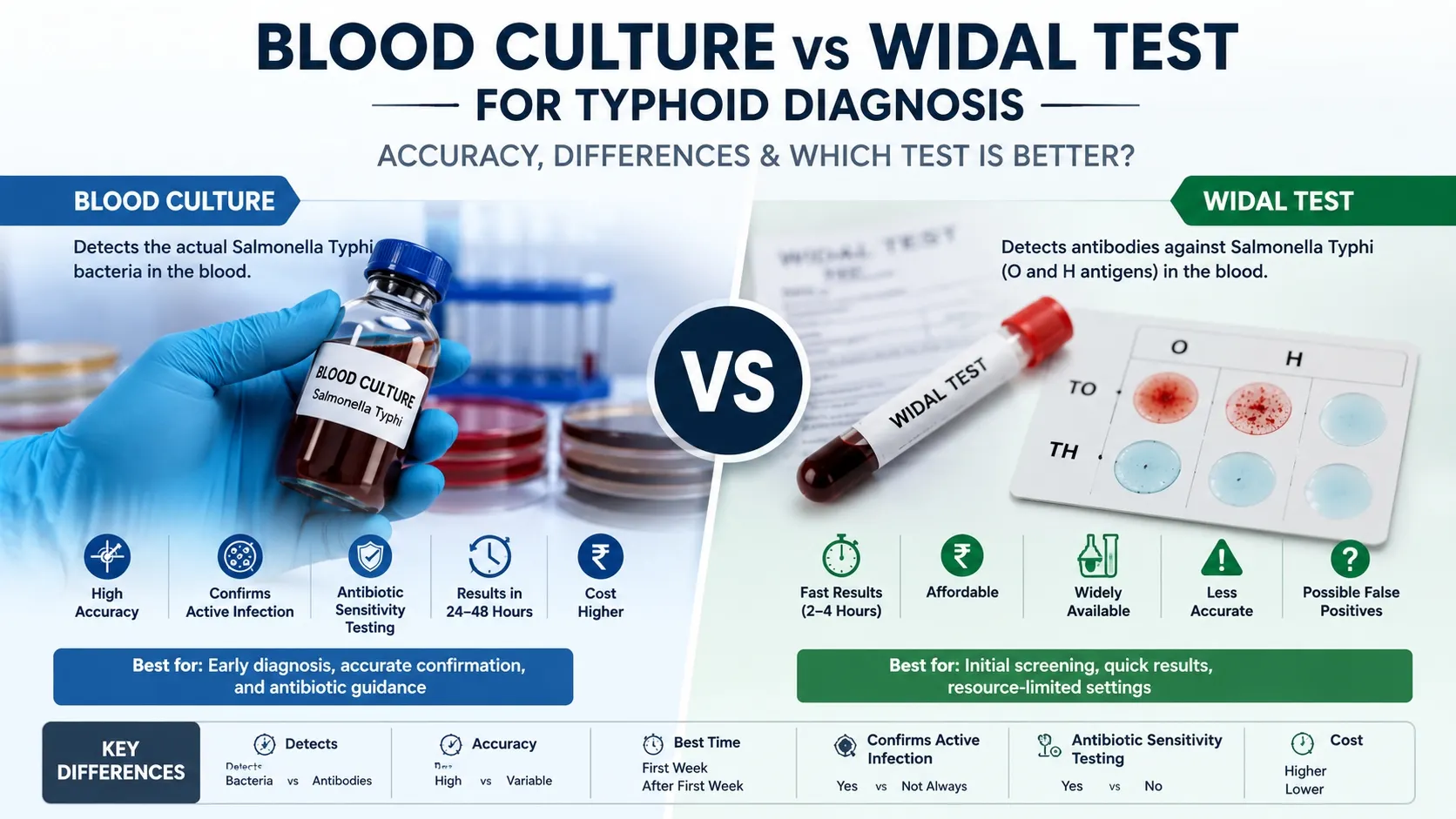
Blood Culture vs Widal Test: Key Differences
| Feature | Blood Culture | Widal Test |
|---|---|---|
| Detects | Actual bacteria | Antibodies |
| Accuracy | High | Variable |
| Best Time | First week of illness | After first week |
| Result Time | 24–48 hours | Few hours |
| Cost | Higher | Lower |
| Equipment Needed | Advanced lab | Basic lab |
| Confirms Active Infection | Yes | Not always |
| Antibiotic Sensitivity | Yes | No |
| False Positives | Rare | Common |
Which Test Is Better for Typhoid Diagnosis?
When the organism causing infection is known, blood culture is regarded as the best diagnostic method in most clinical situations as it directly detects the organism responsible for the infection. Blood culture is usually recommended when a correct diagnosis is crucial and is recommended by healthcare professionals.
However, the Widal test still plays a role in areas where:
- Advanced laboratories are unavailable
- Resources are limited
- Rapid screening is needed
- Cost is a concern
In many hospitals, doctors combine clinical symptoms with laboratory findings to improve diagnostic accuracy.
When Should You Choose a Blood Culture?
Blood culture is recommended when:
- Symptoms are severe
- Fever has lasted less than 7 days
- Accurate confirmation is required
- Antibiotic resistance testing is needed
- Previous antibiotics have not been used
It is especially valuable in hospitals and urban diagnostic centers with proper laboratory facilities.
When Is the Widal Test Useful?
The Widal test may still be useful when:
- Healthcare resources are limited
- Fast preliminary results are needed
- Blood culture facilities are unavailable
- Patients cannot afford expensive testing
Even then, many doctors recommend confirming positive Widal results with additional testing whenever possible.
Emerging Alternatives for Typhoid Diagnosis
Modern diagnostic methods are improving typhoid detection. Newer tests include:
- PCR-based molecular testing
- TyphiDot IgM tests
- Rapid antigen detection kits
- Stool culture
- Bone marrow culture
Although these technologies offer improved sensitivity, many remain costly or unavailable in low-resource settings.
Final Thoughts
Typhoid diagnosis is made with either blood culture or Widal test; both are widely used but each for a different function. Blood culture is still the most sensitive way to diagnose active typhoid fever and to determine the appropriate antibiotic therapy. The Widal test remains in use due to its low cost, fast turnaround, and availability.
Blood culture is sometimes ordered when laboratory facilities are available to obtain the most accurate diagnosis. The Widal test should be taken into consideration as an initial screening tool in resource-poor areas, but should be viewed with caution.
Early diagnosis and proper treatment are essential to prevent complications from typhoid fever. When symptoms last longer, always ask for medical advice and laboratory confirmation.