


Updated 4 months ago
What Is Typhoid Fever and How Does a Typhoid Rapid Test Kit Work?

Admin
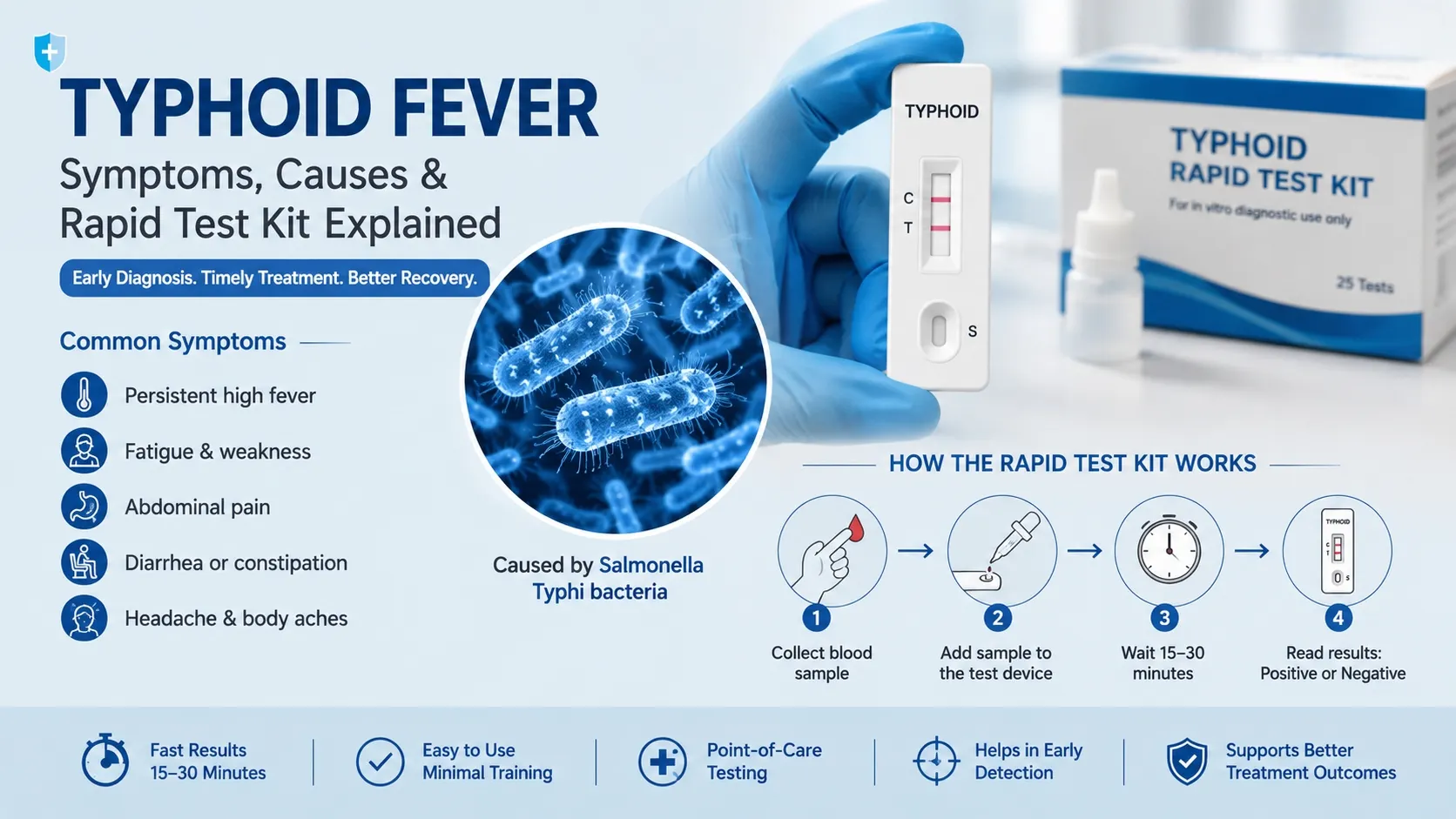
What Is Typhoid Fever and How Does a Typhoid Rapid Test Kit Work?
Typhoid fever continues to be a significant public health problem in many countries of the world, particularly in areas where there is inadequate access to clean water and sanitation facilities. Early diagnosis is critical, as otherwise, typhoid has the potential to cause serious complications such as intestinal bleeding, organ damage and death. Healthcare providers are leveraging advancements in rapid diagnostic technologies to make more timely diagnoses and initiate treatment quicker.
This is the typhoid fever guide that provides information about typhoid fever, its symptoms and causes, and how typhoid rapid test can be used in clinical and point-of-care context.
Understanding Typhoid Fever
Typhoid fever is an infection due to the bacterium Salmonella enterica serotype Typhi, also called Salmonella Typhi. The disease is transmitted through contaminated food, water or unhygienic activities. It is particularly prevalent in areas of developing countries where sanitation facilities are lacking.
Recent assessments of rapid diagnostic technologies confirm that typhoid remains a major health problem worldwide, especially in endemic areas of Asia and Africa.
Common Symptoms of Typhoid Fever
Illness typically occurs 6 to 30 days after exposure and can be a progressive process. Common symptoms include:
- Persistent high fever
- Fatigue and weakness
- Headache
- Abdominal pain
- Loss of appetite
- Diarrhea or constipation
- Nausea and vomiting
- Muscle aches
- Skin rash in some patients
Complications related to delayed therapy include intestinal perforation, sepsis and neurological issues in severe cases.
How Typhoid Fever Spreads
Typhoid bacteria are mainly transmitted via the fecal-oral route. Individuals get sick from eating or drinking food or water that has been contaminated. High risk of infection due to poor sanitation, unsafe drinking water and improper food handling.
Those who are travelling in endemic countries face risk as well, particularly when consuming street food or drinking unboiled water.
Why Early Diagnosis Matters
Timely diagnosis plays a pivotal role in the control of typhoid fever. Immediate antibiotic therapy can help minimize complications and shorten the length of the illness. The diagnosis of typhoid may be challenging however, since its symptoms are similar to those of malaria, dengue, influenza and other febrile conditions.
Blood culture is regarded as a traditional laboratory method, and used as a reference standard, but it takes many days to provide a result and may require highly developed laboratory facilities.
This makes rapid diagnostic tests (RDTs) more and more useful in hospitals, clinics, rural health care centers and emergency response contexts.
What Is a Typhoid Rapid Test Kit?
Typhoid rapid test kit is a diagnostic kit that can detect markers from typhoid infection in minutes at the point of care. These kits are easy to use, and usually do not require high-tech laboratory machinery.
The majority of rapid tests look for either:
- IgG and IgM antibodies against Salmonella Typhi
- Specific typhoid antigens
- Immune responses associated with active infection
Rapid test kits are especially useful in:
- Rural healthcare facilities
- Emergency medical camps
- Low-resource environments
- Clinics requiring quick screening
- Outbreak management programs
Many modern rapid diagnostic kits can deliver results within 15–30 minutes.
How Does a Typhoid Rapid Test Kit Work?
Most typhoid rapid test kits use lateral flow immunochromatographic technology, similar to many rapid infectious disease tests.
Step-by-Step Process
1. Sample Collection
A healthcare professional collects a small blood sample from the patient. Depending on the kit, the sample may include:
- Whole blood
- Serum
- Plasma
2. Applying the Sample
The blood sample is placed into the sample well of the test cassette. A buffer solution is then added to facilitate movement across the test strip.
3. Reaction Phase
If typhoid-related antibodies or antigens are present, they react with special coated particles inside the test strip.
4. Result Interpretation
Within approximately 15–30 minutes, visible colored lines appear in the result window:
- Control line (C): Indicates the test is functioning correctly
- Test line (T): Indicates a positive reaction
The interpretation instructions vary slightly depending on the manufacturer and test design.
Advantages of Typhoid Rapid Test Kits
Rapid diagnostic kits provide several important advantages over conventional testing methods.
Faster Results
Traditional blood culture testing may require several days. Rapid tests can provide preliminary results in less than half an hour.
Easy to Use
Most kits are designed for simplified workflows and minimal training requirements.
Suitable for Point-of-Care Testing
Rapid tests are highly useful in remote clinics and resource-limited healthcare settings.
Improved Outbreak Response
Quick screening helps healthcare teams identify potential infections rapidly and implement infection control measures.
Reduced Laboratory Dependency
Rapid kits reduce the need for advanced microbiology laboratories in primary healthcare environments.
Limitations of Rapid Typhoid Tests
Rapid tests are useful, but they are not 100% accurate. Studies have indicated that the sensitivity and specificity can be different in different countries and with different kits.
Some limitations include:
- False positive results
- False negative results in early infection
- Cross-reactivity with other infections
- Variability between manufacturers
As a result of these restrictions, health professionals might use rapid tests along with clinical assessment and other lab techniques, if needed.
Rapid Tests vs. Widal Test
The Widal test has been used for the diagnosis of typhoid fever until now, but it has some limitations in its accuracy. The modern rapid diagnostic tests are increasingly appealing due to their advantages of providing:
- Faster turnaround time
- Easier interpretation
- Better usability in field settings
- Reduced operator dependency
But systematic reviews have shown that there is currently no single rapid test that could be used to replace confirmatory laboratory testing in all situations.
Key Features to Look for in a Typhoid Rapid Test Kit
When selecting a typhoid rapid test kit, healthcare providers should consider several factors:
Diagnostic Accuracy
Sensitivity and specificity remain critical performance indicators.
Ease of Use
Simple procedures reduce user error and improve workflow efficiency.
Result Time
Most modern kits deliver results in 15–30 minutes.
Storage Requirements
Stable storage conditions are important for transport and field deployment.
Regulatory Certifications
Certified and validated kits improve reliability and compliance.
The Future of Rapid Typhoid Diagnostics
The technology for rapid diagnosis is continually developing. Antigen-based tests have increased sensitivity and specificity being developed. Further developments are planned such as:
- Digital result interpretation
- Smartphone integration
- AI-assisted diagnostics
- Multiplex infectious disease panels
- Enhanced portability
In addition, the need for quick diagnosis of infectious diseases is rising worldwide, as healthcare systems seek to spread out testing and boost preparedness for outbreaks.
Final Thoughts
Typhoid fever is still a dangerous disease and early diagnosis and treatment is essential. Typhoid rapid test kits are enabling healthcare providers to enhance screening efficiency especially in low resource and high risk environments.
Rapid tests are important for early detection, outbreak control and point-of-care healthcare delivery, but they should not replace confirmatory laboratory testing. With the ongoing advancement of diagnostics, fast typhoid tests are expected to be even more accurate, accessible and effective globally in the future.