



Updated 3 weeks ago
Vacuum Blood Collection Tubes: How to Choose the Right Tube for Laboratory Tests

Trustlab
The author is a specialist at Ningbo Trustlab Instruments Co., Ltd., a leading provider of laboratory and medical consumables since 2015. With extensive experience in global healthcare and laboratory markets, they focus on delivering high-quality, innovative solutions and professional support to laboratories, hospitals, and distributors worldwide. Trustlab’s products are trusted in over 100 countries, reflecting the company’s commitment to reliability, excellence, and customer satisfaction.

Vacuum Blood Collection Tubes
Matching a cap color to a test name is only one small part of choosing a Vacuum Blood Collection Tube. Generating the correct specimen matrix, holding the right blood-to-additive ratio, working in the laboratory's processing flow, and being compatible with analyzers all need to be considered.
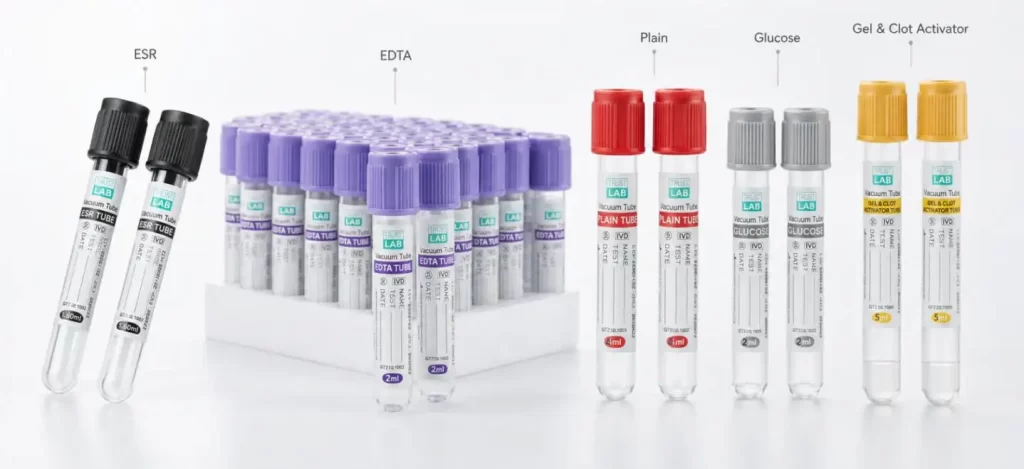
That's why Trustlab suggests weighing Vacuum Blood Collection Tubes in this order:
Test requirement → specimen type → additive → draw volume → separation method → processing conditions → analyzer compatibility.
This method is necessary for hematology, coagulation, clinical chemistry, and glucose testing because using the incorrect additive or failing to fill the tube correctly can introduce preanalytical errors prior to the specimen even being presented to the analyzer.
This approach is particularly important for hematology, coagulation, clinical chemistry and glucose testing, where a wrong additive or incomplete tube fill can introduce preanalytical error before the specimen reaches the analyzer.
Start With Whole Blood, Plasma or Serum
The required specimen matrix should be the first selection parameter.
| Laboratory Application | Typical Specimen | Common Tube Configuration | Critical Control Point |
| CBC / Hematology | Whole blood | EDTA | Cell preservation |
| PT / aPTT / INR | Citrated plasma | Sodium citrate | Correct filling |
| Clinical chemistry | Serum / plasma | Clot activator / heparin | Assay compatibility |
| Serology | Serum | Serum / separator tube | Complete clotting |
| Glucose testing | Preserved plasma | Fluoride-based tube | Glycolysis control |
The cap color is useful for identification, but Vacuum Blood Collection Tubes should ultimately be specified by additive, concentration, nominal draw volume and intended use.
Trustlab's range includes EDTA, sodium citrate, heparin, ESR, clot activator and glucose-related tube configurations, enabling laboratories and distributors to build a tube portfolio around actual test requirements rather than color alone.
EDTA Tubes: Match Anticoagulation to Hematology Requirements
EDTA prevents coagulation by binding calcium and is widely used where cellular components must remain available for hematological analysis.
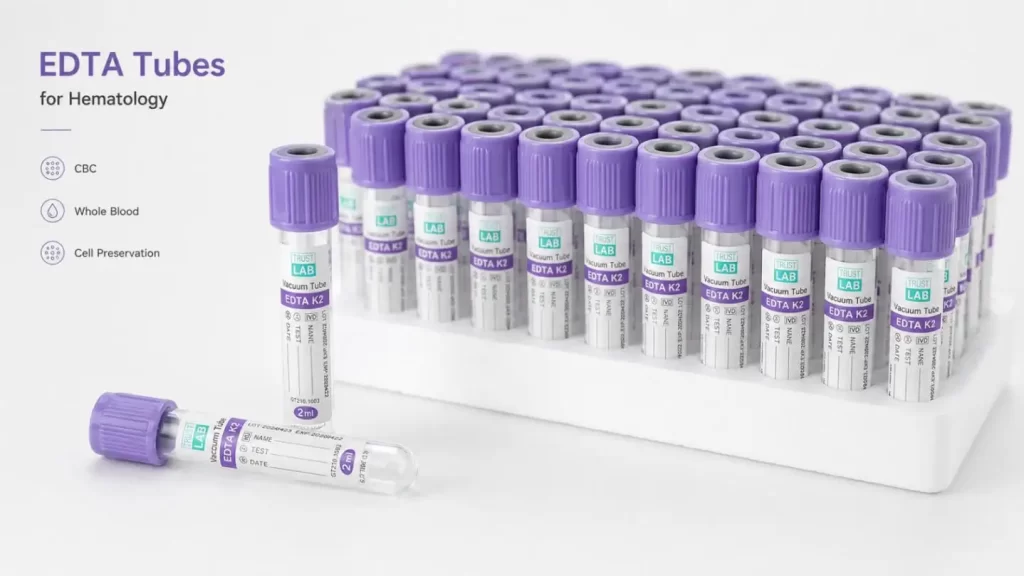
Typical applications include:
•Complete blood count
•Hemoglobin-related testing
•Hematocrit
•Platelet analysis
•Selected hematology workflows
K2EDTA vs. K3EDTA
K2EDTA and K3EDTA are not simply two names for the same product.
Important selection factors include:
•Additive form and concentration
•Potential dilution effect
•Cell morphology requirements
•Analyzer instructions
•Laboratory validation protocol
For procurement, the specification should therefore state K2EDTA or K3EDTA explicitly, rather than only requesting a purple-cap tube.
Sodium Citrate Tubes: Fill Volume Is a Functional Parameter
Coagulation testing places stricter requirements on filling accuracy than many routine applications.
Sodium citrate Vacuum Blood Collection Tubes are commonly used for tests such as:
•PT
•aPTT
•INR
•Fibrinogen
•D-dimer
The critical relationship is:
Vacuum level → blood draw volume → blood-to-citrate ratio → coagulation result
If a citrate tube is significantly underfilled, citrate becomes excessive relative to the plasma volume. This can alter calcium-dependent coagulation measurements.
This makes vacuum retention and nominal draw-volume consistency important manufacturing and procurement parameters, not merely user-convenience features.
When evaluating Trustlab or another supplier, laboratories should verify the specified draw volume and confirm performance under their collection conditions rather than accepting “citrate tube” as a complete specification.
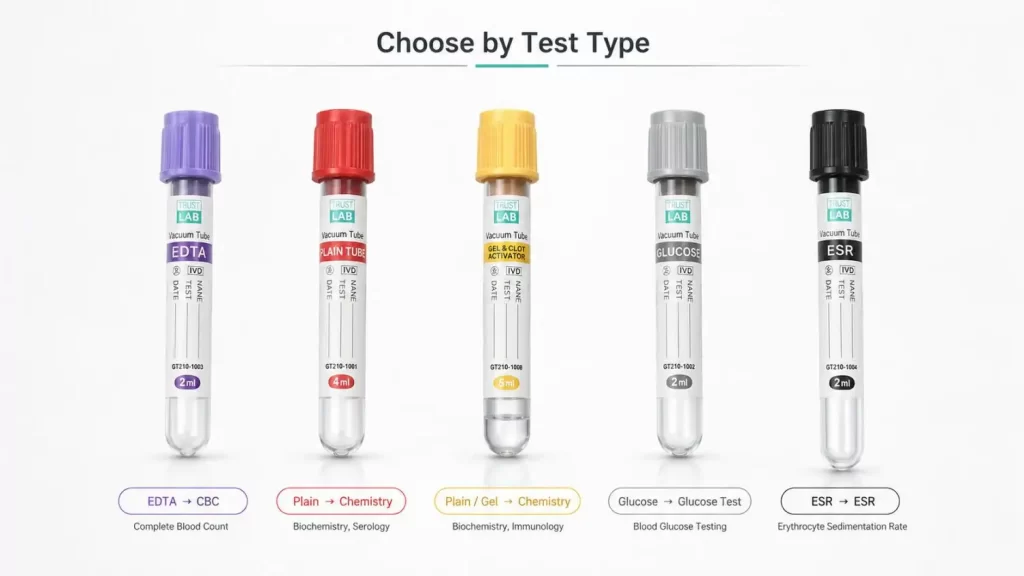
Serum vs. Heparin Plasma for Clinical Chemistry
Clinical chemistry creates a different decision.
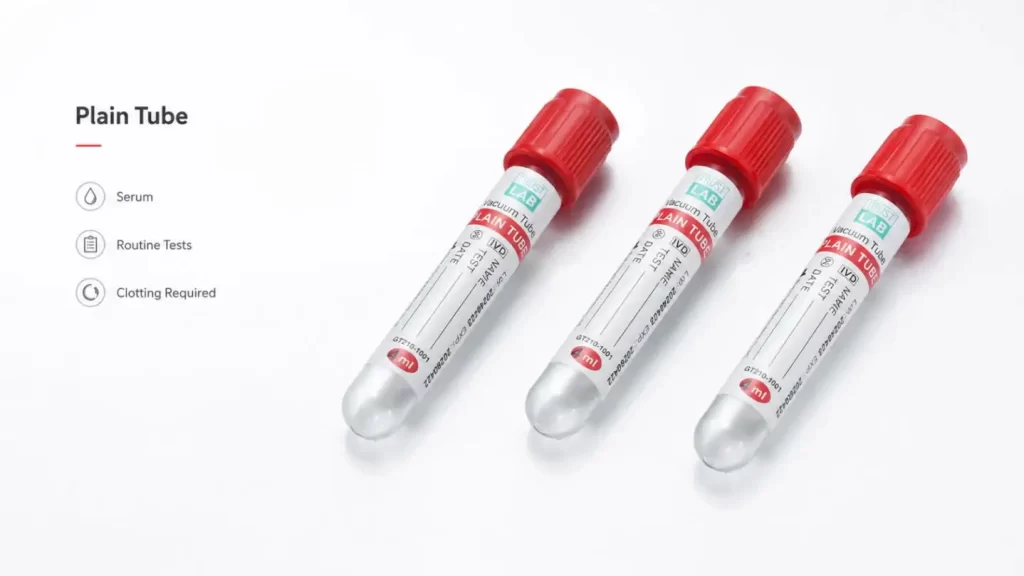
Serum Tubes
Serum Vacuum Blood Collection Tubes allow coagulation before centrifugation. Depending on the configuration, they may include:
•Clot activator
•Separator gel
•Both clot activator and gel
The workflow generally requires adequate clot formation before centrifugation.
Heparin Tubes
Heparin prevents coagulation and produces plasma, which can be advantageous where faster specimen processing is required.
| Factor | Serum Tube | Heparin Tube |
| Specimen | Serum | Plasma |
| Clotting step | Required | Not required |
| Processing speed | Longer | Potentially faster |
| Fibrin risk | Possible if clotting incomplete | Lower |
| Selection basis | Assay requirement | Assay requirement |
Neither system is universally superior. Laboratories should follow the analytical method and analyzer instructions.
Separator Gel or Plain Serum Tubes?
Separator gels provide a physical barrier to separate cellular fractions from serum or plasma and aid in cleaning the tube and minimizing the need for manual transfers. The gel separator may not work as expected. A number of factors affect the performance of the gel.
Variable factors include:
•Gel density
•Gel viscosity
•Relative centrifugal force (RCF)
•Duration of the centrifugation
•Temperature
•Sample characteristics
•The geometry of the tube
Due to the above factors that may contribute to gel system performance, Vacuum Blood Collection Tubes with separator gel should be considered in conjunction with the rest of the centrifugation system.
Speeds of the centrifuges cannot be assumed to improve the separation of tubes. RCF and time have to be within the processing limitations of the tube system and the assay that is done on the sample.
Why the Correct Tube Can Still Produce an Unacceptable Sample
Tube selection is only one part of preanalytical control.
1. Incorrect Filling
Underfilling changes the effective blood-to-additive ratio and is particularly critical in citrate tubes.
2. Inadequate Mixing
Vacuum blood collection tubes with additives are designed to be inverted a specific amount post collection. Not inverting enough leads to clotting. Over inverting can cause hemolysis.
3. Premature Centrifugation
Prematurely centrifuging a serum tube results in fibrin clot interferences with the sample's processing.
4. Incorrect Centrifugation
Laboratories must request a specific RCF, not RPMs. This is because some rotors have a larger radius and therefore less centrifugal force.
5. Delayed Processing
Time and temperature between collection and analysis can affect cell integrity and analyte stability even when the correct tube is used.
Check Physical Compatibility With Automated Laboratories
Additive chemistry is just one part of the specification for high-throughput labs.
Buyers should also check:
•Outside diameter and length of tubes
•Nominal blood draw volume
•Closure and stopper shapes
•Barcode placement
•Rack and centrifuge compatibility
•Automated sorters, decappers
•Analyzer loading
Trustlab has Vacuum Blood Collection Tubes in a variety of sizes and configurations, so you can select tubes that fit both your lab's testing and physical workflow needs.
Select Vacuum Blood Collection Tubes From the Test Backward
The most reliable purchasing sequence is:
Test menu → specimen matrix → additive → required draw volume → separation method → centrifugation and handling → automation compatibility → documentation → supplier validation.
This prevents a laboratory from standardizing the wrong Vacuum Blood Collection Tubes simply because the cap color or general product description appears correct.
Trustlab supplies multiple blood collection tube configurations for hematology, coagulation, chemistry and related laboratory workflows. Buyers can provide their required additives, draw volumes, tube dimensions and target applications to identify a more appropriate Vacuum Blood Collection Tubes configuration before moving to sample evaluation or volume procurement.
FAQs
Q1. What types of Vacuum Blood Collection Tubes does Trustlab offer?
Trustlab provides blood collection tubes for numerous lab workflows, including tubes with EDTA, sodium citrate, heparin, ESR, clot activator and tubes for glucose-related collections. The type of tube is selected based on the type of specimen and the test method.
Q2. How should Trustlab Vacuum Blood Collection Tubes be selected for a specific laboratory test?
First, identify the type of specimen, whether it is whole blood, plasma, or serum. Then consider the additive, nominal draw volume, separation, centrifugation, and analyzer requirements.
Q3. Does Trustlab offer EDTA Vacuum Blood Collection Tubes for hematology?
Yes. Trustlab manufactures EDTA Collection Tubes for hematology. K2EDTA or K3EDTA requirements should be confirmed by the analyzer and the laboratory procedure and test.
Q4. Are Trustlab sodium citrate tubes for coagulation testing?
Trustlab offers sodium citrate tubes for use in coagulation. Filling is very important as coagulation tests require a specific blood to anticoagulant ratio.
Q5. Does Trustlab furnish serum and clot activator blood collection tubes?
Yes. Trustlab provides tubes for collection of serum and clot activator. The tubes should be selected based on the desired clot activator, the type of centrifugation, and the compatibility of the assay performed downstream.
Written by
Trustlab
The author is a specialist at Ningbo Trustlab Instruments Co., Ltd., a leading provider of laboratory and medical consumables since 2015. With extensive experience in global healthcare and laboratory markets, they focus on delivering high-quality, innovative solutions and professional support to laboratories, hospitals, and distributors worldwide. Trustlab’s products are trusted in over 100 countries, reflecting the company’s commitment to reliability, excellence, and customer satisfaction.


