



Updated 3 weeks ago
Blood Collection Tube Free Sample Supplier Guide: How Distributors Should Evaluate Samples
trustlabofficial

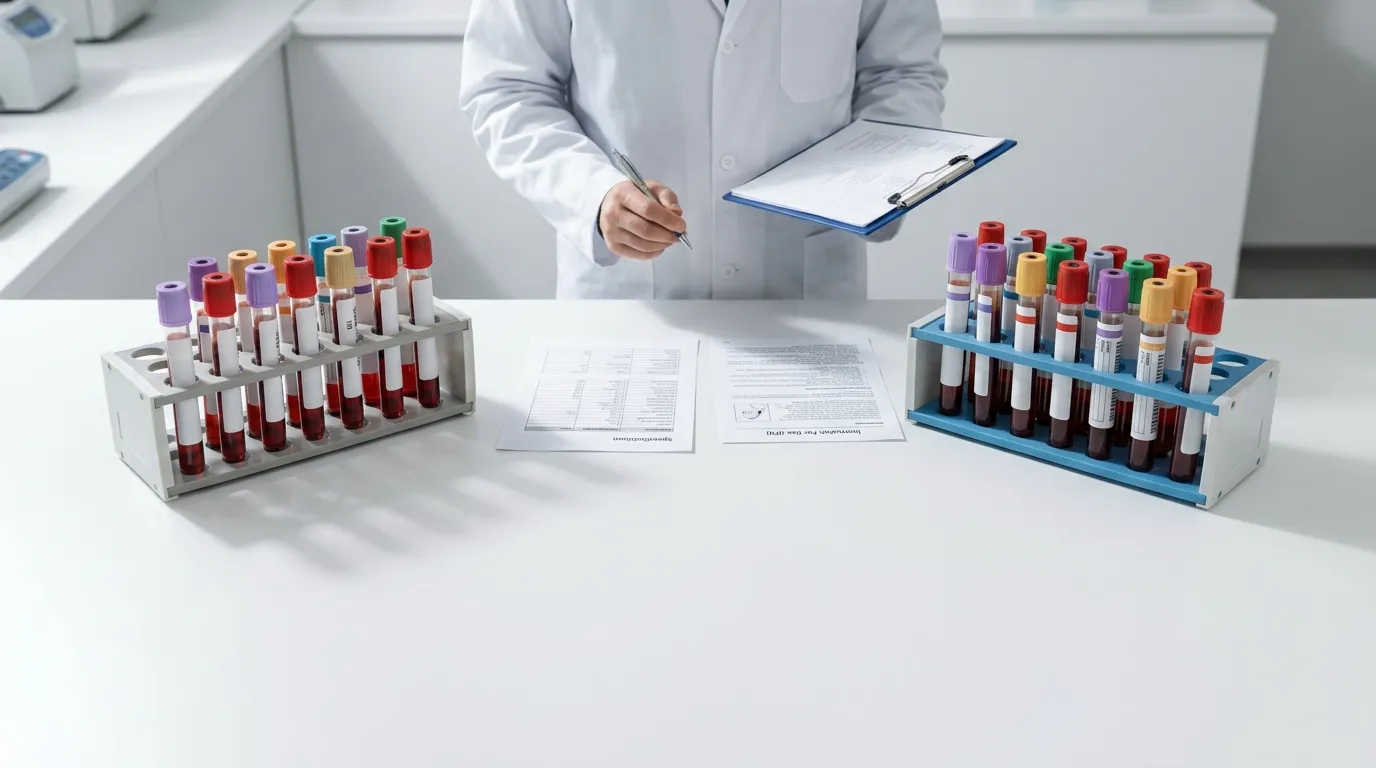
Blood collection tube samples being inspected by a gloved laboratory professional during supplier evaluation.
A free sample from a blood collection tube supplier is not the end of your research—it's the beginning of a structured evaluation. For distributors deciding whether to add a new tube line to their portfolio, free samples provide an opportunity to assess packaging, labeling, documentation, and basic functionality before committing to a volume purchase. The goal is simple: determine whether a supplier earns a purchase order.
This guide walks through a practical, repeatable evaluation process—from building a sample request to running functional checks and verifying supplier documentation. By the end, you'll have a clear framework for comparing suppliers and making a confident go/no-go decision.
What a Free Sample Can—and Can't—Prove About a Tube Supplier
Before unboxing anything, set realistic expectations. A free sample package is useful, but it has limits.
What a sample can show you:
- Basic build quality—tube body integrity, cap fit, and visible defects
- Labeling quality and completeness
- Packaging condition and shipping care
- Whether documentation like an Instructions for Use (IFU) is actually included
- Basic vacuum function and fill behavior when tested properly
What a sample cannot prove:
- Clinical performance or diagnostic reliability
- Sterility assurance—a sealed package is not proof of a sterile product
- Consistency across full production lots or long manufacturing runs
- Regulatory or certification claims that you haven't independently verified
A sample represents one moment in a supplier's production. It's a screening tool, not a substitute for proper supplier qualification. If you plan to resell tubes for clinical diagnostics, independent laboratory validation may still be necessary—and that's an investment your free samples should help you justify.
Building a Sample Request: What a Distributor Should Ask For
A vague "send me some samples" request produces a vague response. Build your sample request around the product families you actually intend to distribute.
How Many Sample Tubes Should a Distributor Request?
Start with enough tubes to perform meaningful checks. A practical minimum is 20–50 collection events per tube type you plan to evaluate, plus reserve pieces for documentation review and retention. This gives you enough volume to observe consistency across multiple tubes without overburdening your team.
The exact quantity depends on your testing goals. If you plan to send tubes to an independent laboratory, you'll need more. If you're only performing visual and functional checks, fewer tubes may suffice. Ask the supplier how many pieces they recommend for distribution-level testing—an experienced supplier will have a sensible answer.
For best results, request tubes from more than one production lot. This helps you assess batch-to-batch consistency, which is more meaningful than a single-lot evaluation.
Tube Families to Include in Your Request
Include samples across the tube types that matter for your market:
- Serum tubes with clot activator and, where applicable, separator gel (often identified by red or gold caps, depending on the manufacturer)
- Plasma tubes containing lithium heparin or another plasma-compatible anticoagulant (often green caps)
- Whole blood tubes containing EDTA (often lavender caps)
- Coagulation tubes containing sodium citrate (often light blue caps)
Different manufacturers use slightly different cap color conventions, so confirm the additive by reading the label, not just the cap color. For a complete reference on tube types, additives, and cap color coding, see our guide to different types of vacuum blood collection tubes.
Documentation to Request Alongside the Tubes
Don't wait for the tubes to arrive before asking for paperwork. Request these documents at the same time:
- The IFU for each tube type
- A copy of the product label or a label mock-up
- A batch certificate or lot release document if one is available
- A declaration of conformity or product certificate, where applicable
- A specification sheet with tube dimensions, nominal draw volume, and additive description
If a supplier hesitates to share basic product documentation, treat that as a signal. Legitimate suppliers expect distributors to ask these questions.
First Checks: Inspecting a Sample Shipment on Arrival

The first fifteen minutes after unboxing can tell you a lot about a supplier's manufacturing discipline. Follow a consistent arrival inspection process for every shipment you receive.
- Inspect the outer packaging. Look for signs of crushing, moisture damage, or rough handling during transit.
- Check the inner packaging. The secondary packaging should be intact, clean, and appropriate for the product.
- Verify the label information. Confirm the product name, catalog code, lot number, expiry date, and storage temperature requirements are clearly printed.
- Confirm the additive and cap color match the tube description in your sample request.
- Check that the IFU is included. A blood collection tube intended for clinical use should ship with instructions for use.
- Count the tubes. Verify the quantity matches the packing list or supplier's confirmation.
- Perform a visual inspection. Look for cracked tubes, loose caps, foreign particles, or visible contamination.
Label and Documentation Verification: What the Labels Should Tell You
The label is a contract between the manufacturer and the end user. It should tell you:
- What the tube contains and in what concentration
- What the nominal draw volume is
- What the intended use is
- Whether the tube is sterile or non-sterile
- How to store the tube
- What the lot number and expiry date are
If a tube is labeled sterile, the label should specify the sterilization method and include appropriate handling warnings. If a tube is not labeled sterile, it should not be described as sterile by the supplier, and you should not assume otherwise.
Keep a copy of the label image in your supplier evaluation file. This helps you verify consistency between the sample, the IFU, and the supplier's catalog claims later.
Functional Checks Before You Commit to a Purchase Order
Once your visual and documentation checks pass, run basic functional checks. These are low-cost tests that help you confirm the product behaves as a blood collection tube should.
Checking Vacuum and Fill Volume
- Test the vacuum. When a standard blood collection needle penetrates the tube stopper, an intact evacuated tube should produce an audible "hiss." Take appropriate safety precautions and use proper phlebotomy technique if you are trained to do so.
- Verify fill volume. After collection, visually compare the blood fill level against the nominal draw volume printed on the label. The blood-to-additive ratio is critical for test accuracy—an underfilled tube can alter the additive concentration and compromise downstream results.
- Check multiple tubes. Test several tubes from different parts of the batch, not just the first few.
Checking Cap and Closure Integrity
- Remove the cap and check for clean separation without cracking or excessive force.
- Inspect the stopper or cap for particulate material or visible residue.
- If the tube is designed to be re-sealed, check whether the cap re-seats properly.
When a Real Laboratory Validation Is Necessary
Basic functional checks are a useful screening step, but they are not clinical validation. If you are supplying tubes for clinical diagnostics, or if you intend to make any claim about clinical compatibility, you need independent laboratory testing.
Industry-standard validation protocols—similar to those described in CLSI guidance—can assess factors such as additive carryover, analyte stability, hemolysis rates, and consistency across multiple lots. These studies require controlled laboratory conditions and appropriate equipment.
Your free-sample evaluation is the triage step that tells you whether a product is worth the cost of deeper laboratory validation. If a sample fails basic checks or documentation is missing, you have saved yourself the expense of a full validation study.
Documentation You Should Expect from a Tube Supplier
Documentation is not paperwork for its own sake. It protects you, your customers, and your reputation.
| Document | What It Tells You | Red Flag If Missing |
|---|---|---|
| Instructions for Use (IFU) | Intended use, handling, storage, warnings | Missing IFU for a clinical product is a serious gap |
| Batch certificate or lot record | Production date, expiry, and batch traceability | No way to trace a product back to its production lot |
| Declaration of conformity or product certificate | Whether a product is certified in a specific market | If claimed but not documented, treat the claim as unverified |
| Quality management system certificate (e.g., ISO 13485) | That the supplier's QMS has been audited to a recognized standard | A missing QMS certificate does not prove a product is non-compliant, but it limits supplier confidence |
| Specification sheet | Dimensions, nominal draw volume, additive, material, closure type | Inconsistency between spec sheet and actual product is a serious concern |
A Critical Distinction: QMS Certification vs. Product Certification
Distributors frequently confuse company-level and product-level certification. An ISO 13485 certificate confirms that a supplier's quality management system has been audited and certified. It does not, by itself, confirm that every product from that supplier holds a CE mark, FDA clearance, or any other product-specific regulatory approval.
Product-level regulatory status is a separate matter and requires its own evidence. If a supplier claims CE marking or another product-level conformity assessment, ask to see the specific document for the exact product you are evaluating. Also confirm the scope of the certificate, the relevant jurisdiction, and the product identifier.
When you're evaluating the broader supplier quality system beyond the sample phase, our guide on how to evaluate blood collection system supplier quality provides a more complete framework.
Comparing Sample Results Across Suppliers
To compare multiple suppliers fairly, you need consistent criteria. Create a scoring sheet before you open the first sample, then apply it to every supplier.
Weight factors by your market risk:
- Documentation completeness and accuracy (highest weight for clinical markets)
- Packaging and shipment integrity
- Label accuracy and traceability
- Functional performance — vacuum retention, fill volume, cap integrity
- IFU quality and completeness
Set disqualifying criteria in advance:
- Missing IFU for a clinical product
- Labels that contradict the IFU or catalog description
- Inability to provide lot traceability
- A claimed certification that cannot be documented
Avoid the reputation trap. A recognizable brand name is not a substitute for documented evidence. Conversely, a less familiar supplier should not be disqualified simply because you haven't heard of them—evaluate what they actually shipped to you.
When comparing suppliers, look for documented evidence such as specification sheets, batch certificates, and conformity declarations. Brand familiarity alone is not sufficient evidence of product quality.
A Simple Scorecard Framework
| Evaluation Criterion | What to Check | Weight |
|---|---|---|
| Documentation completeness | IFU, batch certificate, spec sheet, conformity document | High |
| Arrival integrity | Packaging condition, physical tube damage | Medium |
| Label quality | Additive description, cap color match, lot number, expiry, storage info | High |
| Functional performance | Vacuum hiss, fill volume accuracy, cap integrity | High |
| Cross-batch consistency | Tubes from multiple lots behave similarly | Medium |
Remember: a sample is a snapshot, not a guarantee. Even a clean scorecard should be validated through a volume order that includes lot traceability and documented quality control.
A Practical Note on Supplier Claims
As you evaluate suppliers, you will encounter a range of claims about product quality, regulatory status, and manufacturing capability. Some of these claims will be well documented; others will not.
When a supplier says a product is "CE approved," "ISO compliant," "sterile," or "medical grade," ask for the specific evidence behind that claim. The document should name the product, identify the certificate or registration number, and state the scope of the approval. If the claim is genuine, the supplier should be able to substantiate it quickly.
Do not accept marketing language as technical evidence. "Safe," "accurate," "high quality," and "contamination-free" are descriptions, not certifications. If a data point matters to your buying decision, verify it with documentation.
Next Step: Request Samples and Run a Structured Evaluation
The process described here is designed to be practical, repeatable, and evidence-based. If you are a distributor evaluating new suppliers, use this framework to build your own sample request, arrival inspection checklist, and supplier scorecard.
Trustlab, part of Ningbo Trustlab Instruments Co., Ltd., supplies vacuum blood collection tubes and related blood collection products as part of its broader blood collection systems offering. If you are building a supplier evaluation panel, contact Trustlab to discuss sample availability for your distributor evaluation. Ask for the current product documentation and confirm that the sample tubes you receive match the specifications you intend to distribute.
A thorough sample evaluation takes time, but it is far less costly than discovering a supplier problem after a volume order is placed. Test the tubes, check the documents, and make your decision based on evidence—not impressions.
Blood Collection Tube Free Sample Evaluation FAQ
What tube types should I ask for in a sample package?
Request samples across the tube families you plan to distribute: serum tubes with clot activator (with or without gel), plasma tubes with lithium heparin, whole blood tubes with EDTA, and coagulation tubes with sodium citrate. Confirm the additive by reading the label, not just the cap color.
How many samples are reasonable to request?
A practical starting point is 20–50 collection events per tube type, plus reserve pieces for documentation review and retention. If you plan to send tubes to an independent laboratory, you will need more. Ask the supplier for their recommendation.
Is a free sample enough to approve a supplier?
No. A free sample proves basic build quality, labeling, packaging, and documentation—but it does not prove clinical performance, sterility assurance, or consistency across full production lots. For clinical applications, independent laboratory validation may be necessary.
What documents must I ask for beyond the tubes?
Request the Instructions for Use, a batch certificate or lot record, a specification sheet, and any declaration of conformity or product certificate the supplier claims to hold. Also ask for evidence of the supplier's quality management system certification, but remember that a QMS certificate is not the same as product-level regulatory approval.