



Updated 2 weeks ago
K2 EDTA vs K3 EDTA Tubes: Which Format Fits Your Workflow?
trustlabofficial

K2 and K3 EDTA blood collection tubes compared in a clinical laboratory
K2 EDTA and K3 EDTA tubes are both used to collect anticoagulated whole blood for hematology testing. The main difference is the EDTA salt and its physical form: K2 is dipotassium EDTA, usually applied as a spray-dried coating, while K3 is tripotassium EDTA, commonly supplied as a liquid additive.
For routine blood cell counting, K2 EDTA is generally the preferred format because liquid K3 can dilute the specimen and may produce greater changes in measured red-cell volume. The International Council for Standardization in Haematology (ICSH) has recommended K2 EDTA for blood cell counting, although K3 EDTA remains in use in some laboratories and regional workflows. Diatron summarizes this recommendation and its hematology implications.
The correct choice still depends on your analyzer instructions, laboratory validation, existing reference ranges, and supplier documentation. Both formats belong within wider blood collection systems and should be selected as part of the complete specimen-collection workflow.
What Are K2 and K3 EDTA Tubes?
EDTA is an anticoagulant that binds calcium ions required for the coagulation process. By chelating calcium, it helps keep collected blood from clotting so that laboratories can examine blood cells in whole-blood samples.
K2 EDTA tubes
K2 EDTA is the dipotassium salt of ethylenediaminetetraacetic acid. In many evacuated blood collection tubes, it is applied as a dry or spray-dried coating on the inside wall of the tube.
The dry format reduces the amount of liquid introduced into the blood sample. This is one reason K2 is commonly preferred for hematology measurements in which the concentration and physical characteristics of blood cells matter.
K3 EDTA tubes
K3 EDTA is the tripotassium salt of EDTA. It is commonly supplied as a liquid additive. Because the additive is liquid, it can introduce a small dilution effect, particularly when the additive-to-blood ratio is not well controlled.
K3 EDTA can still provide effective anticoagulation and remains used in some laboratories. However, its liquid format and potential effect on measured cell parameters should be considered when selecting tubes for routine hematology.
Both K2 and K3 tubes are commonly identified by a lavender or purple top. The color indicates an EDTA tube, but it does not by itself identify whether the additive is K2 or K3. Laboratories should check the tube label, product specification, or IFU.
For broader background on tube categories, see different types of vacuum blood collection tubes.
The Key Differences: K2 vs K3 EDTA Tubes
| Comparison factor | K2 EDTA | K3 EDTA |
|---|---|---|
| Chemical form | Dipotassium EDTA | Tripotassium EDTA |
| Common physical form | Dry or spray-dried coating | Liquid additive |
| Main routine use | Blood cell counting and hematology | Hematology workflows where the laboratory protocol permits it |
| Dilution concern | Usually minimizes additive-related dilution | Liquid additive may dilute the specimen |
| Potential effect on MCV | Generally preferred when minimizing additive-related changes is important | May produce a reduction in measured MCV |
| Standards context | Recommended by ICSH for blood cell counting | Still used in some laboratories and regions |
| Tube identification | Commonly lavender or purple top | Commonly lavender or purple top |
| Selection requirement | Confirm analyzer and laboratory protocol | Confirm analyzer, protocol, and reference-range suitability |
The difference is not simply that one tube is “stronger” than the other. K2 and K3 are different potassium salts of the same anticoagulant, and the physical form of the additive affects how the collected specimen interacts with the tube.
A commonly cited study by Goossens and colleagues found that K3 concentrations substantially above the normal level could affect hematology results, while high K2 concentrations could also influence MCV. The practical lesson is that additive concentration, blood-to-additive ratio, and tube preparation matter; the comparison should not be reduced to a universal claim that one salt has no possible effect. PubMed: Goossens et al.
Clinical Impact: How the Choice Affects Blood Test Results
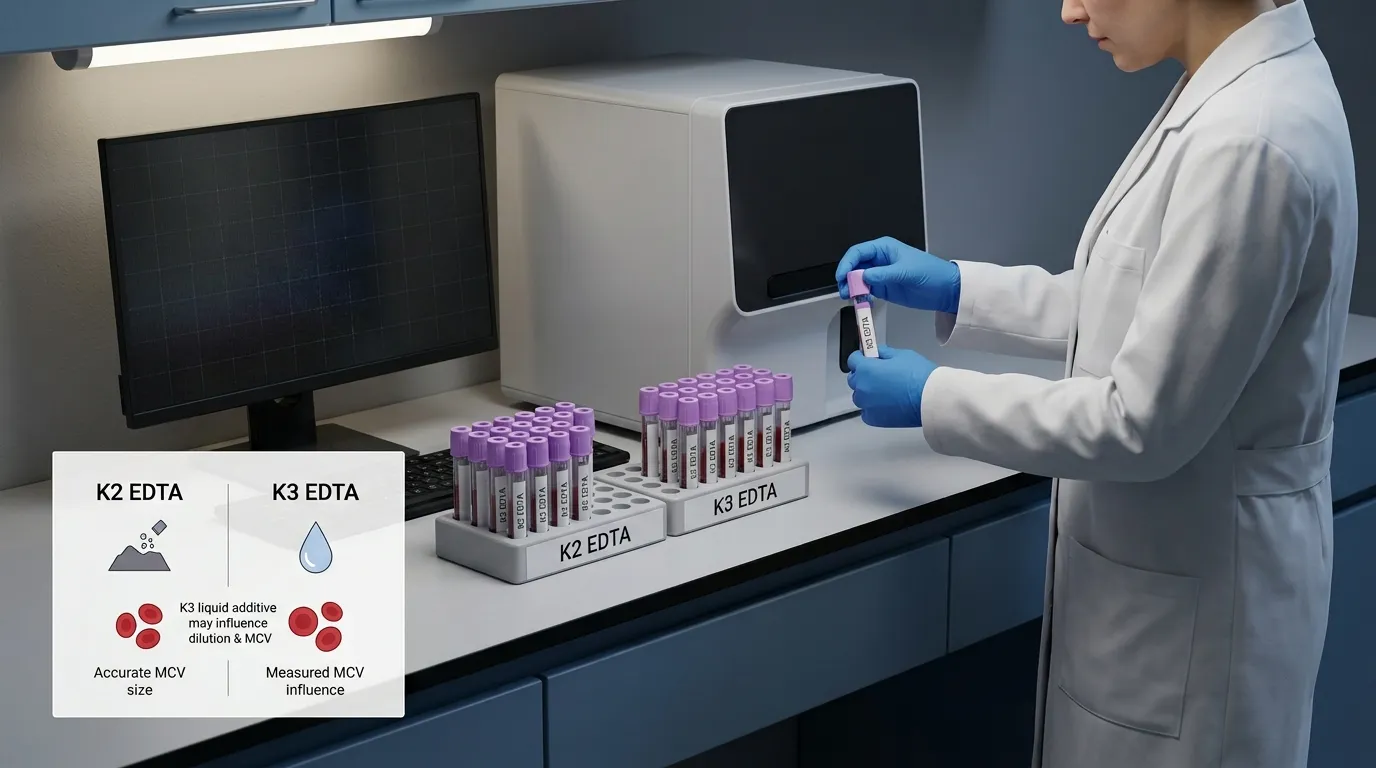
The K2-versus-K3 decision matters because the anticoagulant and its concentration can influence measured blood-cell parameters.
MCV and red-cell measurements
MCV, or mean cell volume, describes the average volume of red blood cells. Liquid K3 EDTA has been associated with a reduction in measured MCV, commonly explained by red-cell shrinkage and dilution-related effects. This can matter when the laboratory compares results against reference ranges or monitors small changes over time.
The effect is not necessarily identical for every tube, collection volume, storage period, or analyzer. The relevant question is whether the tube system produces results that are acceptable for the laboratory's validated method.
Other CBC parameters
A 2021 study comparing K2 and K3 EDTA for complete blood count and erythrocyte sedimentation rate testing reported statistically significant differences in several parameters, including hemoglobin, hematocrit, MCV, MCHC, RDW, PDW, MPV, platelet-related measurements, and ESR. The reported differences remained within the study's stated limits of agreement, so the findings should not be interpreted as proof that every K2/K3 comparison will produce clinically unacceptable results. Zahraini, Indrasari and Kahar, 2021
This distinction is important:
- A statistically significant difference is not automatically a clinically important difference.
- Results from one study do not establish performance for every tube manufacturer, analyzer, blood volume, or storage condition.
- A laboratory switching tube formats should evaluate the effect under its own validated conditions.
Why K2 is commonly preferred
K2 is commonly preferred for routine hematology because its spray-dried format can reduce liquid-additive dilution and is consistent with the ICSH recommendation for blood cell counting. It is not a guarantee that every K2 tube will perform identically, and it does not remove the need to follow the tube manufacturer's instructions or validate a new collection system.
K3 may remain acceptable where it is specified by an established laboratory protocol, supported by analyzer instructions, or required by existing local practice. The decision should be based on documented suitability rather than on the additive name alone.
Standards Guidance: What Do ICSH and CLSI Recommend?
The ICSH recommendation most frequently cited in this comparison is that K2 EDTA should be used for blood cell counting. The reason is its lower risk of liquid-additive dilution and its generally more favorable effect on measured cell volume than liquid K3 EDTA.
This is a professional standardization recommendation, not a universal regulatory prohibition on K3. A laboratory may still use K3 when its method has been established and validated, provided that the tube, analyzer, collection volume, handling procedure, and reference intervals are appropriate.
The original ICSH recommendation should be checked in the laboratory's current standards library or method documentation before it is used as a formal compliance statement. Secondary technical guidance, including the Diatron comparison, attributes the recommendation to ICSH's 1993 guidance. Diatron
Do not treat a general reference to CLSI as proof of a particular K2/K3 requirement unless the applicable CLSI document and edition have been identified. Standards organizations, laboratory accreditation requirements, analyzer instructions, and local regulations may address different parts of the workflow.
Workflow and Practical Considerations
The tube format should fit the complete pre-analytical and analytical process, not just the collection step.
If your laboratory is considering a switch
Before replacing K3 with K2, or K2 with K3, review:
- Analyzer instructions: Confirm which EDTA tube formats and collection conditions the analyzer manufacturer supports.
- Laboratory validation: Compare results from the current and proposed tube under the laboratory's normal collection, mixing, storage, and testing conditions.
- Reference ranges: Determine whether the change could affect established reference intervals or longitudinal comparison of patient results.
- Collection volume: Verify that the tube is filled according to the manufacturer's instructions and the laboratory's method requirements.
- Mixing procedure: Follow the exact inversion and handling instructions for the selected tube. Do not assume that a liquid and spray-dried format require identical handling.
- Storage and testing time: Use the applicable product IFU and laboratory protocol for storage and maximum holding time.
- Downstream tests: Confirm that the tube is appropriate for the intended CBC, ESR, morphology, or other hematology method.
K2 and K3 should not be treated as automatically interchangeable simply because both contain EDTA. Interchangeability is a laboratory validation question.
Pediatric and low-volume workflows
Tube format is only one part of pediatric collection. The laboratory must also consider the required blood volume, additive-to-blood ratio, collection method, and test menu.
Trustlab's product pages list K2/K3 options within its EDTA tube range, and its lab micro tube page identifies K2/K3 formats for micro-volume applications. The exact volume, additive concentration, package configuration, and other specifications should be confirmed on the applicable current product documentation rather than inferred from the product family.
For more information about the collection method itself, see vacuum blood collection tubes.
Regional practice does not replace validation
K3 may be more familiar in some regional or historical workflows, while K2 is widely preferred for modern routine hematology. Regional availability can influence purchasing decisions, but it should not override the requirements of the laboratory's analyzer, method validation, or quality system.
Choosing Your Tube and Supplier: A Practical Selection Guide
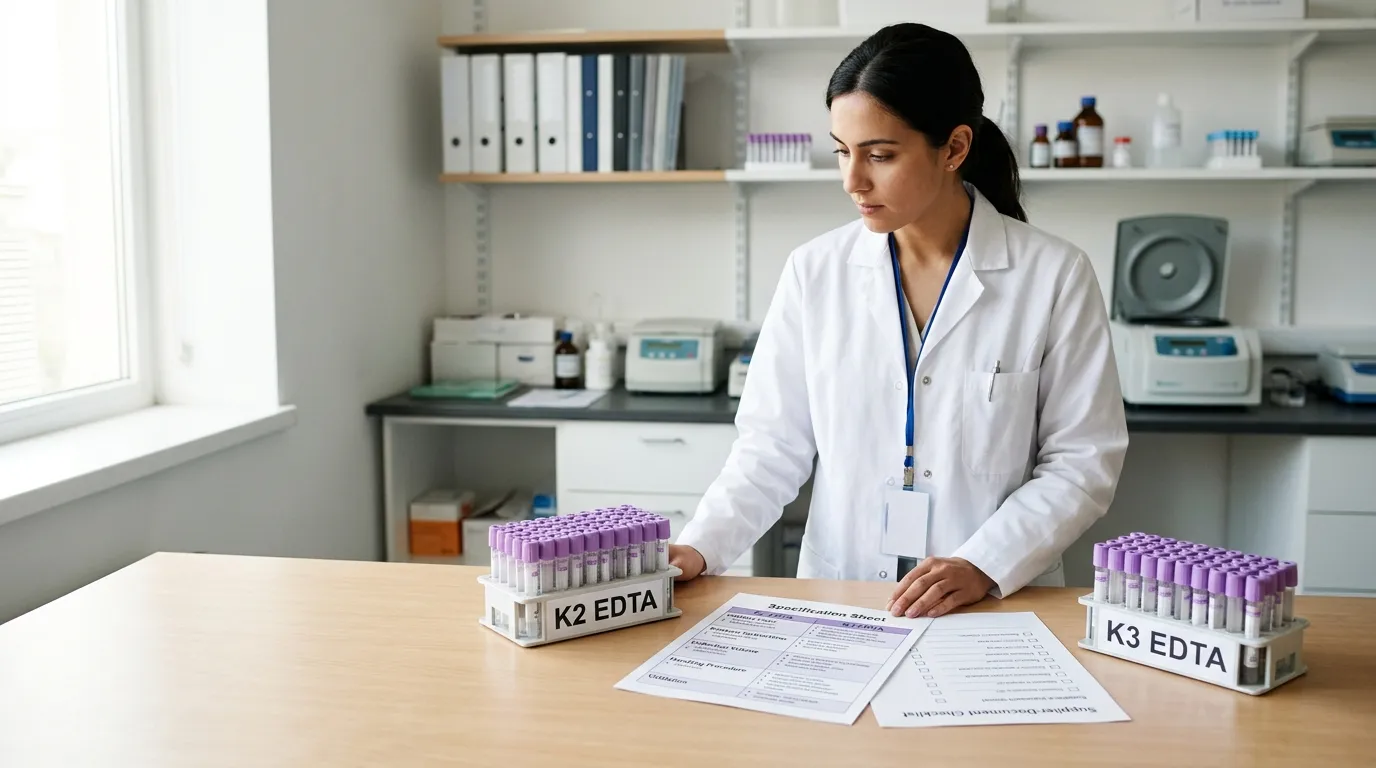
For most laboratories selecting a default tube for routine CBC and blood-cell counting, K2 EDTA is the logical starting point because it aligns with the ICSH recommendation and minimizes concerns related to liquid-additive dilution.
Use the following decision process:
- Choose K2 as the default candidate when the workflow is routine hematology and there is no documented reason to use K3.
- Review the analyzer documentation before standardizing a tube format.
- Confirm the required draw volume and tube configuration for adult, pediatric, or micro-volume collections.
- Check the additive and product documentation rather than relying only on the lavender-top color.
- Validate any change in tube supplier, additive format, material, collection volume, or handling process.
- Compare results under normal storage and testing conditions before changing the laboratory's established supply.
- Request current product documentation for the exact tube configuration being considered.
- Ask the supplier how product variants are identified, including additive type, tube size, package quantity, and any model or catalog code.
- Separate company quality documentation from product documentation. An ISO 9001 or ISO 13485 quality-management certificate, where applicable, does not automatically prove product-level regulatory approval, sterility, or performance.
For additional procurement guidance, read how to evaluate blood collection system supplier quality.
Trustlab Product Availability
Trustlab's EDTA tube product pages list K2 or K3 additive options, including an EDTA tube product page and an EDTA blood tube page. The Trustlab lab micro tube page also lists K2/K3 options for micro-volume applications.
These pages establish that Trustlab presents K2 and K3 EDTA formats within its product range. They do not, by themselves, establish every tube's additive concentration, volume, sterility status, analyzer compatibility, certification, or regulatory status. Buyers should confirm those details for the exact product configuration before ordering.
Frequently Asked Questions
Can K2 and K3 EDTA tubes be used interchangeably?
Not automatically. Both are EDTA tubes, but their salt form and physical additive format differ. A laboratory changing from K2 to K3, or from K3 to K2, should review analyzer instructions, verify collection and handling procedures, and validate the effect on results and reference ranges.
Why is K2 EDTA usually preferred for hematology?
K2 EDTA is usually preferred because its spray-dried format minimizes liquid-additive dilution and aligns with the ICSH recommendation for blood cell counting. K3 can still be suitable when it is supported by a validated laboratory method.
Does K3 EDTA affect MCV?
K3 EDTA has been associated with a reduction in measured MCV, particularly in connection with its liquid format and additive concentration. The size of the effect depends on the tube design, blood-to-additive ratio, storage conditions, and analytical method.
Does the EDTA format affect ESR results?
It can. The 2021 comparison by Zahraini and colleagues reported differences in ESR as well as several CBC parameters between K2 and K3 samples. Laboratories should interpret that evidence in the context of their own ESR method and validation data.
What color are K2 and K3 EDTA tubes?
Both are commonly supplied with lavender or purple tops. Because the color does not identify the potassium salt, check the label or product documentation to determine whether the tube contains K2 or K3 EDTA.
What should a laboratory do before switching from K3 to K2?
Review the analyzer and laboratory requirements, confirm the exact replacement tube, compare results using representative samples, and document the validation before changing the routine collection process. The supplier should provide the relevant product information for the selected configuration.
Choosing the Right EDTA Tube for Your Workflow
K2 EDTA is generally the preferred starting point for routine hematology because it is the format recommended by ICSH for blood cell counting and avoids the liquid-additive dilution concern associated with K3. K3 EDTA can remain appropriate for established, validated workflows, but the two formats should not be treated as automatically interchangeable.
Trustlab lists both K2 and K3 EDTA tube formats. For a specific laboratory requirement, review the applicable product documentation and confirm the additive, volume, configuration, and documentation needed before requesting a quotation or placing an order.