


Updated 3 weeks ago
PT Tube Blood Collection Supplier for Coagulation Testing
trustlabofficial

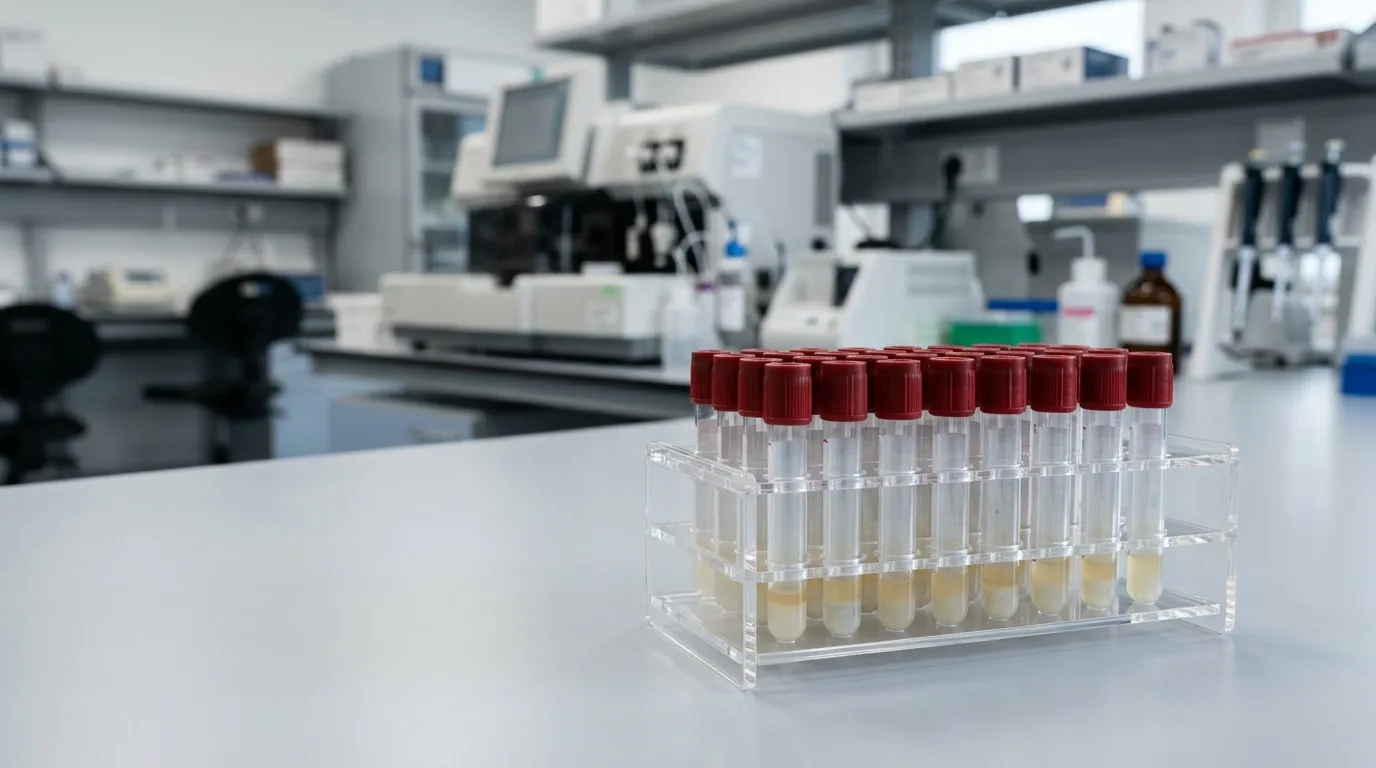
Blue-top PT blood collection tubes in a laboratory tube rack
A PT tube — also called a coagulation tube or citrate tube — is a vacuum blood collection tube containing a fixed volume of 3.2% sodium citrate solution. It is used to collect venous blood for coagulation testing, most commonly prothrombin time (PT) and INR, as well as activated partial thromboplastin time (APTT), thrombin time, and fibrinogen assays. The tube is identified by its blue closure and must be filled to its stated nominal volume so the citrate mixes with the blood in a 1:9 ratio.
If you are assessing a new supplier of vacuum blood collection tubes for a laboratory, hospital, or distribution programme, this page explains what makes a PT tube different, why the additive ratio matters clinically, and which documents you should ask for before you commit to a purchase.
What Is a PT Tube?
A PT tube is a blood collection tube designed specifically for coagulation studies. Its defining feature is the liquid anticoagulant inside: 3.2% sodium citrate. When a correctly filled tube is mixed, one part citrate solution is combined with nine parts whole blood. This controlled ratio prevents the sample from clotting during transport while preserving the coagulation factors needed for laboratory testing.
| Feature | PT tube specification |
|---|---|
| Primary use | Coagulation testing |
| Additive | 3.2% sodium citrate solution |
| Mix ratio | 1 part additive to 9 parts blood |
| Closure colour | Blue |
| Tube material options | PET or glass |
| Fill volume | Supplier-specific; the tube must be filled to its labelled nominal draw volume |
Which tube is required for a PT-INR? The blue-top sodium citrate tube is the standard sample type for PT and INR measurement.
PT tubes are one member of the broader family of evacuated sample tubes. If you need a quick overview of how tube types differ by additive, our guide to different types of vacuum blood collection tubes explains the full range.
Why 3.2% Sodium Citrate (1:9) Matters in Coagulation Testing

Sodium citrate works by chelating — binding — calcium ions in the blood sample. Calcium is required for the coagulation cascade to proceed, so when it is unavailable, the blood cannot clot inside the tube. That keeps the plasma suitable for testing downstream.
The ratio matters as much as the concentration. In a correctly filled PT tube, one part of 3.2% sodium citrate is mixed with nine parts of blood. If the draw volume is too low, the proportion of citrate becomes too high relative to blood; if the tube is overfilled, the proportion becomes too low. Either condition can alter PT/INR results. For this reason, fill-volume accuracy is one of the most important quality checks when choosing a PT tube supplier.
Clinical guidance also points to 3.2% as the recommended concentration. Guidance issued during the sodium citrate tube shortage confirms that sodium citrate coagulation tubes are essential for testing and that alternative sources require formal validation before routine use. Some regions have historically used higher concentrations, but 3.2% is the concentration laboratories should expect from a supplier whose tubes are intended for PT/INR testing.
Preanalytical Factors That Affect PT Results
A PT result is only as reliable as the sample inside the tube. Several preanalytical factors can compromise coagulation testing:
- Underfilled or overfilled tubes. Because the 1:9 ratio is fixed, an incomplete or excessive draw changes the citrate-to-blood balance. This is one of the most common causes of unreliable PT results.
- Poor mixing. The blood must be mixed gently with the citrate soon after collection. Without adequate mixing, small clots can form and the sample may be rejected by the laboratory.
- Transport and storage conditions. According to Ochsner Health's specimen-handling guidance, PT testing should be performed within 24 hours of collection, and the specimen should be transported at room temperature.
- Order of draw. When multiple tubes are collected from the same patient, the standard order-of-draw sequence should be followed to prevent additive carryover from other tubes. The Laboratory Tube Collection reference at NCBI describes this sequence and the preanalytical problems it prevents.
- Tube component interference. Even the tube itself can introduce variability. A 2025 review in the Journal of Laboratory and Precision Medicine notes that tube walls, stoppers, surfactants, and internal additives can interfere with laboratory assays, which is why laboratories are advised to validate blood collection tubes before routine use. See: Blood collection device components: issues, innovations, and recommendations.
For a procurement professional, these factors are not just clinical background. They define exactly which supplier specifications and quality records actually matter.
How to Evaluate a PT Tube Supplier — What to Ask Before You Buy

Many suppliers can list the words "3.2% sodium citrate" on a product page. Fewer can provide the documentation that proves the tube was manufactured, filled, and quality-checked to the right standard. A practical evaluation starts with written evidence.
Documentation to request from any PT tube supplier
| Documentation | Scope | What it shows |
|---|---|---|
| Specification sheet | Product | Additive type and concentration, nominal fill volume, tube dimensions, material, and closure type |
| Certificate of analysis | Batch/lot | Measured additive concentration for a specific production lot |
| Instructions for use (IFU) | Product | Intended use, fill-volume requirements, handling, and storage |
| CE conformity documentation | Defined product/market | Product-level conformity assessment for the stated market |
| FDA registration / listing | Establishment/product | US registration status where applicable; it is not the same as "FDA approved" |
| ISO 13485 certificate | Company quality management system | Confirms a certified QMS, not automatic product approval |
Buyers often misunderstand the difference between a company-level quality certificate and a product-level regulatory status. A manufacturer may hold ISO 13485 certification — meaning its quality management system is audited — while individual products still require their own conformity assessment, such as CE marking for the European market or FDA registration/listing for the United States. Ask the supplier to state precisely which level of certification applies to the PT tube you intend to buy.
The European Federation of Clinical Chemistry and Laboratory Medicine also advises laboratories to validate blood collection tubes locally rather than relying only on the manufacturer's claims. If you are sourcing for a clinical laboratory, you should therefore expect your supplier to provide enough detail for your own validation — not just a marketing sheet.
Commercial questions to add to your checklist
- What is the minimum order quantity (MOQ)?
- Are samples available before a full order?
- Can the tube be customised for private-label or OEM programmes?
- What fill-volume options are offered for coagulation testing?
- Are batch-level quality records and lot traceability available?
- What packaging configurations are supplied?
- What is the current lead time for the volume you need?
Trustlab is a manufacturer and wholesaler of medical and laboratory supplies, with blood collection tubes among its core product categories. As with any supplier, put Trustlab's PT tube offering through the same checklist: request the current specification sheet, confirm the sodium citrate concentration and fill-volume accuracy, and ask for the applicable quality and conformity documentation before ordering. For a broader view of the supplier-selection process, read our guide on how to evaluate blood collection system supplier quality.
How to Request PT Tube Specifications and Samples from Trustlab
Once your checklist is ready, the next step is to test it against a real supplier response. If you are evaluating Trustlab for PT tube supply, send a structured request rather than a generic inquiry. Include the specifications you need, such as:
- Required fill volume and tube dimensions
- Material preference (PET or glass)
- Closure colour and additive specification (3.2% sodium citrate, 1:9 ratio)
- Estimated annual or per-order quantity
- Destination market, so the supplier can confirm the applicable documentation
- Any private-label, packaging, or OEM requirements
- Request for a current specification sheet, IFU, and applicable quality certificates
A supplier that cannot answer those questions with written documentation should be treated with caution. A supplier that can — and is willing to provide samples for your own evaluation — gives you a practical basis for moving forward.
Contact Trustlab directly to request current PT tube specifications, sample availability, and quotation details for your coagulation testing programme.