



Updated 3 weeks ago
Custom Cap Color Blood Collection Tubes for Clear Test Identification
trustlabofficial

Blood collection tubes with custom colored caps in a laboratory rack.
Blood collection tube caps are not decorative. Their colors give phlebotomists and laboratory staff an immediate visual cue about the additive inside, which is the first step toward routing a sample to the correct test. Within the broader category of blood collection systems, some institutions want to go further and use cap colors that match their own labeling logic, internal protocols, or procurement needs. Custom cap color blood collection tubes make this possible, but they require more thought than simply picking a different color.
This guide explains why cap color matters, confirms that custom cap colors are available, walks through the manufacturing process, and outlines the standards, risks, and supplier questions you should consider before requesting a customized tube.
Why Cap Color Matters for Test Identification
A blood collection tube is designed for a specific preanalytical task. Some tubes contain anticoagulants such as EDTA, heparin, or sodium citrate; others contain clot activators or serum separator gel. The additive determines which laboratory tests can be performed on that sample. Because the wrong additive can ruin a specimen or produce unreliable results, clear identification is a patient-safety issue, not just a convenience.
Cap color is the quickest identification mechanism used at the collection site. Reference sources such as the NCBI StatPearls laboratory tube collection chapter explain that these visual codes help staff select the correct tube and avoid sample errors. The color signals the additive, but it does not define the additive's quality or function.
When a hospital system, laboratory network, or distributor uses many tube types, standard colors can still be ambiguous if staff are unfamiliar with a particular brand's palette or if packaging looks similar in low light. Custom cap colors solve a practical problem: they let an institution tie tube appearance directly to its own protocols, which supports more consistent test identification.
Standard Cap Color Coding — Quick Reference
Before discussing customization, it helps to know the conventional color assignments used in many regions. These are widely recognized but not globally mandated. A compact reference looks like this:
| Cap color | Additive / tube type | Common laboratory use |
|---|---|---|
| Red | No additive or clot activator | Serum chemistry, serology |
| Gold or tiger-top | Clot activator + separator gel | Serum chemistry |
| Light blue | Sodium citrate | Coagulation studies |
| Lavender or purple | EDTA | Hematology, whole-blood assays |
| Green | Heparin (sodium or lithium) | Plasma chemistry |
| Gray | Sodium fluoride / potassium oxalate | Glucose and lactate testing |
Sources such as Cleveland Clinic Laboratories' blood collection tube guide confirm the relationship between additive and commonly used tube color.
For a fuller review of tube types and their uses, see our guide to the different types of vacuum blood collection tubes. The important point here is that these colors are conventions, not a universal legal code.
Can You Get Custom Cap Colors for Blood Collection Tubes?
Yes. Custom cap colors are a recognized option in the blood collection tube market. Some manufacturers and cap suppliers produce closure colors beyond the standard palette, usually as part of an OEM or private-label program. Globe Scientific, for example, states on its cap product pages that custom colors can be produced for most of its cap styles.
Trustlab also lists cap color as a customization parameter in its medical consumable supplies OEM guide, alongside other specification-sensitive options. That guide helps procurement teams understand which product attributes can be adjusted during OEM manufacturing. For the latest custom color options, MOQ, and sample policy, you would need to contact Trustlab's sales team directly.
It is worth being explicit about what custom cap color does and does not change. A custom color changes only the visual identifier of the cap. It does not change the additive inside the tube, the vacuum draw, the tube material, or the test the tube is intended to support. In other words, a lavender-cap tube with a custom blue cap is still an EDTA tube; the blue cap should simply be defined in your internal labeling system as the identifier for EDTA.
How Custom Cap Colors Are Made — The Process
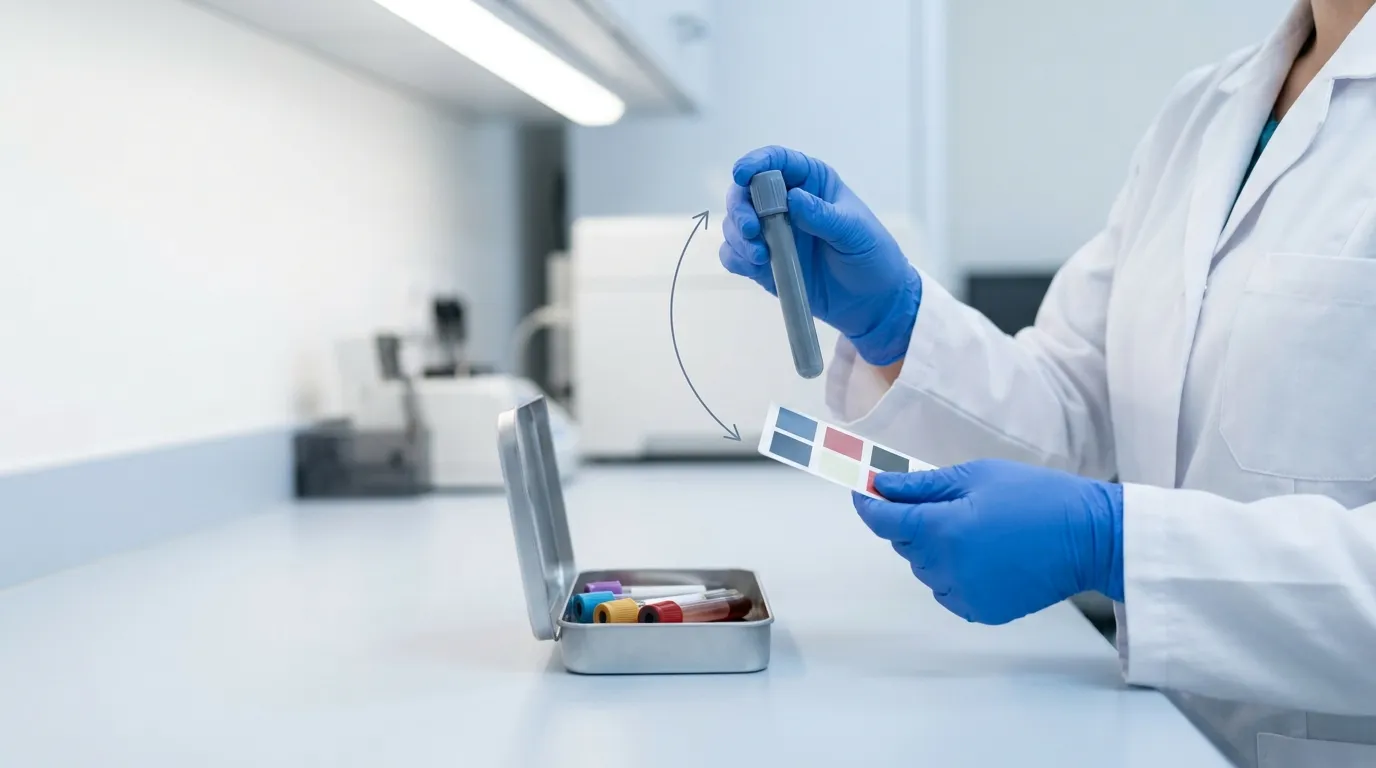
Although exact processes vary by manufacturer, custom cap color production generally follows a predictable sequence.
- Specification and color selection. The buyer chooses a color from the manufacturer's existing cap palette or supplies a reference sample, such as a plastic chip, printed color, or Pantone-style code.
- Color matching. The manufacturer produces prototype caps and compares them against the reference. Color matching can require several iterations because plastic formulations and molding conditions affect the final appearance.
- Sample approval. The buyer receives physical samples to verify color, cap fit, and legibility of any molded text or label. This step is essential because a color that looks correct on a screen can look different on a molded cap.
- Production. Once the sample is approved, the manufacturer produces the caps and assembles them onto the specified vacuum blood collection tubes. Production controls should confirm that the cap still forms a proper seal with the tube rim.
- Quality control and documentation. The finished tubes are checked for cap color consistency, correct additive pairing, label accuracy, and any performance criteria defined by the applicable standard. Buyers should be able to request batch documentation that traces each cap color to the correct additive tube.
The cap material matters during this process. Rubber and plastic stoppers accept dyes differently, and some surface finishes are more resistant to handling and storage than others. For that reason, manufacturers may limit custom colors to specific cap materials or offer a narrower range for certain tube designs.
Standards, Regulations, and Custom Colors — What You Need to Know
A custom cap color does not automatically make a tube noncompliant, but it brings the finished tube into a regulatory and standards context that buyers should understand.
Product standards for single-use blood collection containers, such as ISO 6710, address the design, materials, and performance of the tube system. These standards do not prescribe a single mandatory cap color for every market. In addition, CLSI has published widely used recommendations on the order of draw and on validation of blood collection tubes. The CLSI order-of-draw resource explains the rationale behind collection sequence, while the GP34 document covers validation and verification of tubes for venous and capillary blood specimen collection.
A key point for anyone considering custom colors comes from the Association for Laboratory Medicine (LabMed UK), which has observed that color coding for blood collection tube closures is not internationally standardized. Their recommendation is that tube closures also carry text markings so users do not rely on color alone. In practice, this means a custom color can be perfectly appropriate as long as the tube is clearly labeled with the additive name or a code that staff understand.
For regulated markets, the relevant CE, FDA, or other regional requirement applies to the finished tube as a medical device or IVD collection product. The need is to confirm that the fully assembled custom-color tube meets the same requirement as the standard version. The cap color itself is usually not the deciding factor for regulatory status; the tube's design, labeling, and intended use are what establish the status.
If you are sourcing custom cap color blood collection tubes, ask the manufacturer for the documentation that applies to the finished product, and confirm exactly which regulatory or QMS certificates apply to which product lines.
Managing Risk with Non-Standard Cap Colors
Choosing a non-standard cap color introduces risks that the standard palette does not. These risks are manageable when you plan for them.
- Label text is more important than ever. If a custom color replaces a conventional color, the tube label must clearly identify the additive and the intended department or test. A staff member who sees an unfamiliar cap should be able to verify the tube contents without guessing.
- Training must cover the full color map. New staff orientation and periodic refreshers should show both the standard colors and any custom colors used by your institution.
- Color vision deficiency affects a meaningful share of the workforce. Approximately one in twelve men have some form of color vision deficiency. Relying on cap color alone can create avoidable errors, so pair color with printed text, barcodes, or other non-color identifiers.
- Regional conventions are not identical. A color that means one additive in one country can mean something different in another. If your staff are used to more than one convention, or if your tubes are distributed internationally, document the meaning clearly.
- Traceability should be verified. A custom cap color should not weaken the link between the cap, the additive, and the batch record. Ask how the manufacturer tracks color-to-additive pairing during production.
A phased rollout can reduce risk. Instead of introducing custom colors across every tube type at once, pilot the new caps in one department or for one set of tests, collect feedback, and refine labeling or training before expanding.
Choosing a Supplier for Custom Cap Color Blood Collection Tubes

Buying custom cap color tubes is not like choosing a standard catalog item. The supplier must be able to demonstrate that it can manage color matching, documentation, and product quality together. Use the following questions when comparing manufacturers.
- What custom cap colors can you produce, and do you match against a customer-supplied reference or a defined color system?
- What is the minimum order quantity for a custom cap color, and how does lead time compare with standard production?
- Can you provide physical samples before production approval?
- Does the cap color process alter the cap material, seal integrity, or additive performance?
- What documentation accompanies each lot? Request a clear explanation of certificates, quality tests, and any applicable standards.
- Which of your company quality certificates apply, and which product-level approvals, registrations, or conformity markings apply to the finished tube?
- Can you provide references from other labs, distributors, or healthcare institutions that have ordered custom cap colors?
The broader process of assessing a tube manufacturer's reliability is covered in our guide on how to evaluate blood collection system supplier quality. It walks through the documentation, factory audit, and quality-system questions that procurement teams should use.
For Trustlab specifically, the company lists cap color as a customization option in its OEM medical consumables guide, but the details of palette, MOQ, and lead time are not published there. To move forward, ask Trustlab's sales team which custom cap colors are available, request samples, and confirm the documentation that would accompany your lot. That direct inquiry is the only way to verify current capabilities for your specific tube type and volume.
Custom cap color blood collection tubes offer a practical way to strengthen test identification in settings where the standard color palette is not enough. Treated as a deliberate procurement decision rather than a cosmetic change, custom colors deliver the clarity institutions need—when paired with clear labels, solid training, and a supplier that can prove its quality and documentation.